Japanese
English
- 有料閲覧
PPV購入案内
1,320円 (1,200円+税10%) こちらは、1393ページから1401ページの文献です。購入には医書.jp本会員登録が必要です。
会員登録完了後に改めて上記「購入サイトへ」を選択してください。
または「購入サイトへ」選択後に「購入ログイン」、「新規会員登録」の順に進んでください。
会員登録について詳しくはをご確認ください。
- Abstract 文献概要
- 1ページ目 Look Inside
- 参考文献 Reference
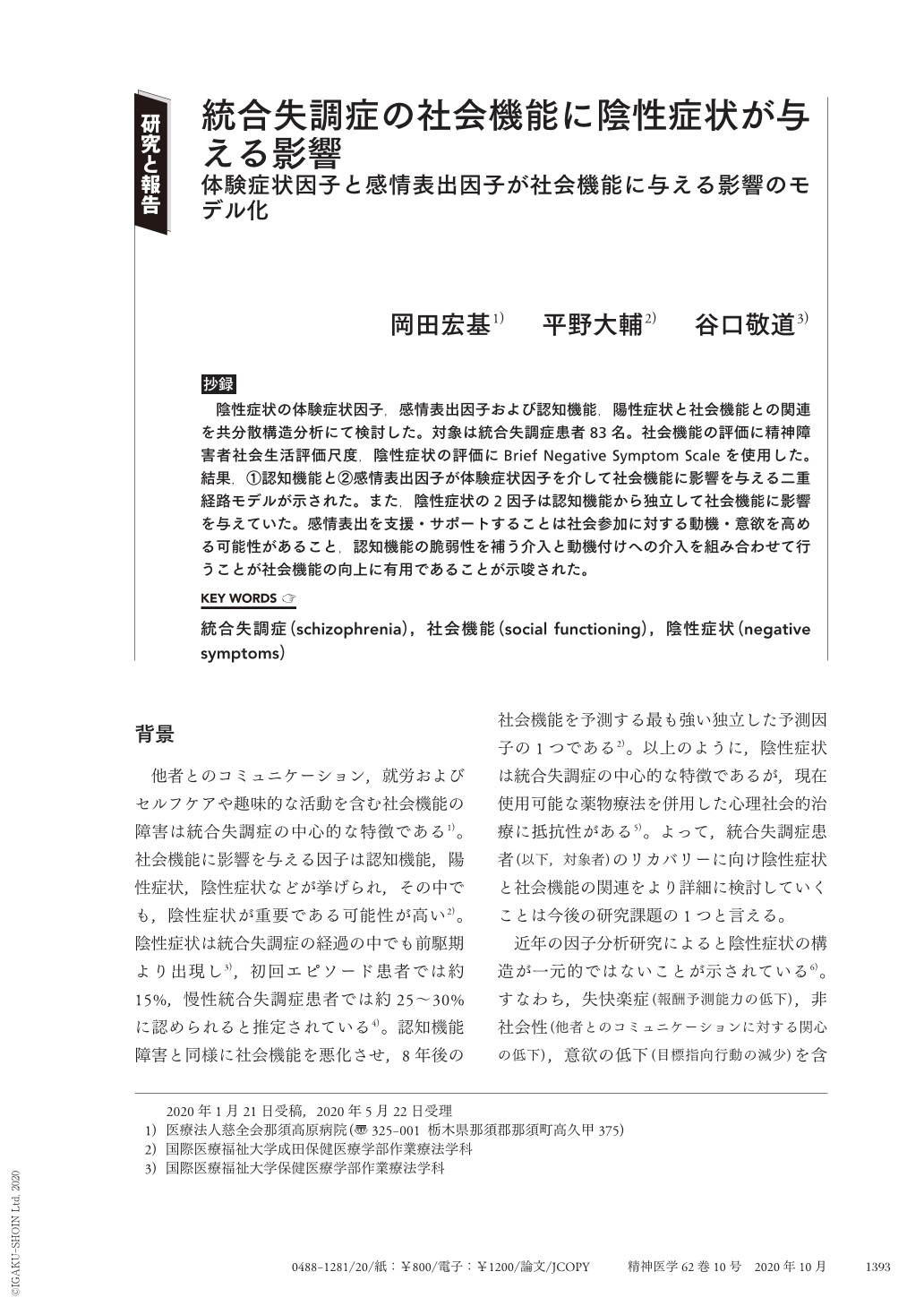
抄録 陰性症状の体験症状因子,感情表出因子および認知機能,陽性症状と社会機能との関連を共分散構造分析にて検討した。対象は統合失調症患者83名。社会機能の評価に精神障害者社会生活評価尺度,陰性症状の評価にBrief Negative Symptom Scaleを使用した。結果,①認知機能と②感情表出因子が体験症状因子を介して社会機能に影響を与える二重経路モデルが示された。また,陰性症状の2因子は認知機能から独立して社会機能に影響を与えていた。感情表出を支援・サポートすることは社会参加に対する動機・意欲を高める可能性があること,認知機能の脆弱性を補う介入と動機付けへの介入を組み合わせて行うことが社会機能の向上に有用であることが示唆された。
The purpose of this study was to evaluate the association between cognitive functioning, positive symptoms, and social functioning by covariance structure analysis after considering negative symptoms separately from experiential and expressive factors. The total sample included 83 patients with schizophrenia. The Social Functioning Scale was used to evaluate social functioning and the Brief Negative Symptom Scale to evaluate negative symptoms. Results suggest that cognitive functioning and experiential and expressive factors show a dual pathway model that affects social functioning. Indeed, the path from expressive to experiential factors affects social functioning independently from cognitive functioning. Thus, supporting emotional expression may increase social motivation. Besides, results suggest that social functioning may be improved by separately performing interventions to compensate for vulnerabilities in cognitive functions and to improve motivation.
Copyright © 2020, Igaku-Shoin Ltd. All rights reserved.