Japanese
English
- 有料閲覧
PPV購入案内
1,320円 (1,200円+税10%) こちらは、411ページから416ページの文献です。購入には医書.jp本会員登録が必要です。
会員登録完了後に改めて上記「購入サイトへ」を選択してください。
または「購入サイトへ」選択後に「購入ログイン」、「新規会員登録」の順に進んでください。
会員登録について詳しくはをご確認ください。
- Abstract 文献概要
- 1ページ目 Look Inside
静脈還流は主に末梢静脈圧と中心静脈圧の差により惹起されるものであるが,心機能,呼吸,腹圧,筋肉運動,姿勢,静脈弁なども重要な因子として知られている。中心静脈圧が上昇すると下肢の浮腫や肝腫大などが起こる。また深部静脈やリンパ管の閉塞によっても下肢の浮腫が発生するが,これらの原因を鑑別するためには大腿静脈の血流速度変化を観察することが有意義なことに気づき,臨床的に検討した結果,若干の新知見が得られたので報告する。
Femoral vein flow velocity in normal subjects and patients with leg edema was measured with a doppler ultrasound flow detector in order to evaluate the efficacy of its clinical use. Venous occlusionplethysmography was also used in order to evaluate venous function of the leg.
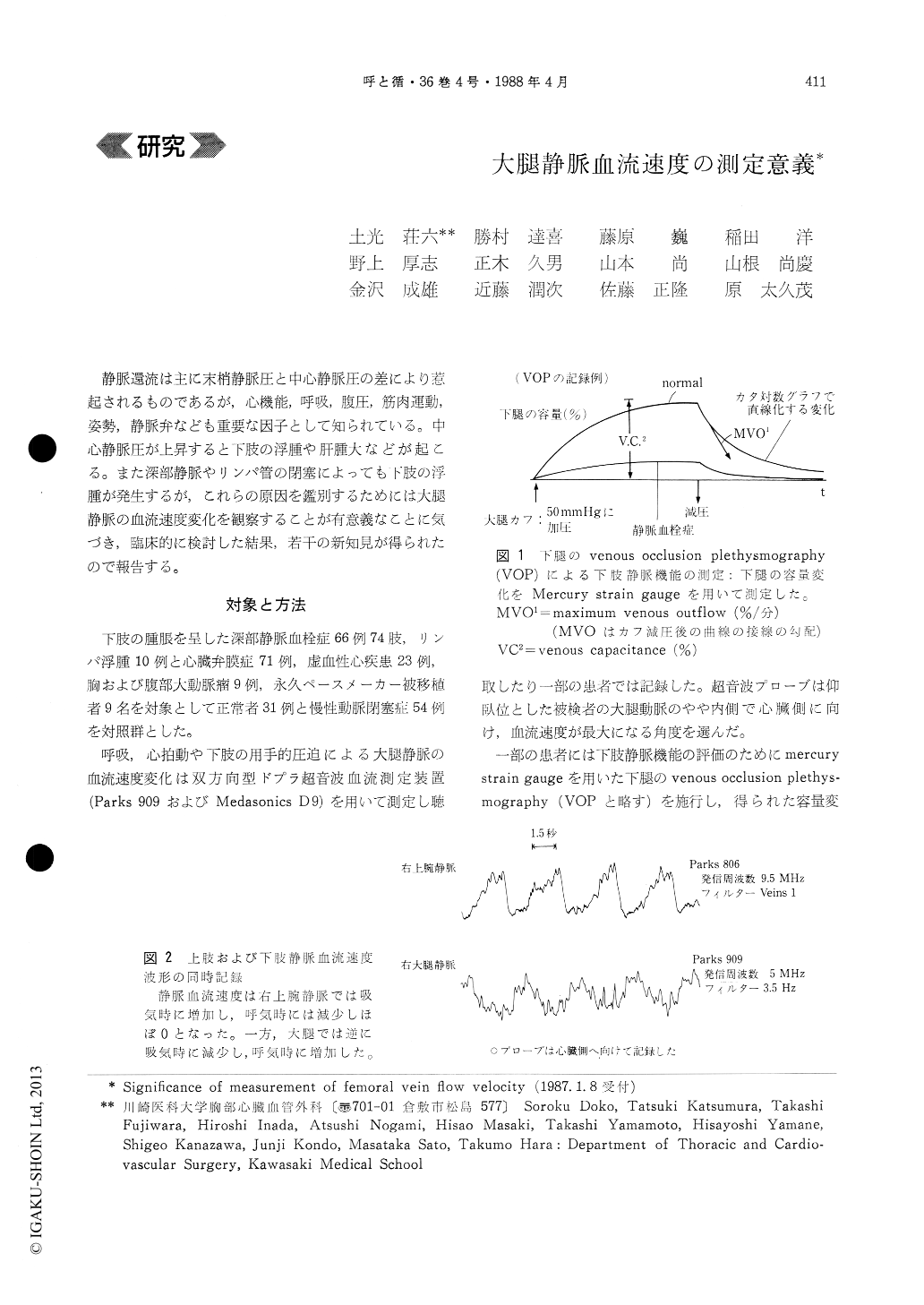
In normal subjects, the femoral vein flow velocity increased during the expiratory period of respiration, while, brachial vein flow velocity increased during the inspiratory period.
In patients with acute iliac vein thrombosis, femoral vein flow velocity did not increase during the expira-tory period. On the other hand, in patients with acute deep vein thrombosis distal to the femoral vein, it increased during the same peroid, but did not signi-ficantly increase with calf or thigh compression.
The venous function of the leg in patients with deep vein thrombosis was worst, and that in patients with lymphedema was worse than that in patients with mild congestive heart failure.
In some patients with an increase in femoral flow velocity during expiration, it was suddenly stopped by a soft hand compression on the lower abdomen. In those cases, rich colateral veins from tributaries of the greater saphenous vein were usually observed by contrast phlebography, the venous function of the leg was usually better than the acute deep vein thro-mbosis and the period from the onset of their symp-toms was usually longer than a few years.
In patients with cardiovascular diseases following surgical procedures, central venous pressure (CVP) and the femoral vein flow velocity were simultaneous-ly measured. In patients with pulsatile femoral vien flow velocity (n=48), CVP was consistently higher than 8 cm of water. In patients without it, on the other hand, CVP was constantly less than 4 cm of water (n=11). So, the means and standard deviations of the former group (12.5=3.5 cm of water) were significantly greater than those of the latter group (4.1±1.6 cm of water), (p<0.001).
Statistical analysis was retrospectively performed whether or not digitalis or diuretics were given to the patients with suspected congestive heart disease (n=116). Application of chi-square analysis indicated that these drugs had been given to the patients with pulsatile femoral vein flow velocity (p<0. 001).
So, it was concluded that the pulsatility of the fe-moral vein could be one of the variables in deciding whether these drugs should be given or not to patients with suspected congestive heart disease.
Copyright © 1988, Igaku-Shoin Ltd. All rights reserved.