Japanese
English
- 有料閲覧
PPV購入案内
1,320円 (1,200円+税10%) こちらは、1317ページから1323ページの文献です。購入には医書.jp本会員登録が必要です。
会員登録完了後に改めて上記「購入サイトへ」を選択してください。
または「購入サイトへ」選択後に「購入ログイン」、「新規会員登録」の順に進んでください。
会員登録について詳しくはをご確認ください。
- Abstract 文献概要
- 1ページ目 Look Inside
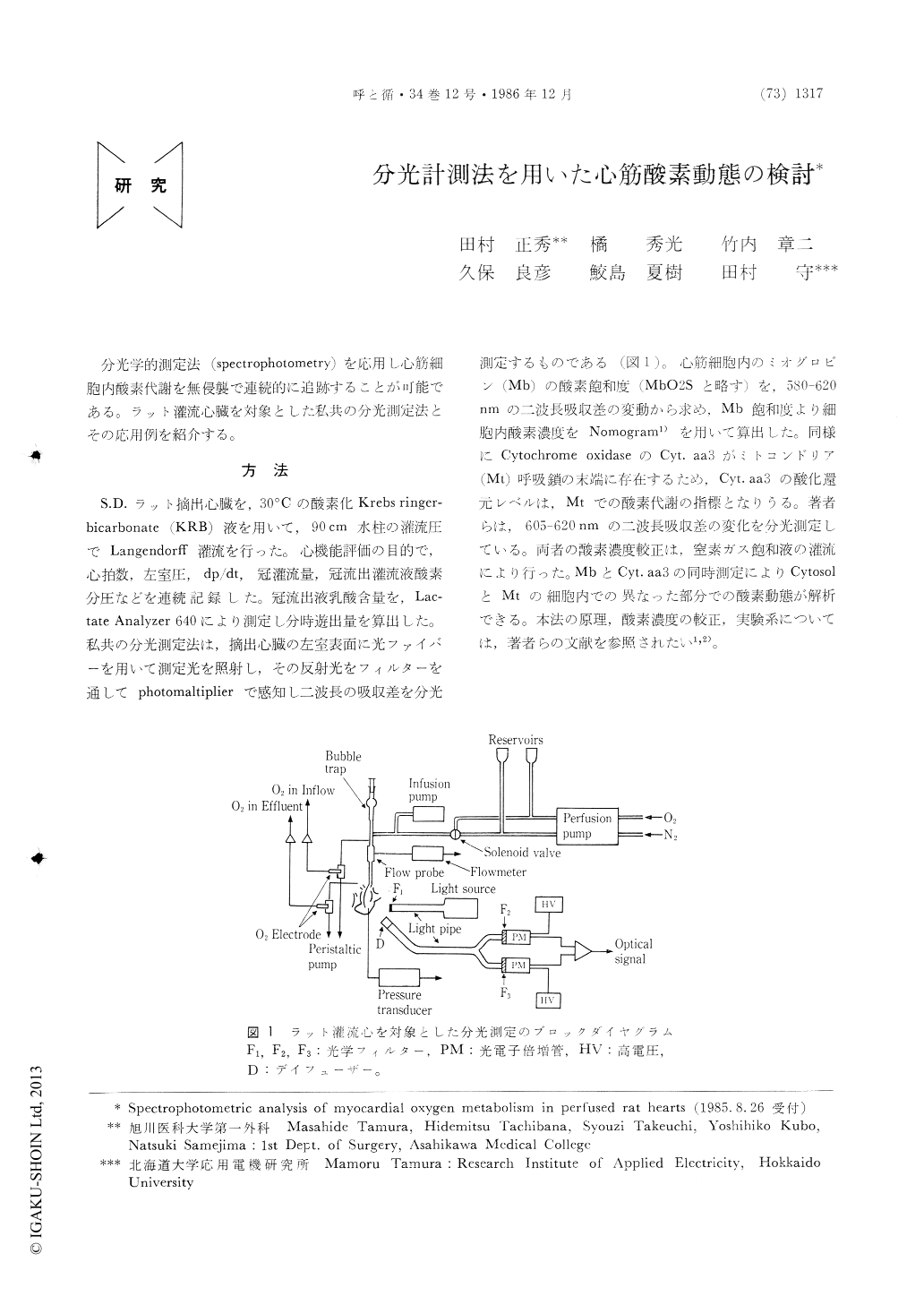
分光学的測定法(spectrophotometry)を応用し心筋細胞内酸素代謝を無侵襲で連続的に追跡することが可能である。ラット灌流心臓を対象とした私共の分光測定法とその応用例を紹介する。
Cardiac muscle contains myoglobin in cytosol and cytochromes in mitochondria, both of which participate in oxygen metabolism of the heart.
The change of myoglobin oxygenation and of the oxidation-reduction state of cytochrome aa3 can be measured by spectrophotometric technique and used as optical indicators of both tissue oxygen concentration and energy state.
We evaluated effects of 1) perfusion pressure, 2)catecholamines, 3) coronary vasodilators such as Ca-antagonist, prostaglandin (PGI2) on intracellular oxy-genation and energy metabolism in perfused rat hearts. Results: 1) With Langendorff perfusion, the cardiac tissue became hypoxic (more than 50% of myoglobin was in deoxygenated state) at perfusion pressure below 30cmH20. This result may indicate the functional obstruc-tion in capillary microcirculation at low perfusion pressure.
2) Infusion of epinephrine (5μg/30 sec.) under normoxic perfusion conditions, increased cardiac work and lactate release. More than 50% of myoglobin was then deoxygenated and cardiac tissue was severely hypoxic. The increase in lactate release was explained by the enhancement of glycolytic flux in tissue hypoxia.
On the other hand, dopamine infusion (50μg/30 sec.) also increased cardiac work at the same degree, but did not alter lactate release. Myoglobin oxygen saturation (MbO 2 S) was kept at normoxic level (MbO2S>80%) and no tissue hypoxia was observed. 3) During mild hypoxic perfusion conditions (MbO-2S≒65%), diltiazem (Ca-antagonist) infusion caused dose-dependent increases in coronary flow and intra-cellular oxygen concentration suggesting that diltiazem improved myocardial hypoxia.
4) Under hypoxic perfusion (MbO2S≒70%), infu-sion of prostaglandin I2 increased coronary flow and oxygen concentration at the coronary sinus. The myoglobin oxygen level shifted to more oxygenated state (normoxic condition). Thus, PGI2 was concluded to act effectively in delivering oxygen into the cardiac tissue and to improve myocardial oxygen metabolism.
Conclusion: Our spectrophotometric technique is quite useful to permit continuous monitoring of oxygen metabolism and biochemical reactions taking place in cytosol and mitochondria.
Copyright © 1986, Igaku-Shoin Ltd. All rights reserved.