Japanese
English
- 有料閲覧
PPV購入案内
1,320円 (1,200円+税10%) こちらは、649ページから652ページの文献です。購入には医書.jp本会員登録が必要です。
会員登録完了後に改めて上記「購入サイトへ」を選択してください。
または「購入サイトへ」選択後に「購入ログイン」、「新規会員登録」の順に進んでください。
会員登録について詳しくはをご確認ください。
- Abstract 文献概要
- 1ページ目 Look Inside
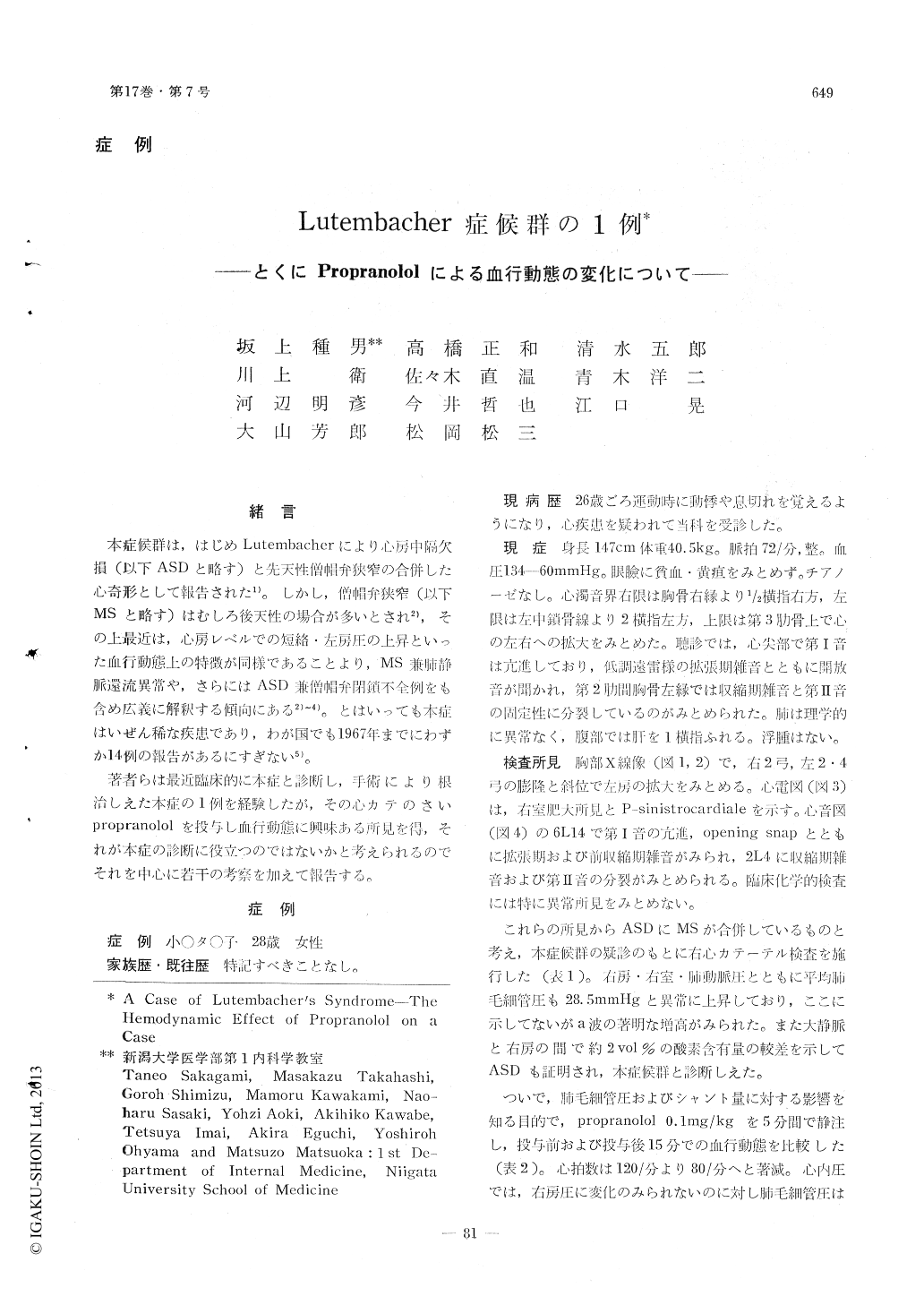
緒言
本症候群は,はじめLutembacherにより心房中隔欠損(以下ASDと略す)と先天性僧帽弁狭窄の合併した心奇形として報告された1)。しかし,僧帽弁狭窄(以下MSと略す)はむしろ後天性の場合が多いとされ2)、その上最近は,心房レベルでの短絡・左房圧の上昇といった血行動態上の特徴が同様であることより,MS兼肺静脈還流異常や,さらにはASD兼僧帽弁閉鎖不全例をも含め広義に解釈する傾向にある2)〜4)。とはいっても本症はいぜん稀な疾患であり,わが国でも1967年までにわずか14例の報告があるにすぎない5)。
著者らは最近臨床的に本症と診断し,手術により根治しえた本症の1例を経験したが,その心カテのさいpropranololを投与し血行動態に興味ある所見な得,それが本症の診断に役立つのではないかと考えられるのでそれを中心に若干の考察を加えて報告する。
A 28-year-old woman was admitted because of exertional dyspnea and palpitation lasting for two years. On examinations, there were clinical findings suggestive of coexistence of mitral stenosis and atrial septal defect. These included an apical rumbling diastolic murmur, an opening snap, an accentuated first heart sound and left atrial enlargement revealed on an electrocardiogram and chest X-ray films, which are characteristic of mitral stenosis, and at the same time, a systolic murmur with the fixed splitting of the second heart sound in the second left interspace, which are characteristic of a left-to-right shunt at the atrial level and a high pulmonary wedge pressure of 28.5 mm Hg, so the dia-gnosis was confirmed. Then with the catheter-tip in the pulmonary artery, 0.1mg/ kg. of propranolol was administered intra-venously over five minutes. Fifteen minutes after the injection, the wedge pressure dec-lined to 18 mm Hg and the magnitude of the shunt was decreased from 56.1 % to 26.6 %.
Classical findings of mitral stenosis observed above have been reported less common in this syndrome, since an elevation of the left atrial pressure is prevented by the existence of the atrial septal defect. But in our case, it was revealed that the defect was too small (0.5 cm. in diameter) to act as above. It is inte-resting that the wedge pressure declined following the administration of propranolol, for this beta-adrenergic blocking agent has been told as acting in a reversed fashion on usual cases. Mitral stenosis has been said to be an exception as to the manner of reaction to this drug, and the prolongation of the diastolic phase was regarded as the essential cause of diminishing the wedge pressure. A same mechanism seems to exist in the present case which has mitral stenosis. This hemo-dynamic change seems to be important not only to diagnose the disease, but also to diminish, though not long enough, a possible danger of pulmonary congestion.
Copyright © 1969, Igaku-Shoin Ltd. All rights reserved.