Japanese
English
- 有料閲覧
PPV購入案内
1,320円 (1,200円+税10%) こちらは、323ページから329ページの文献です。購入には医書.jp本会員登録が必要です。
会員登録完了後に改めて上記「購入サイトへ」を選択してください。
または「購入サイトへ」選択後に「購入ログイン」、「新規会員登録」の順に進んでください。
会員登録について詳しくはをご確認ください。
- Abstract 文献概要
- 1ページ目 Look Inside
- 参考文献 Reference
- サイト内被引用 Cited by
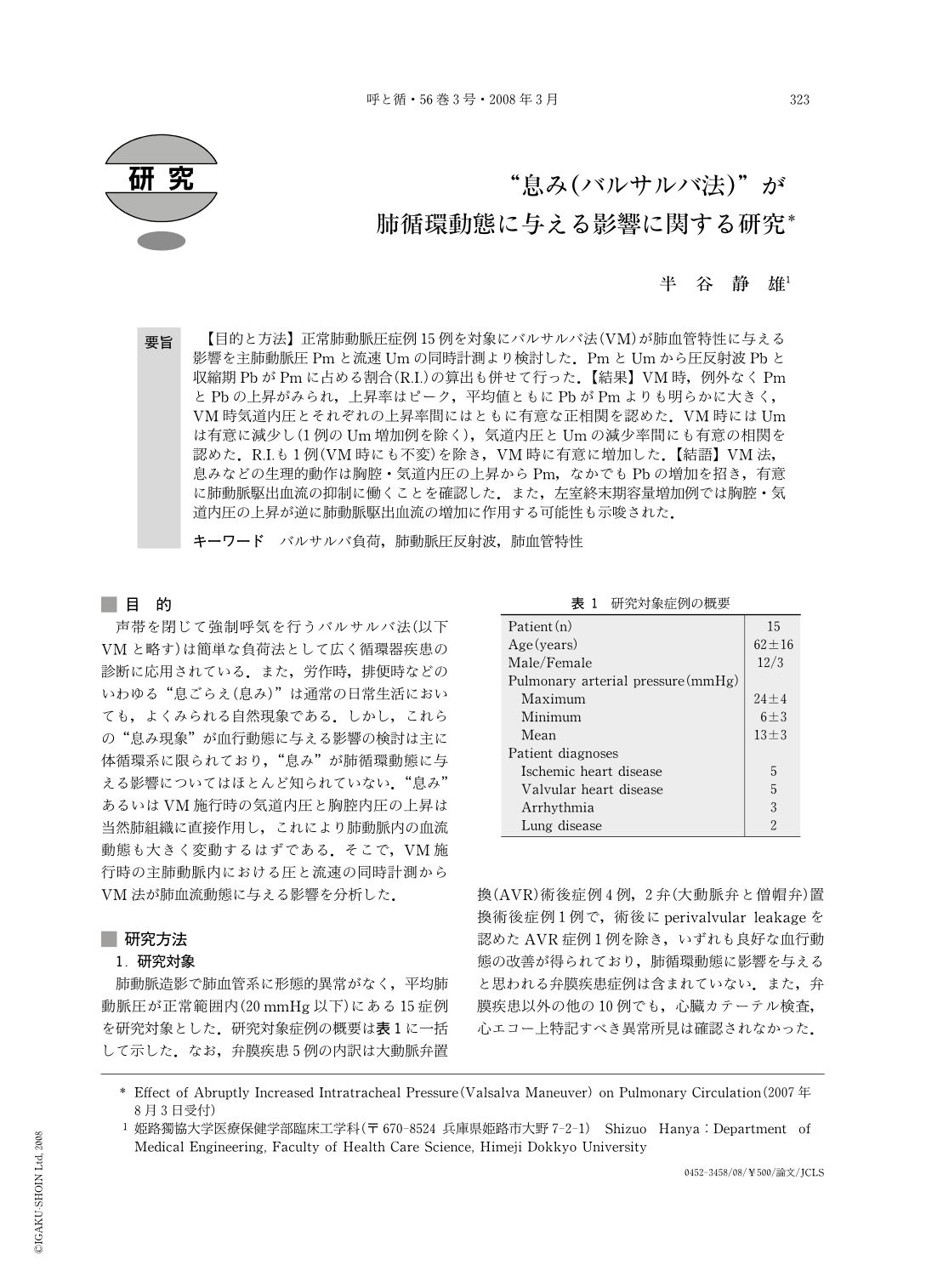
要旨 【目的と方法】正常肺動脈圧症例15例を対象にバルサルバ法(VM)が肺血管特性に与える影響を主肺動脈圧Pmと流速Umの同時計測より検討した.PmとUmから圧反射波Pbと収縮期PbがPmに占める割合(R.I.)の算出も併せて行った.【結果】VM時,例外なくPmとPbの上昇がみられ,上昇率はピーク,平均値ともにPbがPmよりも明らかに大きく,VM時気道内圧とそれぞれの上昇率間にはともに有意な正相関を認めた.VM時にはUmは有意に減少し(1例のUm増加例を除く),気道内圧とUmの減少率間にも有意の相関を認めた.R.I.も1例(VM時にも不変)を除き,VM時に有意に増加した.【結語】VM法,息みなどの生理的動作は胸腔・気道内圧の上昇からPm,なかでもPbの増加を招き,有意に肺動脈駆出血流の抑制に働くことを確認した.また,左室終末期容量増加例では胸腔・気道内圧の上昇が逆に肺動脈駆出血流の増加に作用する可能性も示唆された.
To assess the effects of straining against a closed glottis(Valsalva maneuver) on pulmonary circulation, pulmonary arterial pressure 〔Pm(t)〕 and pulmonary flow velocity 〔Umt)〕 were measured simultaneously using a multisensor catheter during the Valsalva maneuver in 15 patients with normal pulmonary arterial pressure. Instantaneous pulse wave reflection 〔Pb(t)〕 was calculated from Westerhof's equation. Pb(t)=1/2〔Pm(t)-ρ・C・U(t)〕, ρ:blood density, C:pulmonary arterial pulse wave velocity. To estimate the amount of reflection in systole, reflection index(R.I.) defined as the area ratio of backward and forward wave in systolic pressure waveform was also calculated.
Valsalva maneuver(VM) over a 15-s straining period significantly increased the mean Pm(t)(13.3±3 to 46±13mmHg, p<0.001), mean Pb(t)(5±2 to 22±7mmHg, p<0.001) without exception, and R.I.(.31±0.09 to 0.46±0.03, p<0.01), whereas VM induced a significant decline of mean Um(t) from 41±15 to 20±20cm/s.(p<0.001) with the exception of one patient with mild aortic regurgitation in whom mean Um(t) increased from 55 to 86cm/s. with no change of R.I. Peak intratracheal pressure during VM was closely correlated with the % increase of mean Pm(t), the % increase of mean Pb(t) and the % decrease of mean Um(t) of its baseline(r=0.777, r=0.715, r=0.728, respectively). Among measured parameters, only the % increase of Pb was significantly correlated(p<0.05) with the % decrease of Um.
These data demonstrate that the Valsalva maneuver reduces significantly pulmonary blood flow velocity because of the development of strong reflection returning to the main pulmonary artery due to mechanical compression of the pulmonary vascular beds in association with the increase of pulmonary arterial pressure during the Valsalva strain phase. On the contrary, in patients with elevated left ventricular filling pressure, increased intrathoracic pressure during the strain seems to increase the pulmonary flow velocity by means of the enhancement of right ventricular function which could act to maintain left ventricular volume resulting in a characteristic "square wave" appearance of the blood pressure tracing through ventricular interdependence.
Copyright © 2008, Igaku-Shoin Ltd. All rights reserved.