Japanese
English
- 有料閲覧
PPV購入案内
1,320円 (1,200円+税10%) こちらは、1215ページから1221ページの文献です。購入には医書.jp本会員登録が必要です。
会員登録完了後に改めて上記「購入サイトへ」を選択してください。
または「購入サイトへ」選択後に「購入ログイン」、「新規会員登録」の順に進んでください。
会員登録について詳しくはをご確認ください。
- Abstract 文献概要
- 1ページ目 Look Inside
- 参考文献 Reference
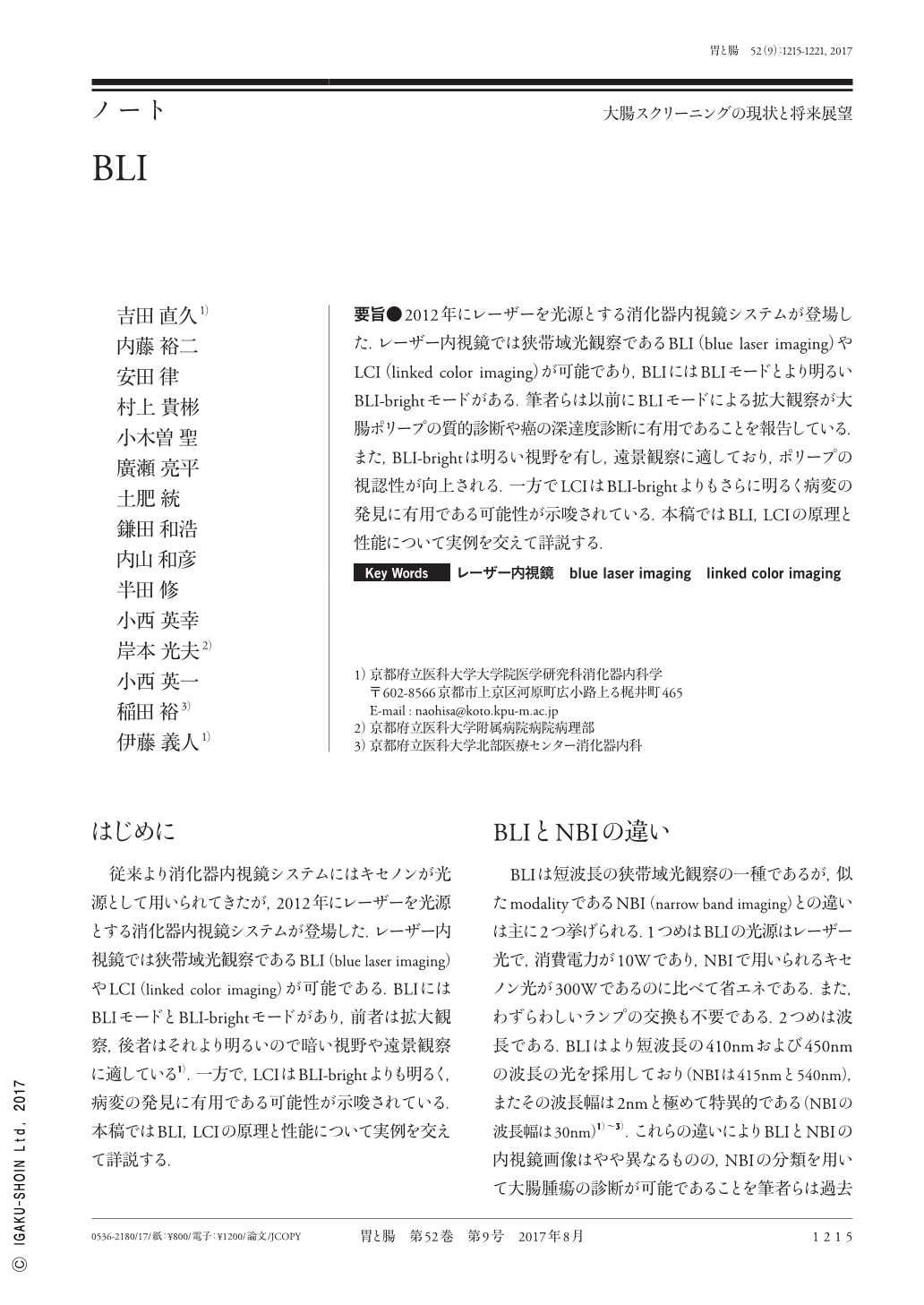
要旨●2012年にレーザーを光源とする消化器内視鏡システムが登場した.レーザー内視鏡では狭帯域光観察であるBLI(blue laser imaging)やLCI(linked color imaging)が可能であり,BLIにはBLIモードとより明るいBLI-brightモードがある.筆者らは以前にBLIモードによる拡大観察が大腸ポリープの質的診断や癌の深達度診断に有用であることを報告している.また,BLI-brightは明るい視野を有し,遠景観察に適しており,ポリープの視認性が向上される.一方でLCIはBLI-brightよりもさらに明るく病変の発見に有用である可能性が示唆されている.本稿ではBLI,LCIの原理と性能について実例を交えて詳説する.
A laser endoscopic system(LASEREO:Fujifilm Co., Tokyo, Japan), which was developed in 2012, can improve polyp detection. There are three modes of narrow-band imaging in the laser endoscopic system:BLI(blue laser imaging), BLI-bright, and LCI(linked color imaging). We have reported that BLI magnification predicts cancer depth and that BLI-bright improved polyp visibility more than WL(white light). With respect to LCI, it is brighter than BLI-bright. For colorectal neoplastic lesions, LCI makes lesions reddish and the surrounding mucosa whitish and enables polyps to be more easily visualized. In this chapter, we explain the efficacies of BLI, BLI-bright and LCI in colonoscopy.
Copyright © 2017, Igaku-Shoin Ltd. All rights reserved.