Japanese
English
- 有料閲覧
PPV購入案内
1,320円 (1,200円+税10%) こちらは、1009ページから1023ページの文献です。購入には医書.jp本会員登録が必要です。
会員登録完了後に改めて上記「購入サイトへ」を選択してください。
または「購入サイトへ」選択後に「購入ログイン」、「新規会員登録」の順に進んでください。
会員登録について詳しくはをご確認ください。
- Abstract 文献概要
- 1ページ目 Look Inside
- サイト内被引用 Cited by
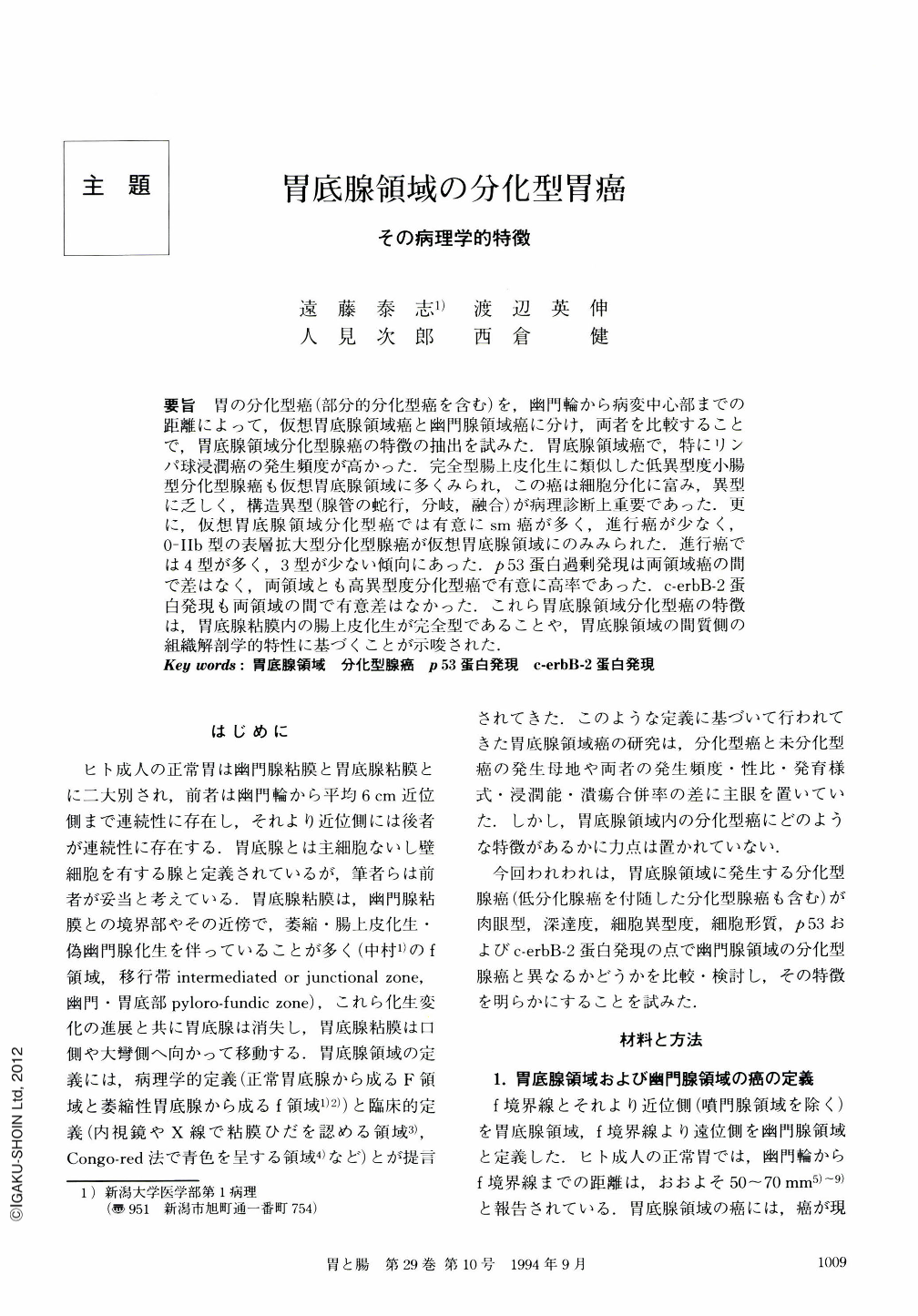
要旨 胃の分化型癌(部分的分化型癌を含む)を,幽門輪から病変中心部までの距離によって,仮想胃底腺領域癌と幽門腺領域癌に分け,両者を比較することで,胃底腺領域分化型腺癌の特徴の抽出を試みた.胃底腺領域癌で,特にリンパ球浸潤癌の発生頻度が高かった.完全型腸上皮化生に類似した低異型度小腸型分化型腺癌も仮想胃底腺領域に多くみられ,この癌は細胞分化に富み,異型に乏しく,構造異型(腺管の蛇行,分岐,融合)が病理診断上重要であった.更に,仮想胃底腺領域分化型癌では有意にsm癌が多く,進行癌が少なく,0-Ⅱb型の表層拡大型分化型腺癌が仮想胃底腺領域にのみみられた.進行癌では4型が多く,3型が少ない傾向にあった.p53蛋白過剰発現は両領域癌の間で差はなく,両領域とも高異型度分化型癌で有意に高率であった.c-erbB-2蛋白発現も両領域の間で有意差はなかった.これら胃底腺領域分化型癌の特徴は,胃底腺粘膜内の腸上皮化生が完全型であることや,胃底腺領域の間質側の組織解剖学的特性に基づくことが示唆された.
We elucidated the pathological features of intestinaltype (differentiated-type) adenocarcinoma, which was located wholly or partly, in the fundic gland area (FGA) of the stomach by comparing them with those in the antral gland area (AGA). Carcinomas with lymphoid stroma which contain parts of differentiated-type carcinoma were prevalent in FGA (9.5% in FGA, 2.0% in AGA), and many of them included a gastric phenotype in differentiated-type adenocarcinoma-parts (4/6 in FGA). Differentiated-type adenocarcinomas with low-grade atypia which were mimicking complete-type intestinal metaplasia were found in FGA alone (4.8%, 3/63), and this evidence arises us a great interest about the relationship between cancers of this type and complete-type intestinal metaplasia which is a predominant form of intestinal metaplasia in FGA.
The frequency of cancers invading the submucosa was higher in FGA (FGA: 36.5%, AGA: 2.2%)(p<0.01), even in carcinomas with low-grade atypia.
Macroscopically, early cancers of 0-Ⅱb type occurred frequently in FGA, and they tended to spread widely on the lesser curvature of the stomach. In advanced cancers, 4-type was prominent and 3-type was infrequent in FGA. As to p 53 and c-erbB-2 protein immunoreactivity, there were no differences in distribution pattern and grading of positive cells between FGA-and AGA-carcinomas.
The above features of differentiated-type cancers in FGA are considered to derive from its histo-anatomical environment, such as thinness of the muscularis mucosa, richness in capillaries and lymphatic vessels, as well as its mucosal environment.
Copyright © 1994, Igaku-Shoin Ltd. All rights reserved.