Japanese
English
- 有料閲覧
PPV購入案内
1,320円 (1,200円+税10%) こちらは、705ページから710ページの文献です。購入には医書.jp本会員登録が必要です。
会員登録完了後に改めて上記「購入サイトへ」を選択してください。
または「購入サイトへ」選択後に「購入ログイン」、「新規会員登録」の順に進んでください。
会員登録について詳しくはをご確認ください。
- Abstract 文献概要
- 1ページ目 Look Inside
- 参考文献 Reference
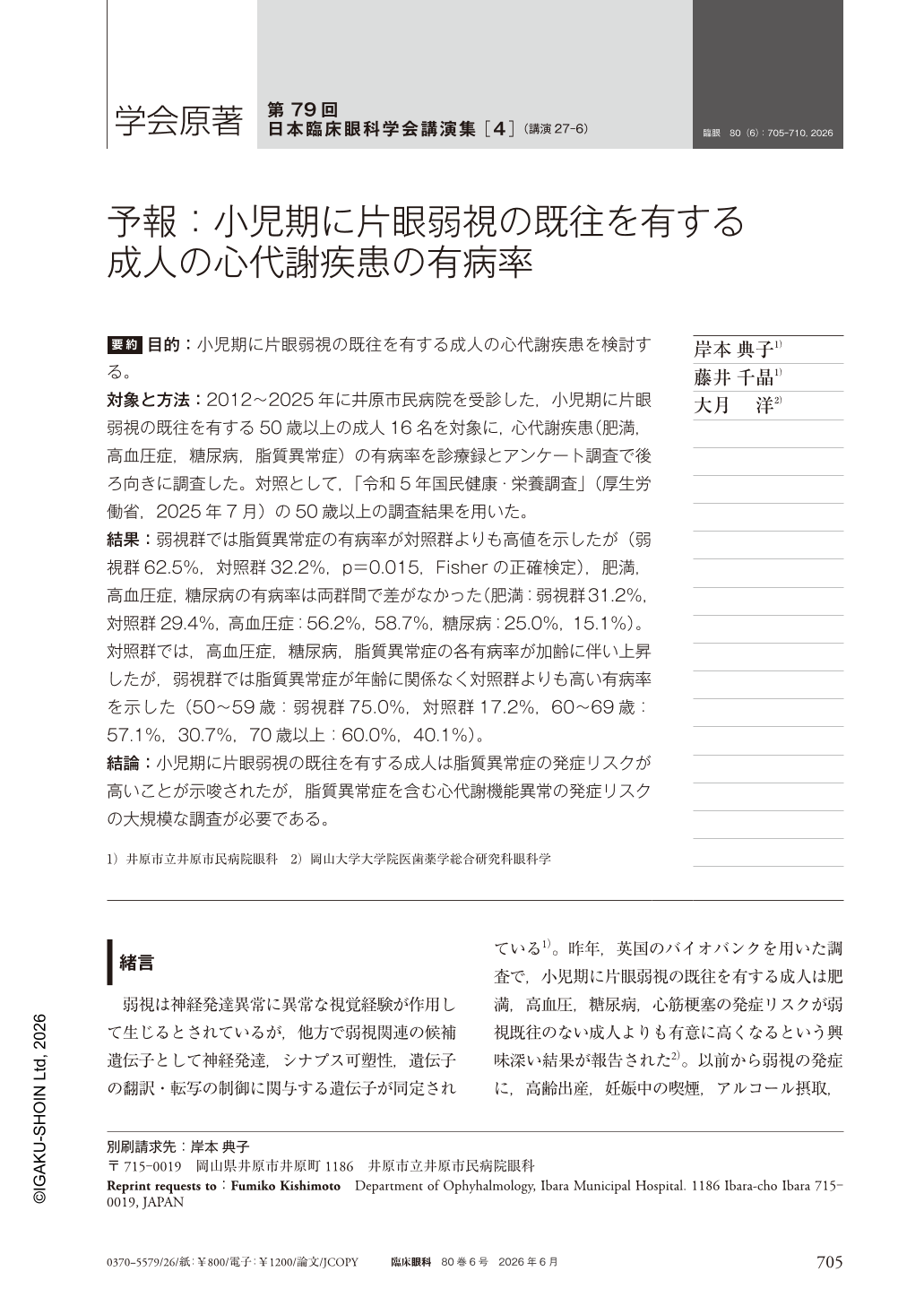
要約 目的:小児期に片眼弱視の既往を有する成人の心代謝疾患を検討する。
対象と方法:2012〜2025年に井原市民病院を受診した,小児期に片眼弱視の既往を有する50歳以上の成人16名を対象に,心代謝疾患(肥満,高血圧症,糖尿病,脂質異常症)の有病率を診療録とアンケート調査で後ろ向きに調査した。対照として,「令和5年国民健康・栄養調査」(厚生労働省,2025年7月)の50歳以上の調査結果を用いた。
結果:弱視群では脂質異常症の有病率が対照群よりも高値を示したが(弱視群62.5%,対照群32.2%,p=0.015,Fisherの正確検定),肥満,高血圧症,糖尿病の有病率は両群間で差がなかった(肥満:弱視群31.2%,対照群29.4%,高血圧症:56.2%,58.7%,糖尿病:25.0%,15.1%)。対照群では,高血圧症,糖尿病,脂質異常症の各有病率が加齢に伴い上昇したが,弱視群では脂質異常症が年齢に関係なく対照群よりも高い有病率を示した(50〜59歳:弱視群75.0%,対照群17.2%,60〜69歳:57.1%,30.7%,70歳以上:60.0%,40.1%)。
結論:小児期に片眼弱視の既往を有する成人は脂質異常症の発症リスクが高いことが示唆されたが,脂質異常症を含む心代謝機能異常の発症リスクの大規模な調査が必要である。
Abstract Objective:To investigate the associations between childhood unilateral amblyopia and cardiometabolic disorders in adulthood.
Subjects and Methods:We analyzed the prevalence of cardiometabolic diseases(obesity, hypertension, diabetes, and dyslipidemia) in 16 patients aged ≧50 years with a history of unilateral childhood amblyopia established using medical records and questionnaire-based surveys, and who visited Ibara Municipal Hospital between 2013 and 2025. We used the 2023 National Health and Nutrition Survey in Japan(Ministry of Health, Labor, and Welfare, July 2025) aged ≧50 years served as the control group.
Results:The amblyopia group showed a higher prevalence of dyslipidemia than the control group(amblyopia group, 62.5%;control group, 32.2%;p=0.015, Fisher exact test). No significant differences were observed in the prevalences of obesity, hypertension, or diabetes between the groups(amblyopia vs. control group for obesity:31.2% vs. 29.4%;hypertension, 56.2% vs. 58.7%;diabetes, 25.0% vs. 15.1%). In the control group, hypertension, diabetes, and dyslipidemia prevalences increased with advancing age, whereas dyslipidemia was more prevalent in the amblyopia group than in the control group, irrespective of the age(50-59 years:amblyopia group 75.0% vs. control group 17.2%;60-69 years:57.1% vs. 30.7%;≧70 years:60.0% vs. 40.1%).
Conclusions:Our study suggested that adults with a history of unilateral amblyopia during childhood might have an elevated risk of developing dyslipidemia. Further research is required to understand the relationship between childhood amblyopia and cardiometabolic dysfunction including dyslipidemia, in adulthood.
Copyright © 2026, Igaku-Shoin Ltd. All rights reserved.