Japanese
English
- 有料閲覧
- Abstract 文献概要
- 1ページ目 Look Inside
- 参考文献 Reference
- サイト内被引用 Cited by
はじめに
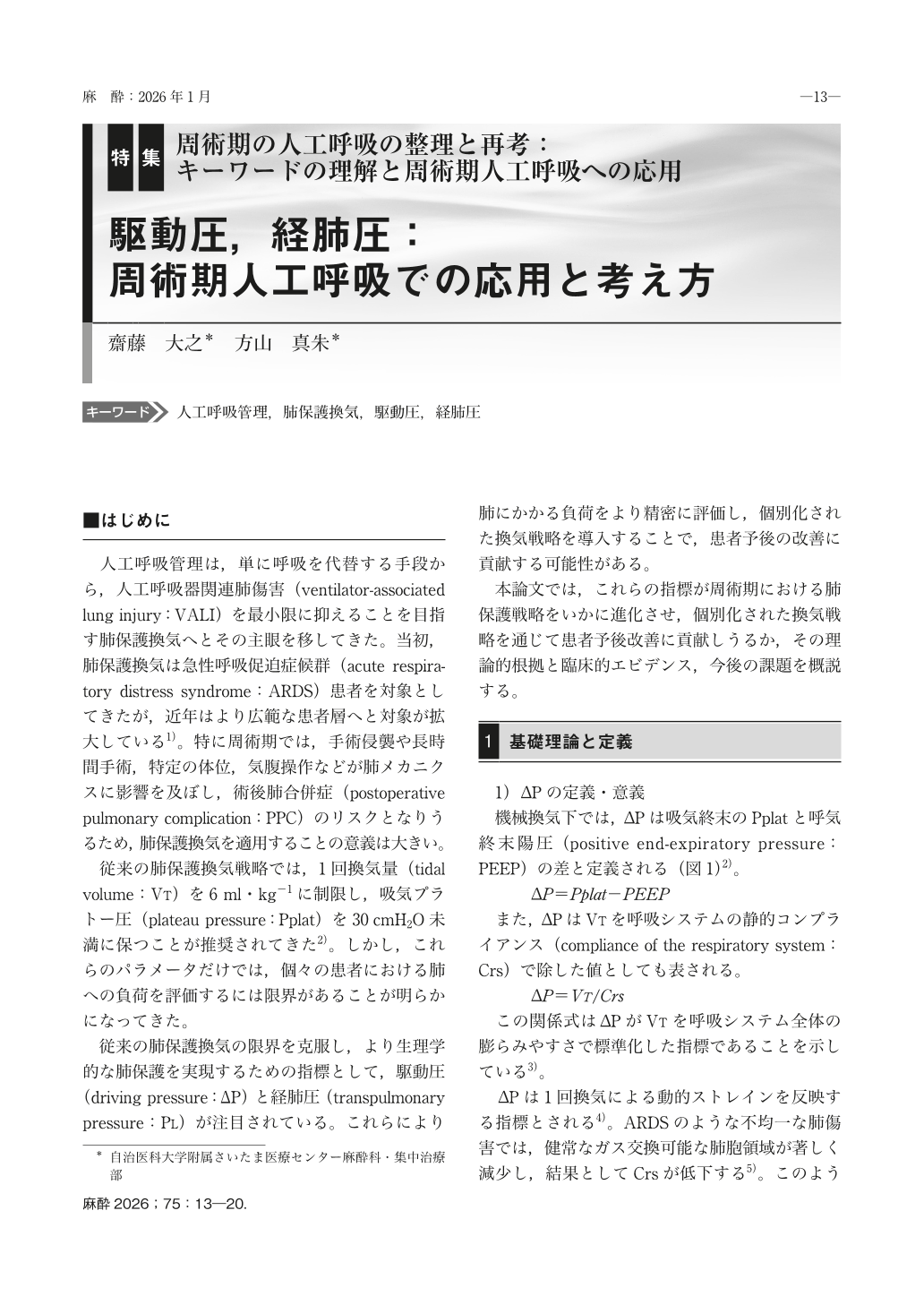
人工呼吸管理は,単に呼吸を代替する手段から,人工呼吸器関連肺傷害(ventilator-associated lung injury:VALI)を最小限に抑えることを目指す肺保護換気へとその主眼を移してきた。当初,肺保護換気は急性呼吸促迫症候群(acute respiratory distress syndrome:ARDS)患者を対象としてきたが,近年はより広範な患者層へと対象が拡大している1)。特に周術期では,手術侵襲や長時間手術,特定の体位,気腹操作などが肺メカニクスに影響を及ぼし,術後肺合併症(postoperative pulmonary complication:PPC)のリスクとなりうるため,肺保護換気を適用することの意義は大きい。
従来の肺保護換気戦略では,1回換気量(tidal volume:Vt)を6ml・kg-1に制限し,吸気プラトー圧(plateau pressure:Pplat)を30cmH2O未満に保つことが推奨されてきた2)。しかし,これらのパラメータだけでは,個々の患者における肺への負荷を評価するには限界があることが明らかになってきた。
従来の肺保護換気の限界を克服し,より生理学的な肺保護を実現するための指標として,駆動圧(driving pressure:∆P)と経肺圧(transpulmonary pressure:Pl)が注目されている。これらにより肺にかかる負荷をより精密に評価し,個別化された換気戦略を導入することで,患者予後の改善に貢献する可能性がある。
本論文では,これらの指標が周術期における肺保護戦略をいかに進化させ,個別化された換気戦略を通じて患者予後改善に貢献しうるか,その理論的根拠と臨床的エビデンス,今後の課題を概説する。
Lung protective ventilation(LPV)is crucial in efforts to minimize the risk of the occurrence of a ventilator-associated lung injury(VALI)during the perioperative period. Conventional LPV strategies focusing on the tidal volume and plateau pressure have limitations in assessments of individual patients’ lung stress. The driving pressure(ΔP), i.e., the change in airway pressure during tidal ventilation, reflects dynamic lung strain. The transpulmonary pressure(Pl), i.e., the pressure distending the lungs, represents the true stress on the lung parenchyma. A lower ΔP value is associated with improved outcomes in patients with ARDS, and a high intraoperative ΔP is an independent risk factor for postoperative pulmonary complications(PPC). Pl-guided PEEP titration can personalize ventilation, especially in patients with altered chest wall mechanics, obesity, or the requirement of a specific surgical position. The emerging concept of transpulmonary driving pressure(ΔPl)may offer a more precise measure of dynamic lung strain. Although the variables ΔP and Pl are key to advancing individualized respiratory support, it is also essential to conduct further high-quality research, standardize measurement techniques, and develop noninvasive estimation methods for widespread clinical implementation and for improving patient outcomes. This review discusses the physiological basis, historical evolution, and clinical applications of ΔP and Pl for optimizing the use of LPV in perioperative settings.
Copyright © 2026 KOKUSEIDO CO., LTD. All Rights Reserved.