Japanese
English
- 有料閲覧
PPV購入案内
1,320円 (1,200円+税10%) こちらは、21ページから30ページの文献です。購入には医書.jp本会員登録が必要です。
会員登録完了後に改めて上記「購入サイトへ」を選択してください。
または「購入サイトへ」選択後に「購入ログイン」、「新規会員登録」の順に進んでください。
会員登録について詳しくはをご確認ください。
- Abstract 文献概要
- 1ページ目 Look Inside
- 参考文献 Reference
- サイト内被引用 Cited by
はじめに
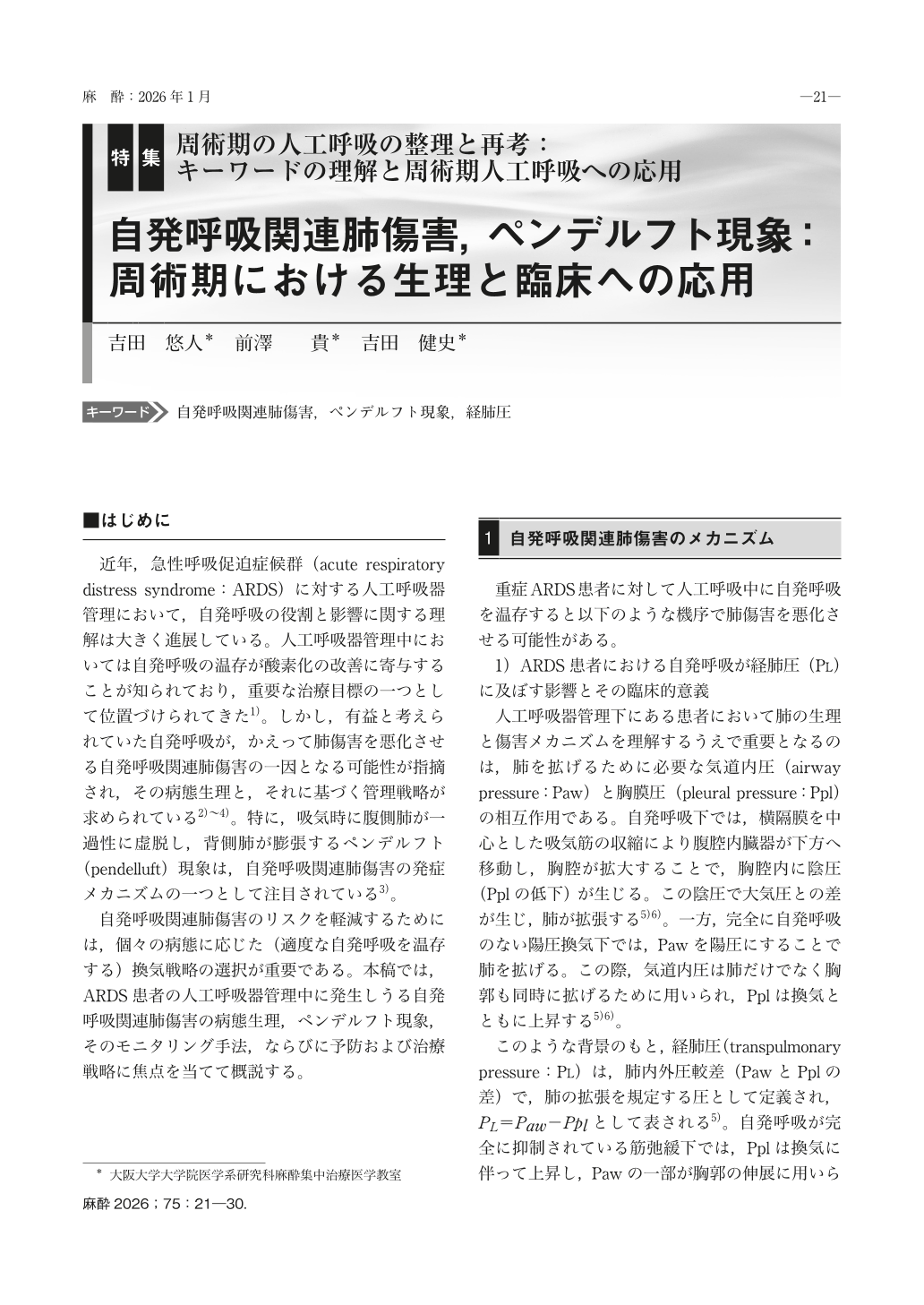
近年,急性呼吸促迫症候群(acute respiratory distress syndrome:ARDS)に対する人工呼吸器管理において,自発呼吸の役割と影響に関する理解は大きく進展している。人工呼吸器管理中においては自発呼吸の温存が酸素化の改善に寄与することが知られており,重要な治療目標の一つとして位置づけられてきた1)。しかし,有益と考えられていた自発呼吸が,かえって肺傷害を悪化させる自発呼吸関連肺傷害の一因となる可能性が指摘され,その病態生理と,それに基づく管理戦略が求められている2)~4)。特に,吸気時に腹側肺が一過性に虚脱し,背側肺が膨張するペンデルフト(pendelluft)現象は,自発呼吸関連肺傷害の発症メカニズムの一つとして注目されている3)。
自発呼吸関連肺傷害のリスクを軽減するためには,個々の病態に応じた(適度な自発呼吸を温存する)換気戦略の選択が重要である。本稿では,ARDS患者の人工呼吸器管理中に発生しうる自発呼吸関連肺傷害の病態生理,ペンデルフト現象,そのモニタリング手法,ならびに予防および治療戦略に焦点を当てて概説する。
The understanding of the role of spontaneous breathing in patients with acute respiratory failure has significantly evolved. Preserving a patient’s spontaneous breathing during mechanical ventilation was traditionally thought to improve oxygenation and was therefore considered beneficial. However, growing evidence suggests that a patient’s strong spontaneous efforts to breathe may actually worsen the risk of lung injury, leading to a condition known as ‘effort-dependent lung injury.’ This concept has introduced new perspectives on the respiratory management of critically ill patients.
One key mechanism contributing to effort-dependent lung injury is the pendelluft(“pendulum air”)phenomenon, in which air shifts from non-dependent(ventral)to dependent(dorsal)lung regions during inspiration. This uneven distribution of ventilation can cause the overdistension of certain lung areas, promoting further injury. Such regional lung stress and strain may go undetected by standardized ventilator settings, making effort-dependent lung injury a challenge to identify and manage. Individualized management strategies are essential in efforts to reduce the risk of effort-dependent lung injury. These strategies include lung-protective ventilation techniques, the optimal adjustment of positive end-expiratory pressure(PEEP), and the careful use of sedatives or neuromuscular blocking agents when necessary. Further research is needed to better understand the mechanisms of effort-dependent lung injury and to establish optimal treatment strategies that can improve outcomes for patients with acute respiratory failure.
Copyright © 2026 KOKUSEIDO CO., LTD. All Rights Reserved.