Japanese
English
- 有料閲覧
- Abstract 文献概要
- 1ページ目 Look Inside
- 参考文献 Reference
- サイト内被引用 Cited by
はじめに
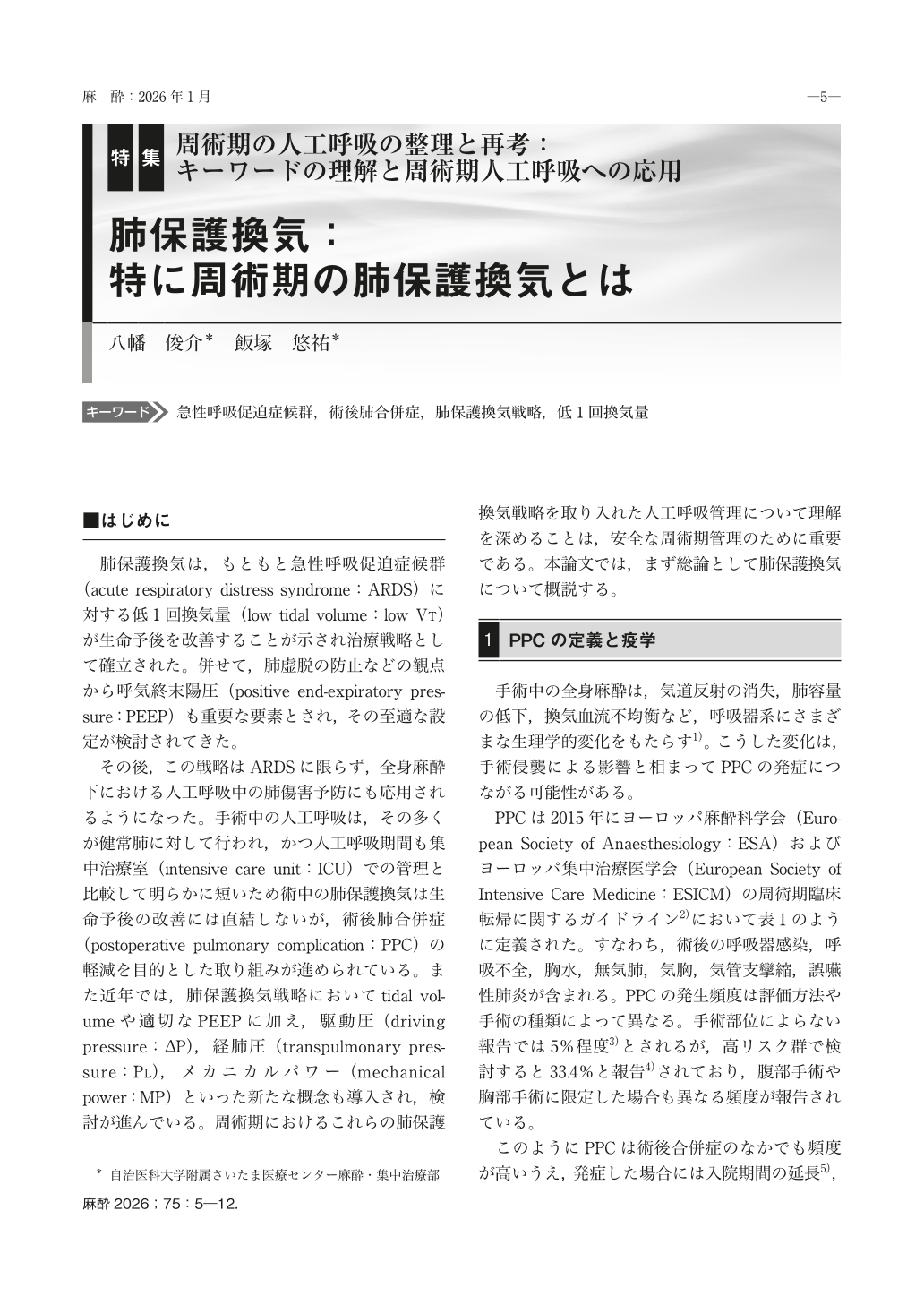
肺保護換気は,もともと急性呼吸促迫症候群(acute respiratory distress syndrome:ARDS)に対する低1回換気量(low tidal volume:low Vt)が生命予後を改善することが示され治療戦略として確立された。併せて,肺虚脱の防止などの観点から呼気終末陽圧(positive end-expiratory pressure:PEEP)も重要な要素とされ,その至適な設定が検討されてきた。
その後,この戦略はARDSに限らず,全身麻酔下における人工呼吸中の肺傷害予防にも応用されるようになった。手術中の人工呼吸は,その多くが健常肺に対して行われ,かつ人工呼吸期間も集中治療室(intensive care unit:ICU)での管理と比較して明らかに短いため術中の肺保護換気は生命予後の改善には直結しないが,術後肺合併症(postoperative pulmonary complication:PPC)の軽減を目的とした取り組みが進められている。また近年では,肺保護換気戦略においてtidal volumeや適切なPEEPに加え,駆動圧(driving pressure:ΔP),経肺圧(transpulmonary pressure:Pl),メカニカルパワー(mechanical power:MP)といった新たな概念も導入され,検討が進んでいる。周術期におけるこれらの肺保護換気戦略を取り入れた人工呼吸管理について理解を深めることは,安全な周術期管理のために重要である。本論文では,まず総論として肺保護換気について概説する。
Lung-protective ventilation(LPV)strategies were originally developed to improve the outcomes of patients with acute respiratory distress syndrome(ARDS)by applying low tidal volumes(TVs)and appropriate levels of positive end-expiratory pressure(PEEP). This approach has since been extended to intraoperative ventilation in surgical patients to prevent postoperative pulmonary complications(PPCs), rather than to directly reduce mortality. Recent studies highlight additional LPV concepts such as the driving pressure(ΔP), transpulmonary pressure, and mechanical power. Although a low TV is consistently associated with a reduced risk of PPCs, the roles of high PEEP and recruitment maneuvers remain controversial, with mixed evidence regarding their effectiveness and safety. In addition, a high intraoperative Fio2 value, which had been proposed for reducing the risk of surgical site infections, has not demonstrated consistent benefit and may actually increase the PPC risk due to atelectasis. Various PPC risk prediction tools, including the ARISCAT and NSQIP calculators, help identify high-risk patients and guide perioperative care. This article provides a general overview of LPV in perioperative patient management, emphasizing the importance of individualized ventilation strategies. An evaluation of the PPC risk and the implementation of a low TV value with appropriate(and not excessive)PEEP remain key elements in optimizing surgical patients’ outcomes.
Copyright © 2026 KOKUSEIDO CO., LTD. All Rights Reserved.