Japanese
English
- 有料閲覧
- Abstract 文献概要
- 1ページ目 Look Inside
- 参考文献 Reference
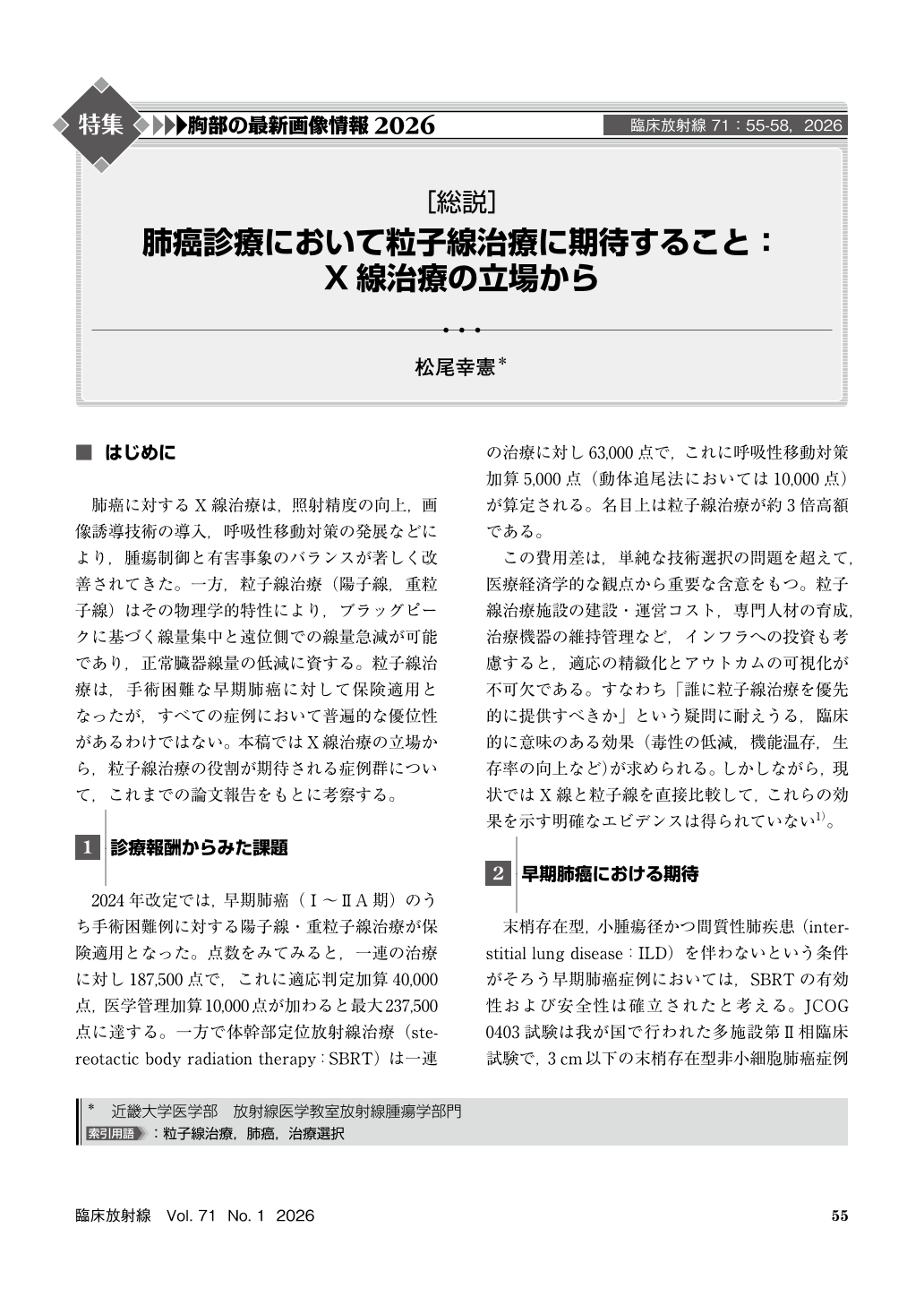
肺癌に対するX線治療は,照射精度の向上,画像誘導技術の導入,呼吸性移動対策の発展などにより,腫瘍制御と有害事象のバランスが著しく改善されてきた。一方,粒子線治療(陽子線,重粒子線)はその物理学的特性により,ブラッグピークに基づく線量集中と遠位側での線量急減が可能であり,正常臓器線量の低減に資する。粒子線治療は,手術困難な早期肺癌に対して保険適用となったが,すべての症例において普遍的な優位性があるわけではない。本稿ではX線治療の立場から,粒子線治療の役割が期待される症例群について,これまでの論文報告をもとに考察する。
Particle therapy offers superior dose distributions based on the Bragg peak, enabling reductions in dose to organs at risk. In lung cancer, however, indications are not uniform, as treatment safety margins vary widely depending on tumor characteristics and comorbidities. Following the 2024 reimbursement reform in Japan, proton and carbon-ion therapy became covered for medically inoperable early-stage lung cancer, but cost differentials versus stereotactic body radiation therapy(SBRT)necessitate careful patient selection. From the standpoint of X-ray radiotherapy, particle therapy may be most beneficial for toxicity reduction in early-stage disease with high risk factors(central tumors, larger lesions, and interstitial lung disease)and potential survival improvements via organ-at-risk sparing in locally advanced disease. The results of RTOG 1308 comparing X-ray and proton therapy will likely shape future clinical adoption.
Copyright © 2026, KANEHARA SHUPPAN Co.LTD. All rights reserved.