Japanese
English
- 有料閲覧
- Abstract 文献概要
- 1ページ目 Look Inside
- 参考文献 Reference
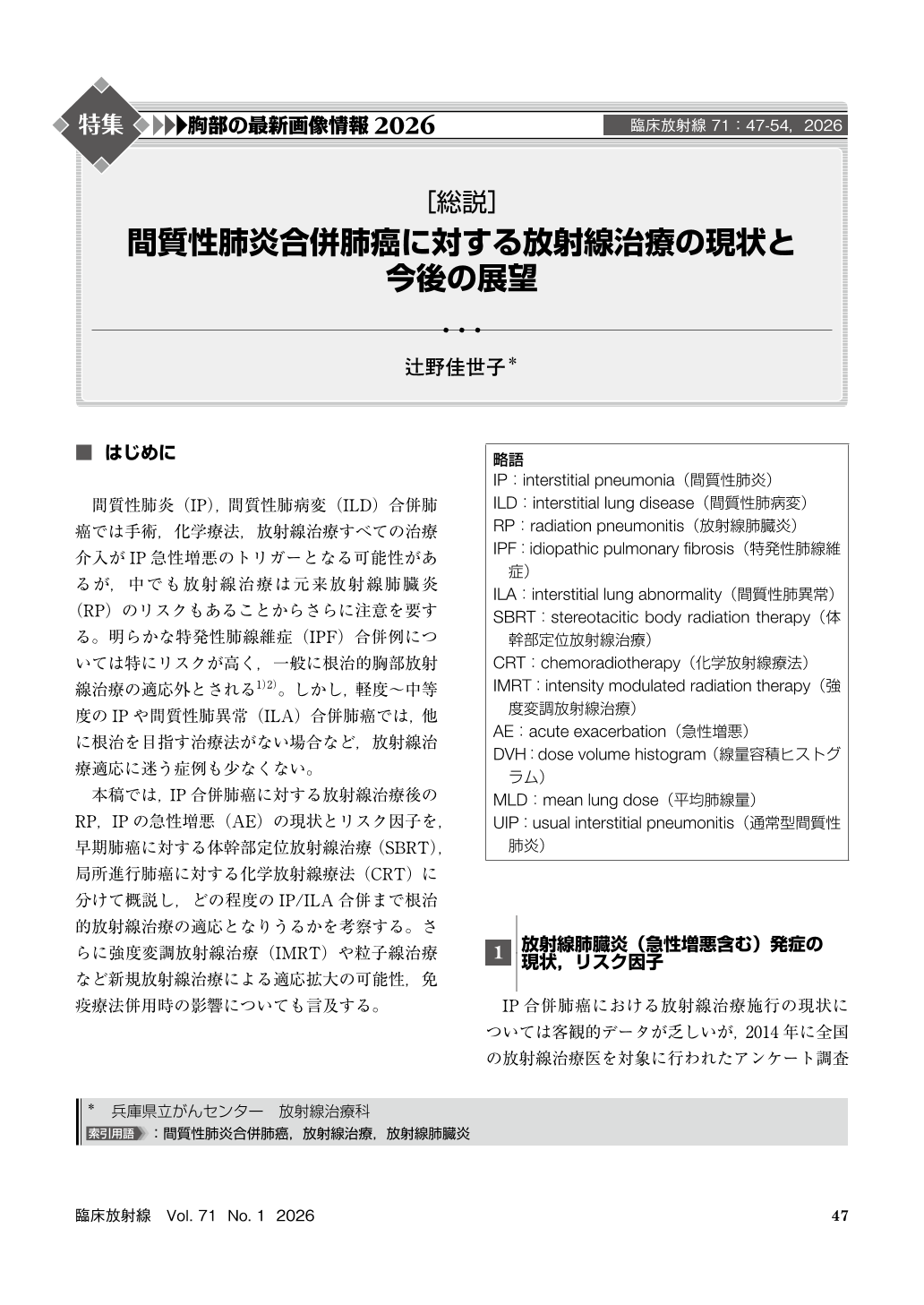
間質性肺炎(IP),間質性肺病変(ILD)合併肺癌では手術,化学療法,放射線治療すべての治療介入がIP急性増悪のトリガーとなる可能性があるが,中でも放射線治療は元来放射線肺臓炎(RP)のリスクもあることからさらに注意を要する。明らかな特発性肺線維症(IPF)合併例については特にリスクが高く,一般に根治的胸部放射線治療の適応外とされる1)2)。しかし,軽度~中等度のIPや間質性肺異常(ILA)合併肺癌では,他に根治を目指す治療法がない場合など,放射線治療適応に迷う症例も少なくない。
Patients with lung cancer complicated by interstitial pneumonia(IP)are at increased risk of acute IP exacerbation and severe radiation pneumonitis(RP), particularly those with idiopathic pulmonary fibrosis(IPF), in whom curative thoracic radiotherapy is generally contraindicated. However, in cases of mild to moderate IP or interstitial lung abnormalities(ILA), radiotherapy may be considered when there are no alternative curative treatment options. This review summarizes the incidence and risk factors for RP and IP exacerbation following stereotactic body radiation therapy(SBRT)for early-stage lung cancer and chemoradiotherapy(CRT)for locally advanced disease in IP-complicated cases. We also discuss criteria for determining treatment eligibility, the potential of advanced techniques such as intensity-modulated radiation therapy(IMRT)and particle beam therapy(proton or carbon beam)to expand indications, and the impact of combining immunotherapy. Although SBRT and CRT are not absolute contraindications for lung cancer with IP, these patients have poorer outcomes and a higher risk of severe RP. Therefore, careful assessment based on IP severity, DVH parameters, and peripheral blood biomarkers, along with thorough patient explanation and informed consent, is essential. Particle beam therapy is promising for high-risk patients with IP-associated lung cancer.
Copyright © 2026, KANEHARA SHUPPAN Co.LTD. All rights reserved.