Japanese
English
- 有料閲覧
- Abstract 文献概要
- 1ページ目 Look Inside
- 参考文献 Reference
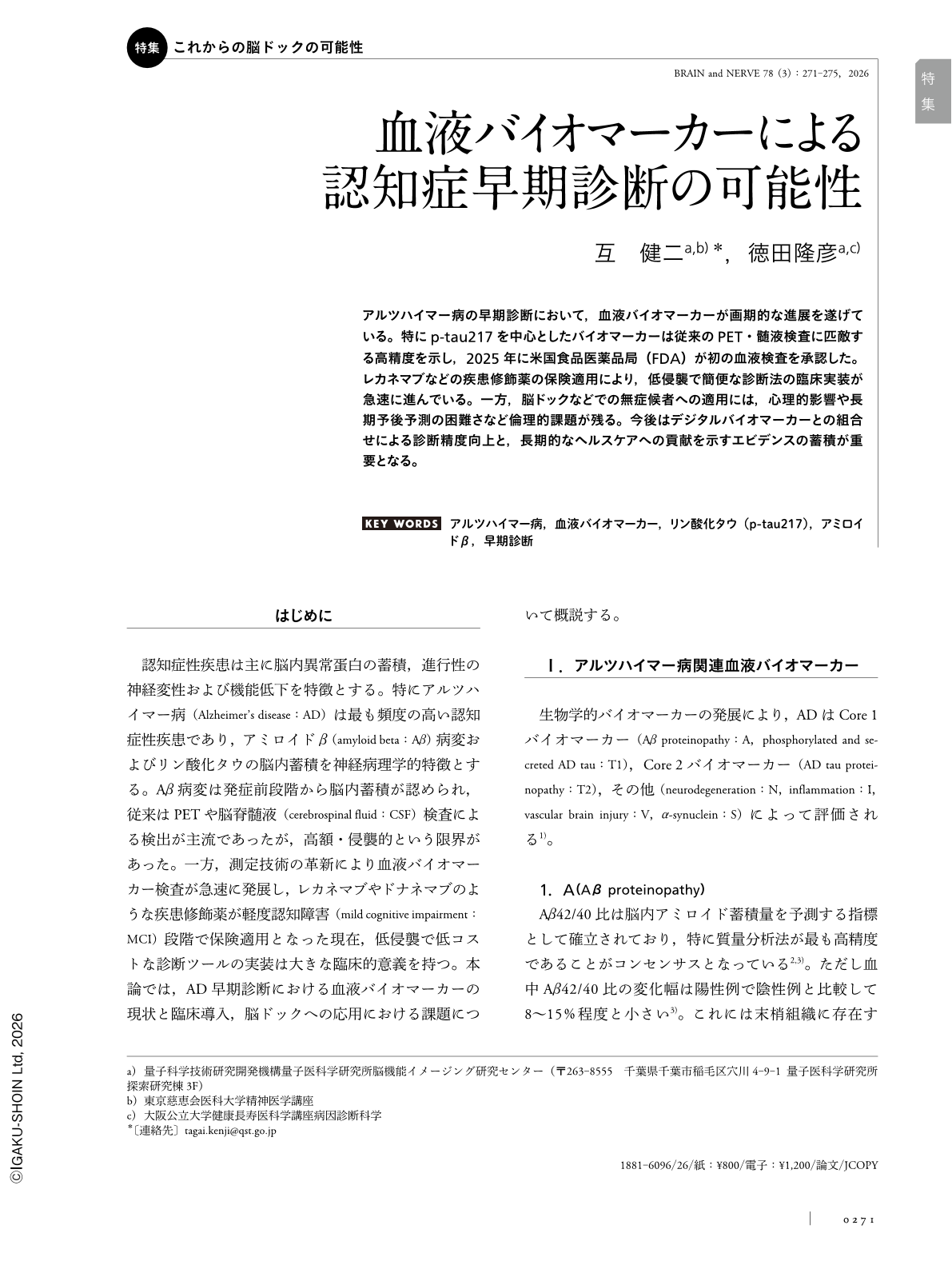
アルツハイマー病の早期診断において,血液バイオマーカーが画期的な進展を遂げている。特にp-tau217を中心としたバイオマーカーは従来のPET・髄液検査に匹敵する高精度を示し,2025年に米国食品医薬品局(FDA)が初の血液検査を承認した。レカネマブなどの疾患修飾薬の保険適用により,低侵襲で簡便な診断法の臨床実装が急速に進んでいる。一方,脳ドックなどでの無症候者への適用には,心理的影響や長期予後予測の困難さなど倫理的課題が残る。今後はデジタルバイオマーカーとの組合せによる診断精度向上と,長期的なヘルスケアへの貢献を示すエビデンスの蓄積が重要となる。
Abstract
Blood biomarkers represent a major breakthrough in the early diagnosis of Alzheimer's disease (AD). Plasma p-tau217/Aβ42 ratio demonstrates diagnostic accuracy comparable to PET and CSF examinations, leading to FDA approval of the first blood-based AD test in May 2025. With insurance coverage now extending to disease-modifying therapies such as lecanemab and donanemab at the mild cognitive impairment (MCI) stage, the clinical adoption of these minimally invasive diagnostic tools is rapidly advancing. Current development includes Core 1 biomarkers (A: Aβ proteinopathy, T1: phosphorylated tau) and emerging Core 2 biomarkers (T2: tau proteinopathy), with novel assays such as mid-p-tau181 showing promise. However, its application to asymptomatic individuals in brain dock settings remains challenging due to ethical considerations, including psychological burden and the uncertainty of predicting disease progression. Future directions include integrating digital biomarkers to enhance diagnostic accuracy and generating evidence for long-term healthcare benefits, while addressing standardization across manufacturers and implementing dual-cutoff strategies to optimize clinical utility.
Copyright © 2026, Igaku-Shoin Ltd. All rights reserved.