Japanese
English
- 有料閲覧
- Abstract 文献概要
- 1ページ目 Look Inside
- 参考文献 Reference
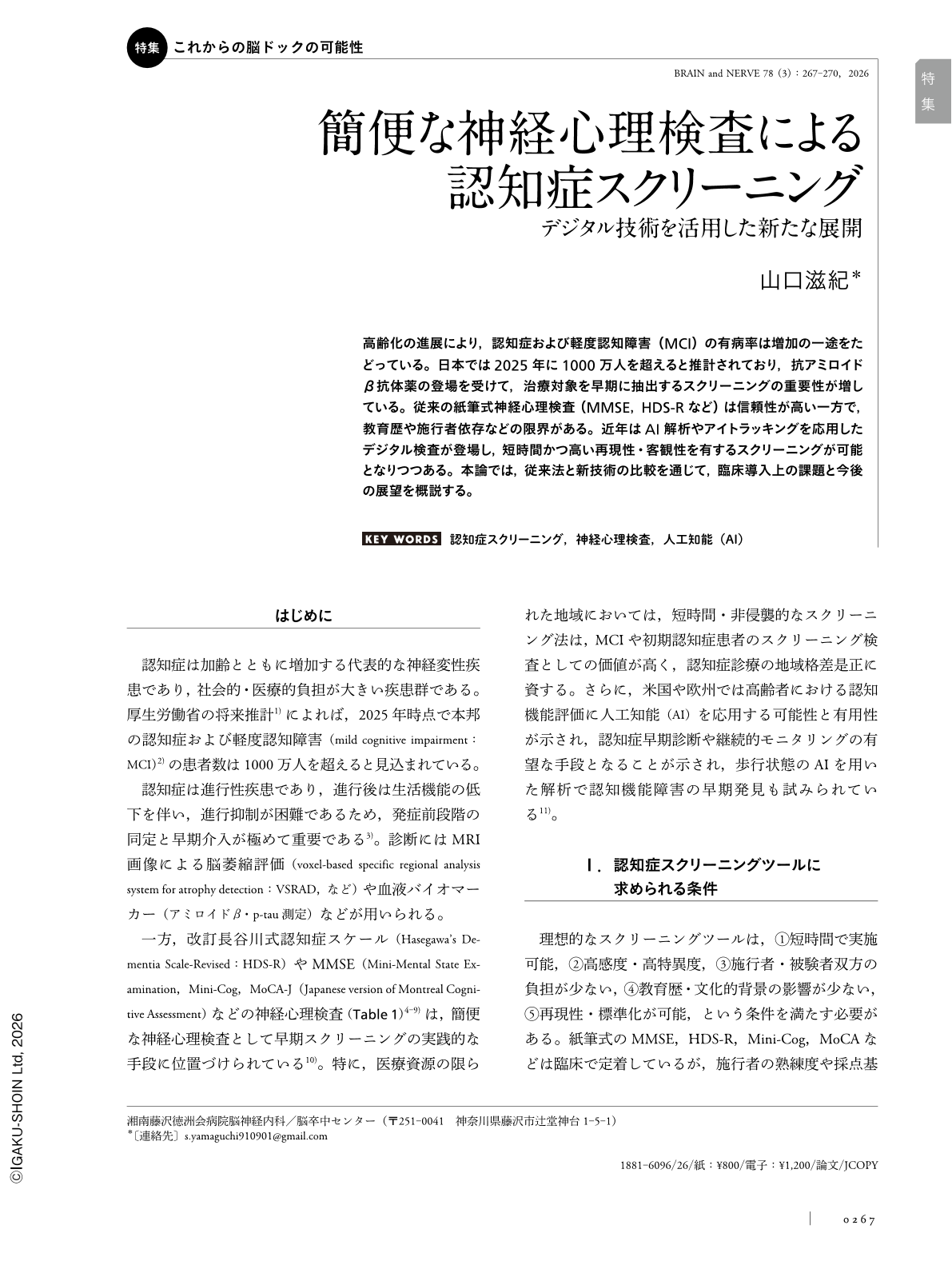
高齢化の進展により,認知症および軽度認知障害(MCI)の有病率は増加の一途をたどっている。日本では2025年に1000万人を超えると推計されており,抗アミロイドβ抗体薬の登場を受けて,治療対象を早期に抽出するスクリーニングの重要性が増している。従来の紙筆式神経心理検査(MMSE,HDS-Rなど)は信頼性が高い一方で,教育歴や施行者依存などの限界がある。近年はAI解析やアイトラッキングを応用したデジタル検査が登場し,短時間かつ高い再現性・客観性を有するスクリーニングが可能となりつつある。本論では,従来法と新技術の比較を通じて,臨床導入上の課題と今後の展望を概説する。
Abstract
With the rapid aging population, the prevalence of dementia and mild cognitive impairment is increasing and is estimated to be >10 million by 2025 in Japan. The emergence of anti-amyloid β-antibody therapies has heightened the importance of early screening to identify treatment candidates. Traditional paper-based neuropsychological tests, such as the Mini-Mental State Examination and Hasegawa Dementia Scale-Revised, are highly reliable but have limitations related to educational background and examiner dependency. Recently, digital screening tools incorporating AI-based analysis and eye tracking technology have been introduced, offering rapid, reproducible, and objective assessments. This article compares conventional methods and new technologies and discusses the challenges in clinical implementation and future perspectives.
Copyright © 2026, Igaku-Shoin Ltd. All rights reserved.