Japanese
English
- 有料閲覧
- Abstract 文献概要
- 1ページ目 Look Inside
- 参考文献 Reference
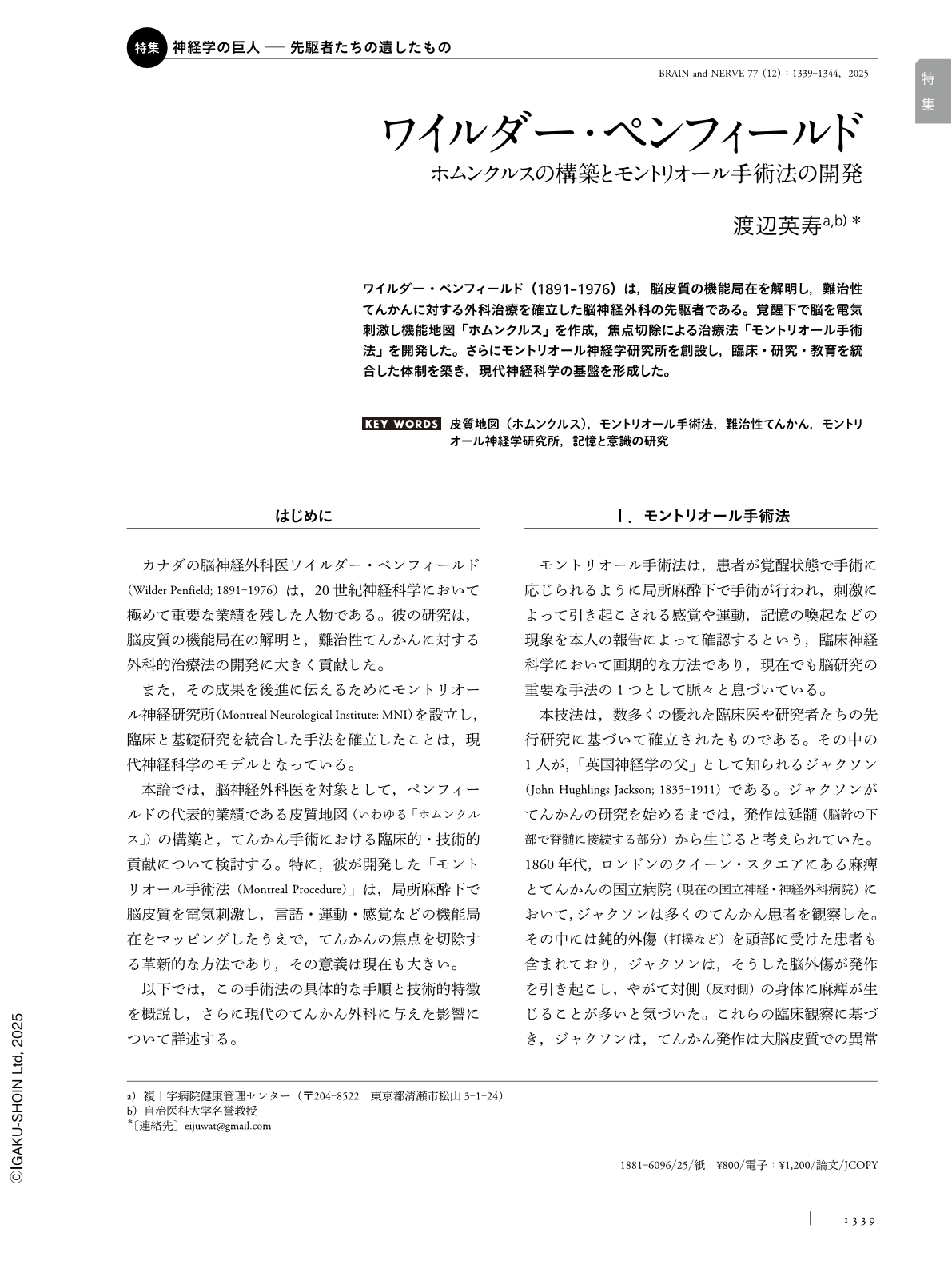
ワイルダー・ペンフィールド(1891-1976)は,脳皮質の機能局在を解明し,難治性てんかんに対する外科治療を確立した脳神経外科の先駆者である。覚醒下で脳を電気刺激し機能地図「ホムンクルス」を作成,焦点切除による治療法「モントリオール手術法」を開発した。さらにモントリオール神経学研究所を創設し,臨床・研究・教育を統合した体制を築き,現代神経科学の基盤を形成した。
Abstract
Wilder Penfield (1891-1976) was a Canadian neurosurgeon whose pioneering work left a lasting mark on neuroscience and epilepsy surgery. He advanced knowledge of cortical localization by electrically stimulating the brain under local anesthesia, allowing patients to report sensations and movements. From these observations, he created the famous “homunculus,” a functional map of motor and sensory areas. Penfield also developed the Montreal Procedure, a groundbreaking surgical approach for intractable epilepsy. By stimulating the cortex during awake operations, he identified and preserved critical regions for speech and movement while safely removing epileptic foci. His studies also revealed that cortical stimulation could evoke vivid memories and experiences, contributing to research on memory and consciousness. In 1934, Penfield founded the Montreal Neurological Institute (MNI), the first center to integrate clinical care, research, and education in neuroscience. This interdisciplinary model fostered collaboration among neurosurgeons, neurologists, psychologists, and basic scientists, becoming the prototype for modern neuroscience institutes. Through his surgical innovations, scientific insights, and commitment to education, Penfield trained generations of specialists and shaped the field of translational medicine. His legacy continues to influence epilepsy surgery, cortical mapping, and the study of brain-mind relationships.
Copyright © 2025, Igaku-Shoin Ltd. All rights reserved.