Japanese
English
- 有料閲覧
- Abstract 文献概要
- 1ページ目 Look Inside
- 参考文献 Reference
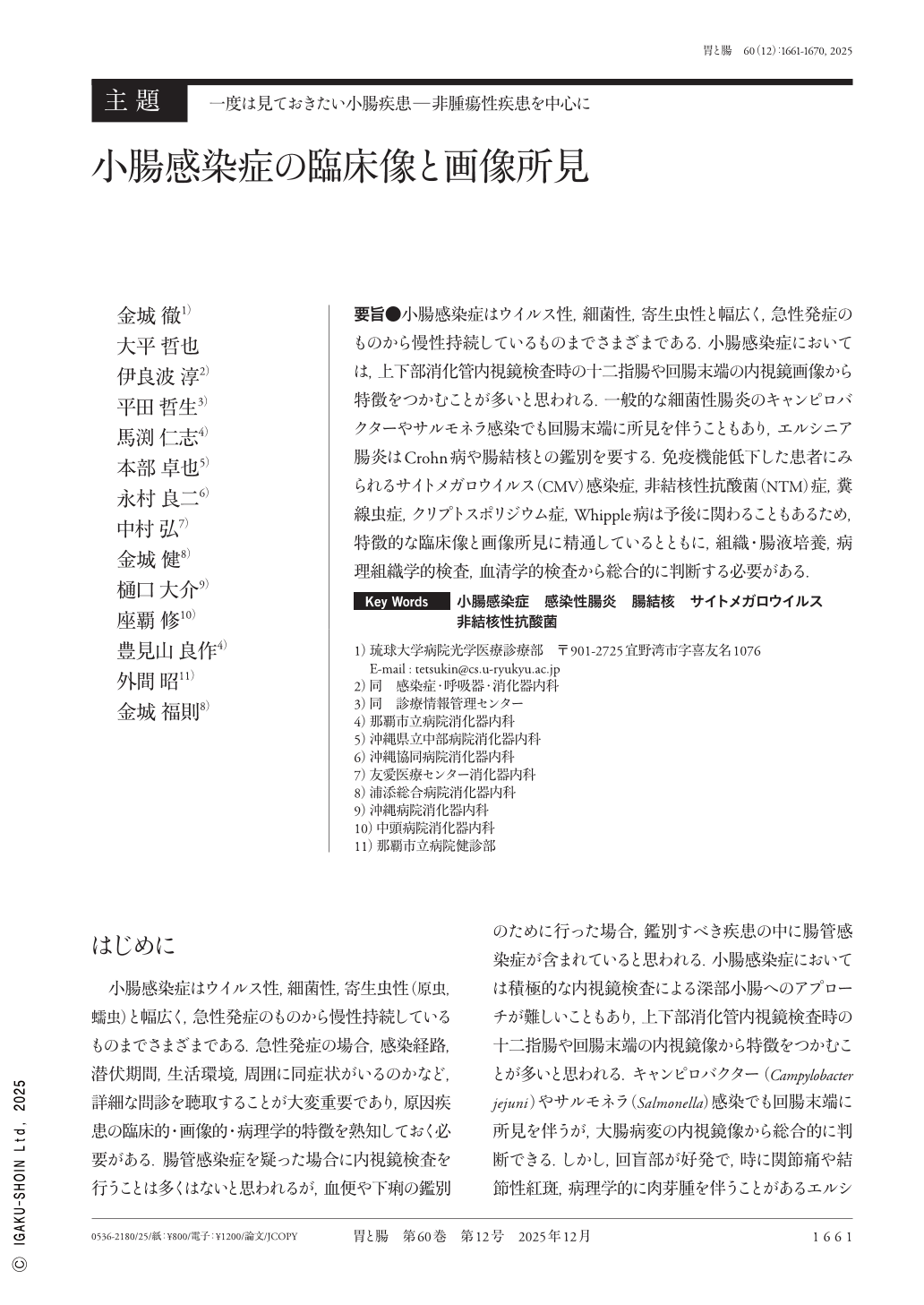
要旨●小腸感染症はウイルス性,細菌性,寄生虫性と幅広く,急性発症のものから慢性持続しているものまでさまざまである.小腸感染症においては,上下部消化管内視鏡検査時の十二指腸や回腸末端の内視鏡画像から特徴をつかむことが多いと思われる.一般的な細菌性腸炎のキャンピロバクターやサルモネラ感染でも回腸末端に所見を伴うこともあり,エルシニア腸炎はCrohn病や腸結核との鑑別を要する.免疫機能低下した患者にみられるサイトメガロウイルス(CMV)感染症,非結核性抗酸菌(NTM)症,糞線虫症,クリプトスポリジウム症,Whipple病は予後に関わることもあるため,特徴的な臨床像と画像所見に精通しているとともに,組織・腸液培養,病理組織学的検査,血清学的検査から総合的に判断する必要がある.
Small intestinal infections encompass a broad spectrum of etiologies, including viral, bacterial, and parasitic agents, and can present as acute or chronic disease. In clinical practice, the characteristic features of small intestinal infections are often revealed by the evaluation of duodenum or terminal ileum with upper and lower gastrointestinal endoscopy. Terminal ileum may be involved even in patients with common bacterial enteritis, such as that caused by Campylobacter or Salmonella species. In contrast, Yersinia enteritis frequently requires careful differentiation from Crohn's disease and intestinal tuberculosis. Opportunistic infections, including those caused by cytomegalovirus, nontuberculous mycobacteria, Strongyloides stercoralis, Cryptosporidium, and Tropheryma whipplei, which are typically observed in immunocompromised patients, have prognostic implications. Therefore, small intestinal infections require a comprehensive approach that integrates characteristic clinical and endoscopic findings with histopathology, intestinal fluid cultures, and serologic testing.
Copyright © 2025, Igaku-Shoin Ltd. All rights reserved.