Japanese
English
- 有料閲覧
- Abstract 文献概要
- 1ページ目 Look Inside
- 参考文献 Reference
Point
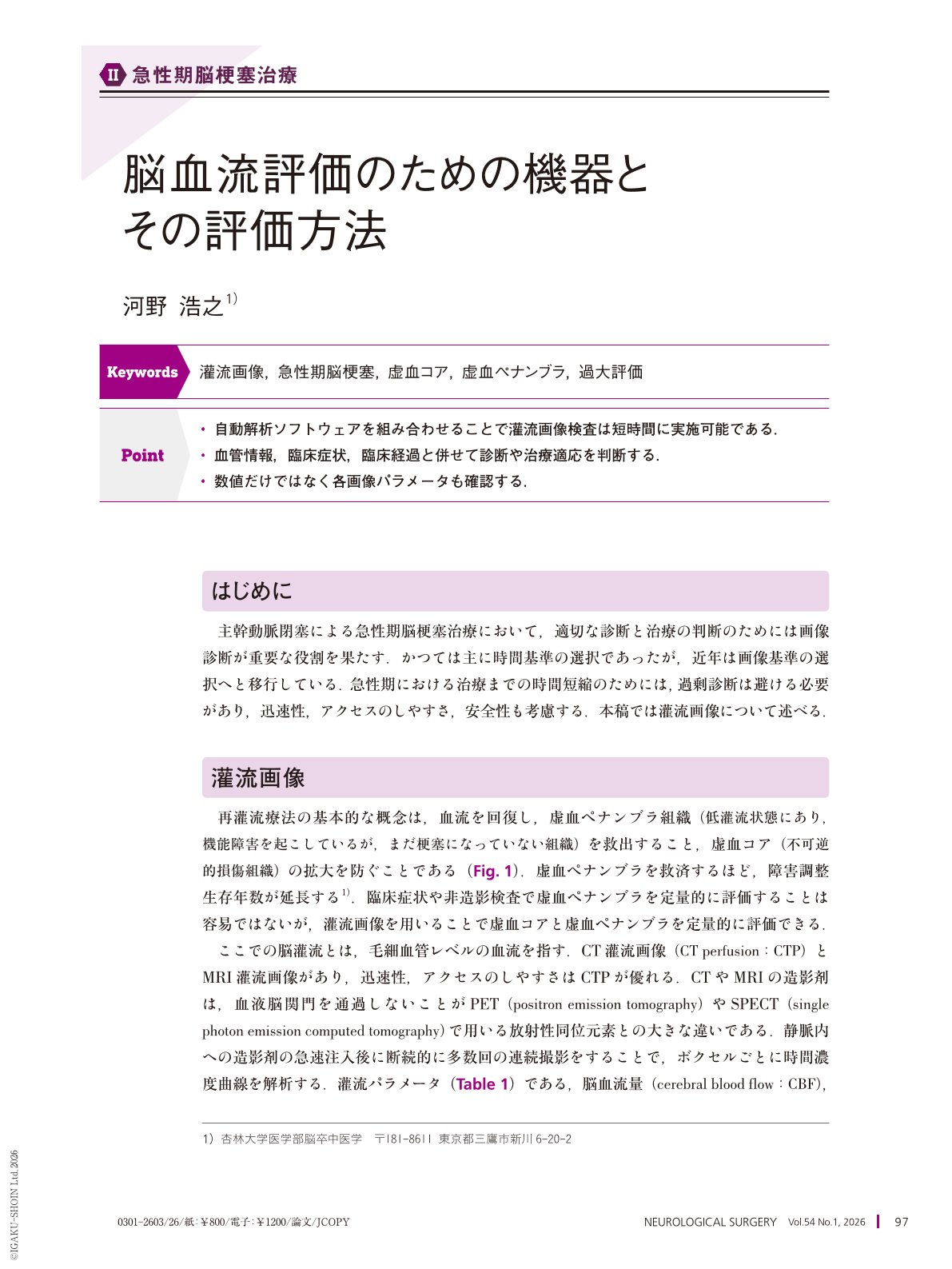
・自動解析ソフトウェアを組み合わせることで灌流画像検査は短時間に実施可能である.
・血管情報,臨床症状,臨床経過と併せて診断や治療適応を判断する.
・数値だけではなく各画像パラメータも確認する.
Neuroimaging studies prior to endovascular treatment for acute ischemic stroke provide essential information for determining eligibility (treatment triage) and procedural strategies. A fundamental concept of recanalization therapy is the mismatch between the ischemic core (irreversibly damaged tissue) and ischemic penumbra (severely hypoperfused, functionally impaired, at-risk, but not yet infarcted tissue). The goal of recanalization therapy is to recanalize an occluded blood vessel, restore blood flow to penumbral tissue before the ischemic core expands, and save the penumbra tissue. Perfusion imaging allows noninvasive evaluation of the ischemic core and penumbral tissue, although the ischemic penumbra is difficult to discern clinically or based on noncontrast imaging alone. Automated postprocessing software can quickly calculate the location and volume of the ischemic core and penumbra. Optimal thresholds vary depending on the specific perfusion software platform. CT perfusion occasionally overestimates or underestimates ischemic core volume. Discordance among CT perfusion findings, clinical symptoms, and CT angiography findings can provide an additional suggestion for the diagnosis of a stroke mimic.
Copyright © 2026, Igaku-Shoin Ltd. All rights reserved.