Japanese
English
- 有料閲覧
- Abstract 文献概要
- 1ページ目 Look Inside
- 参考文献 Reference
Ⅰ はじめに
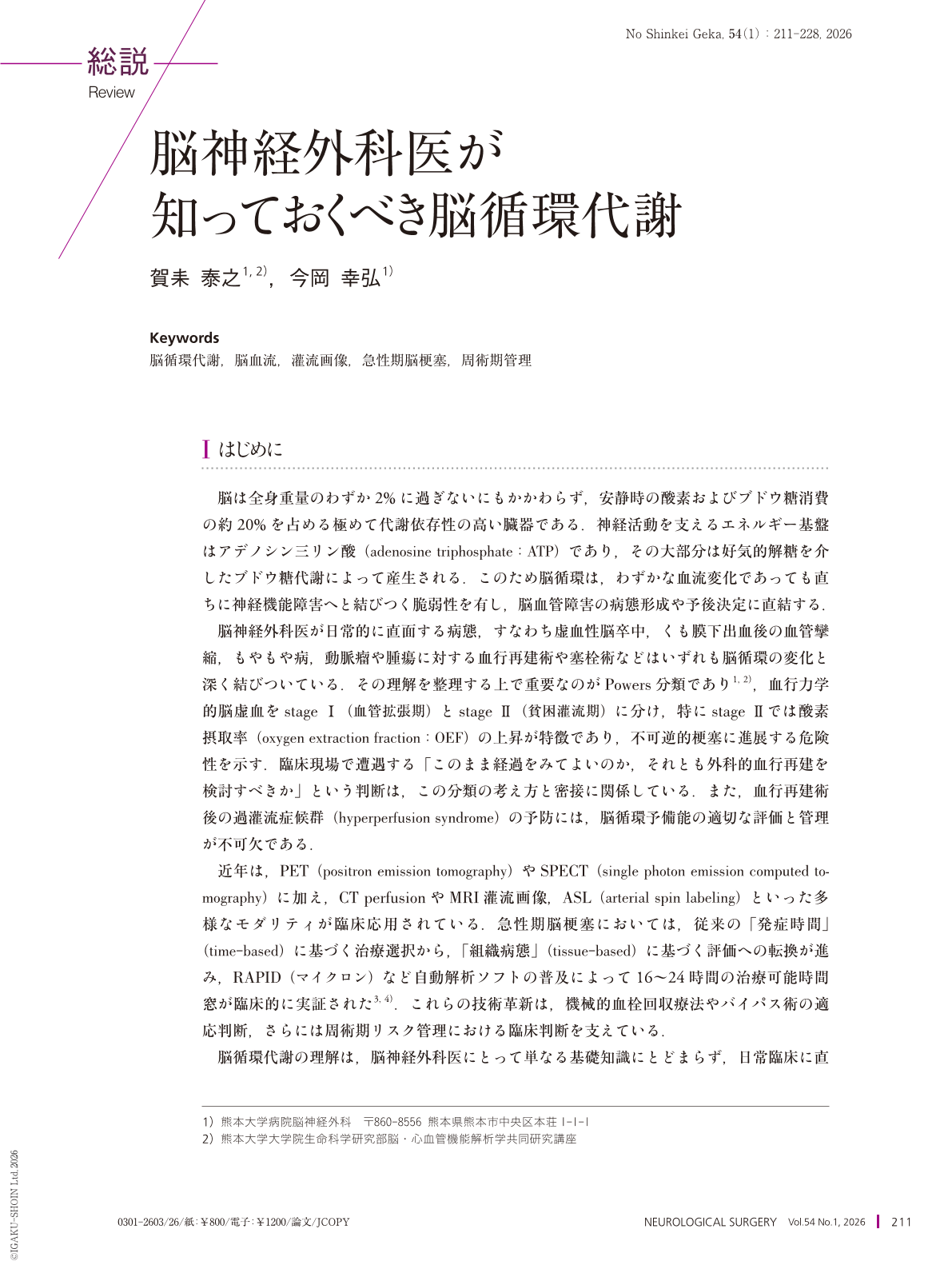
脳は全身重量のわずか2%に過ぎないにもかかわらず,安静時の酸素およびブドウ糖消費の約20%を占める極めて代謝依存性の高い臓器である.神経活動を支えるエネルギー基盤はアデノシン三リン酸(adenosine triphosphate:ATP)であり,その大部分は好気的解糖を介したブドウ糖代謝によって産生される.このため脳循環は,わずかな血流変化であっても直ちに神経機能障害へと結びつく脆弱性を有し,脳血管障害の病態形成や予後決定に直結する.
脳神経外科医が日常的に直面する病態,すなわち虚血性脳卒中,くも膜下出血後の血管攣縮,もやもや病,動脈瘤や腫瘍に対する血行再建術や塞栓術などはいずれも脳循環の変化と深く結びついている.その理解を整理する上で重要なのがPowers分類であり1, 2),血行力学的脳虚血をstage Ⅰ(血管拡張期)とstage Ⅱ(貧困灌流期)に分け,特にstage Ⅱでは酸素摂取率(oxygen extraction fraction:OEF)の上昇が特徴であり,不可逆的梗塞に進展する危険性を示す.臨床現場で遭遇する「このまま経過をみてよいのか,それとも外科的血行再建を検討すべきか」という判断は,この分類の考え方と密接に関係している.また,血行再建術後の過灌流症候群(hyperperfusion syndrome)の予防には,脳循環予備能の適切な評価と管理が不可欠である.
近年は,PET(positron emission tomography)やSPECT(single photon emission computed tomography)に加え,CT perfusionやMRI灌流画像,ASL(arterial spin labeling)といった多様なモダリティが臨床応用されている.急性期脳梗塞においては,従来の「発症時間」(time-based)に基づく治療選択から,「組織病態」(tissue-based)に基づく評価への転換が進み,RAPID(マイクロン)など自動解析ソフトの普及によって16〜24時間の治療可能時間窓が臨床的に実証された3, 4).これらの技術革新は,機械的血栓回収療法やバイパス術の適応判断,さらには周術期リスク管理における臨床判断を支えている.
脳循環代謝の理解は,脳神経外科医にとって単なる基礎知識にとどまらず,日常臨床に直結する実践的な知識である.本稿では,脳循環代謝の基本概念から最新の診断技術,臨床応用に至るまでを整理し,臨床における理解を深める一助としたい.
Cerebral hemodynamics and metabolism are central to neurosurgical decision-making and directly influence management in cerebrovascular disease, revascularization, and perioperative care. Powers'classification offers a physiological basis for hemodynamic ischemia, and quantitative positron emission tomography remains the gold standard for evaluating cerebral blood flow, cerebral blood volume, oxygen extraction fraction, and the cerebral metabolic rate of oxygen. Single photon emission computed tomography with acetazolamide, computed tomography/magnetic resonance perfusion, and arterial spin labeling have improved clinical accessibility and allow assessment of cerebrovascular reserve, time-to-peak, mean transit time, and time-to-maximum. In acute ischemic stroke, perfusion imaging has advanced treatment selection from a time-based to a tissue-based paradigm, supporting thrombectomy in patients with large ischemic cores. Post-recanalization phenomena, including hyperperfusion and no-reflow, illustrate the complexity of microcirculatory dynamics. Perfusion studies also inform decisions in bypass surgery and carotid revascularization. For neurosurgeons, understanding these modalities and their complementary interpretations is essential for safe and effective practice. Future integration of imaging metrics with physiological data through artificial intelligence may facilitate patient-specific strategies, standardized protocols, multicenter validation, and ultimately reduce complications while improving outcomes.
Copyright © 2026, Igaku-Shoin Ltd. All rights reserved.