Japanese
English
- 有料閲覧
- Abstract 文献概要
- 1ページ目 Look Inside
- 参考文献 Reference
Point
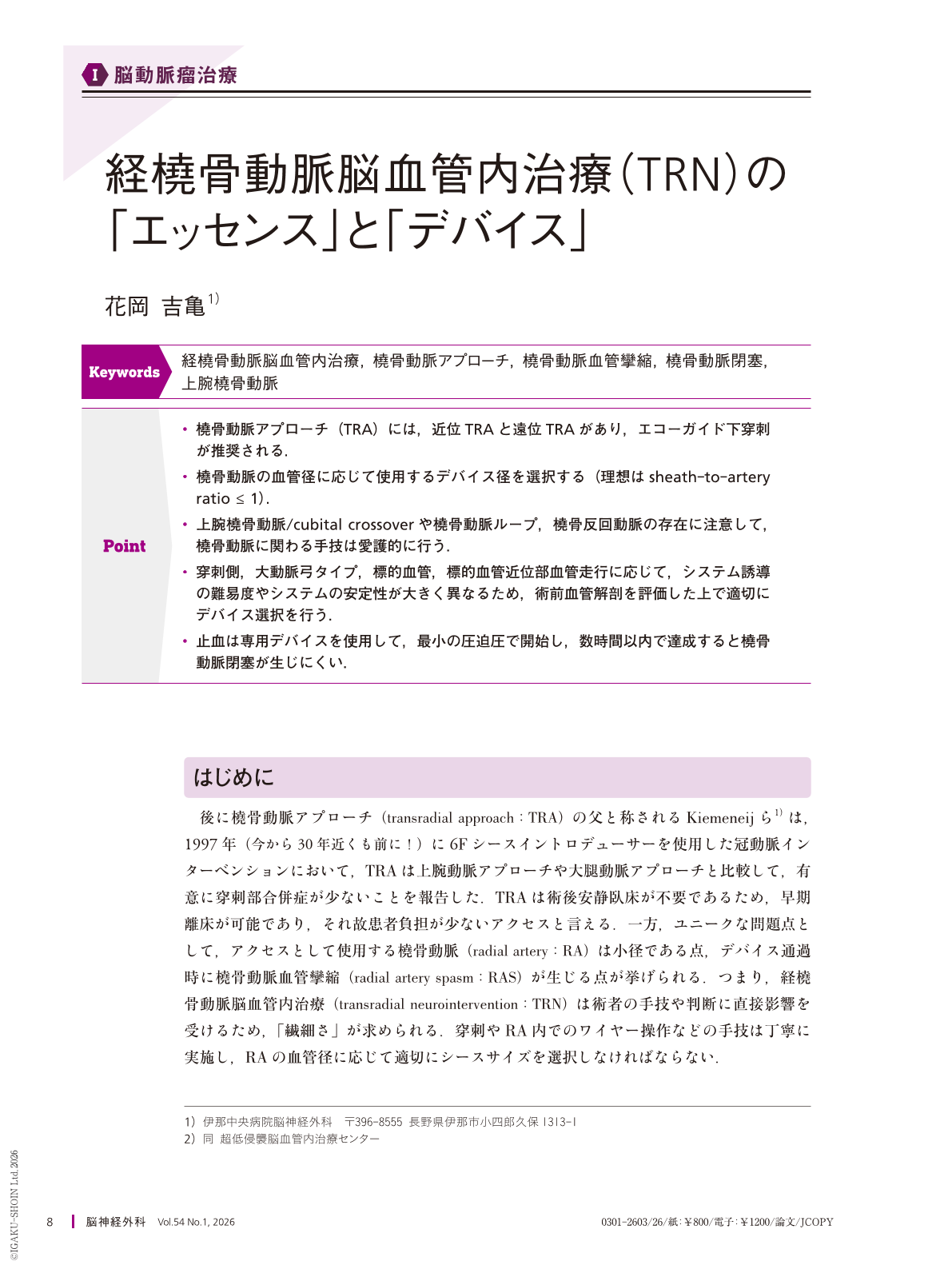
・橈骨動脈アプローチ(TRA)には,近位TRAと遠位TRAがあり,エコーガイド下穿刺が推奨される.
・橈骨動脈の血管径に応じて使用するデバイス径を選択する(理想はsheath-to-artery ratio ≤ 1).
・上腕橈骨動脈/cubital crossoverや橈骨動脈ループ,橈骨反回動脈の存在に注意して,橈骨動脈に関わる手技は愛護的に行う.
・穿刺側,大動脈弓タイプ,標的血管,標的血管近位部血管走行に応じて,システム誘導の難易度やシステムの安定性が大きく異なるため,術前血管解剖を評価した上で適切にデバイス選択を行う.
・止血は専用デバイスを使用して,最小の圧迫圧で開始し,数時間以内で達成すると橈骨動脈閉塞が生じにくい.
Transradial neurointervention (TRN) benefits patients and neurointerventionalists. The radial artery is small in diameter and prone to vasospasm; thus, it must be handled gently from puncture to hemostasis. Ultrasound-guided puncture is recommended. Normal variations, such as the brachioradial artery or radial artery loop, should be considered. The size of the catheter system was selected based on radial artery diameter. The sheath-to-artery ratio must be ≤1, particularly with large-bore catheter systems or sheathless technique. The difficulty of TRN and system stability vary depending on the transradial approach side, aortic arch type, target vessel, including the common carotid and vertebral arteries, and proximal target vessel trajectory. The optimal system setup should be determined before TRN. Hemostasis should be performed using a hemostatic device, applying minimal compression and completing hemostasis within 120 min to minimize the risk of radial artery occlusion.
Copyright © 2026, Igaku-Shoin Ltd. All rights reserved.