Japanese
English
- 有料閲覧
- Abstract 文献概要
- 1ページ目 Look Inside
- 参考文献 Reference
Point
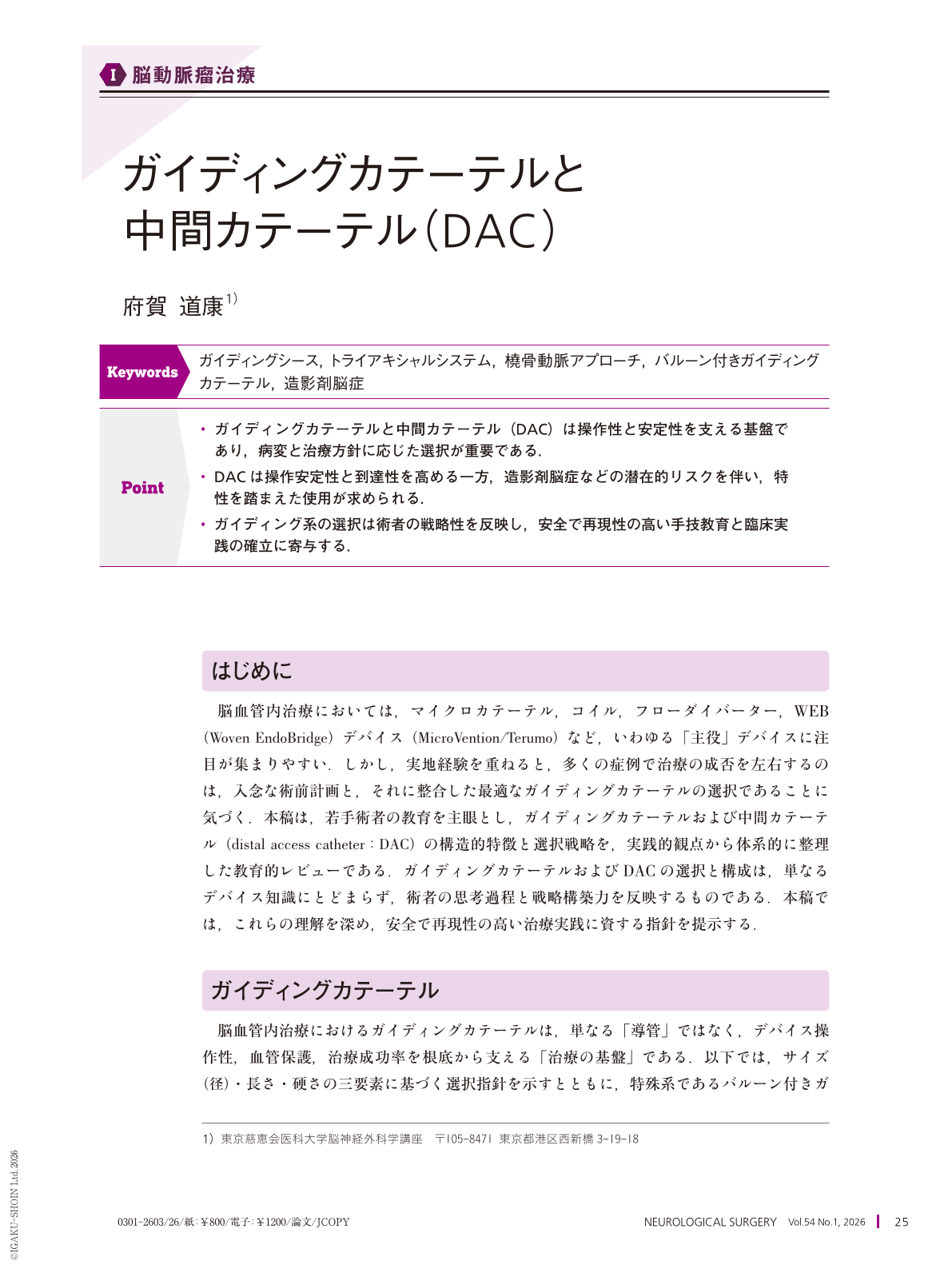
・ガイディングカテーテルと中間カテーテル(DAC)は操作性と安定性を支える基盤であり,病変と治療方針に応じた選択が重要である.
・DACは操作安定性と到達性を高める一方,造影剤脳症などの潜在的リスクを伴い,特性を踏まえた使用が求められる.
・ガイディング系の選択は術者の戦略性を反映し,安全で再現性の高い手技教育と臨床実践の確立に寄与する.
Guiding and distal access catheters (DACs) play a fundamental yet often underrecognized role in neuroendovascular therapy by supporting device maneuverability, procedural stability, and vascular protection. Although attention frequently centers on microcatheters, coils, and flow diverters, procedural success depends on guiding system configuration and meticulous preoperative planning. This review summarizes structural characteristics and selection principles of guiding catheters and DAC from both practical and educational perspectives. Three factors—size, length, and stiffness—determine guiding catheter stability, navigability, and vascular safety. A rational selection process tailored to the vascular anatomy and treatment strategy was outlined, including the use of balloon-guiding catheters for proximal flow control and guiding sheaths that allow sheathless operation while reducing puncture-site complications. This section on DACs highlights their role in overcoming vessel tortuosity, improving distal support, and enhancing microcatheter control and reproducibility. Advances in thin-wall construction and graded flexibility have improved distal reach while preserving support, although potential risks, such as contrast-induced encephalopathy and vessel injury, warrant caution. Ultimately, selection of the optimal guiding system reflects not only technical preference but also procedural strategy and clinical judgment. Systematizing these principles transforms individual experiences into structured, teachable knowledge and promotes safer and more reproducible neuroendovascular practices.
Copyright © 2026, Igaku-Shoin Ltd. All rights reserved.