Japanese
English
- 有料閲覧
- Abstract 文献概要
- 1ページ目 Look Inside
- 参考文献 Reference
Point
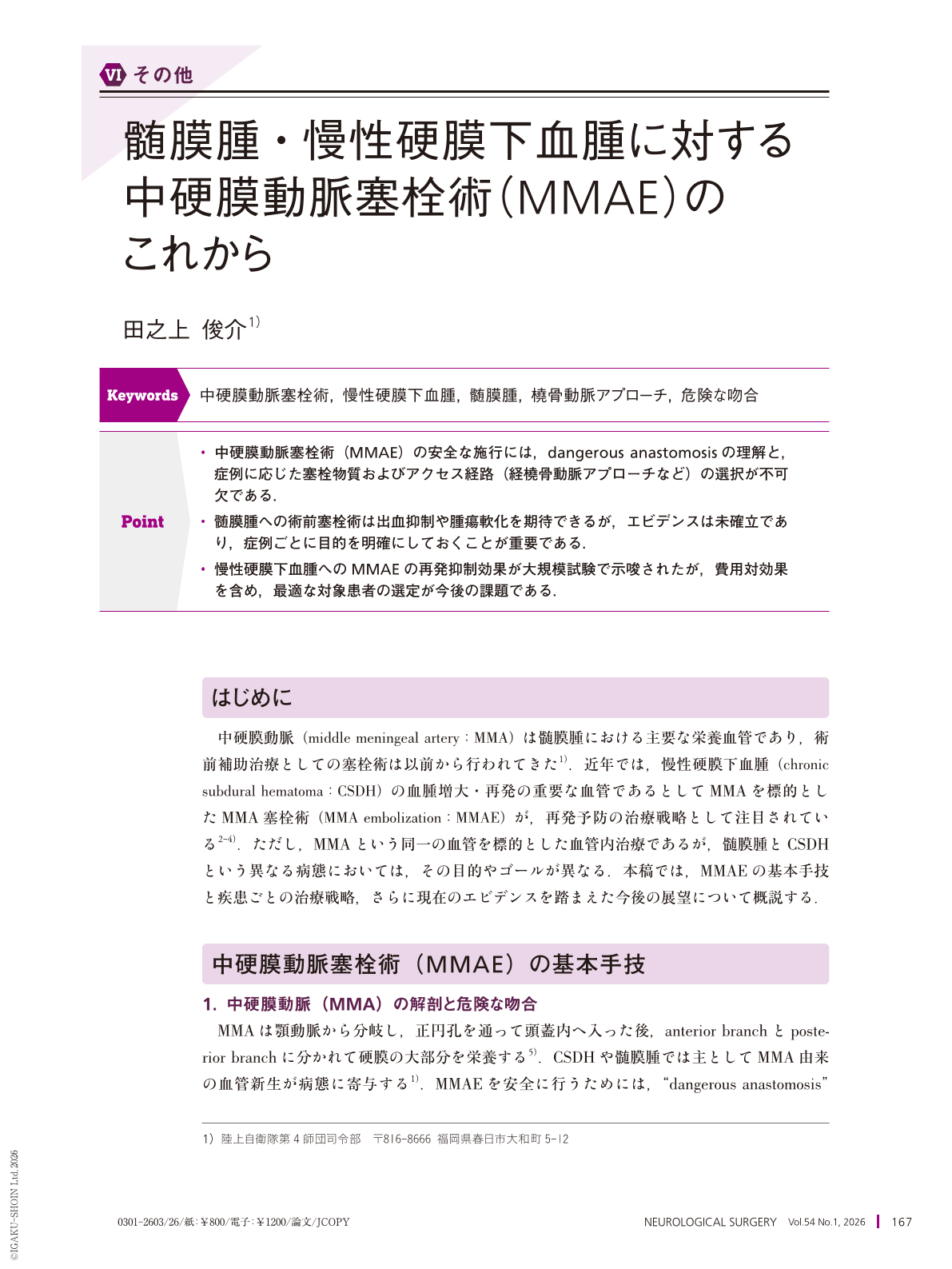
・中硬膜動脈塞栓術(MMAE)の安全な施行には,dangerous anastomosisの理解と,症例に応じた塞栓物質およびアクセス経路(経橈骨動脈アプローチなど)の選択が不可欠である.
・髄膜腫への術前塞栓術は出血抑制や腫瘍軟化を期待できるが,エビデンスは未確立であり,症例ごとに目的を明確にしておくことが重要である.
・慢性硬膜下血腫へのMMAEの再発抑制効果が大規模試験で示唆されたが,費用対効果を含め,最適な対象患者の選定が今後の課題である.
Middle meningeal artery embolization (MMAE) has emerged as an important endovascular intervention, though its applications differs between meningiomas and chronic subdural hematomas (CSDH). For meningiomas, MMAE serves as a preoperative adjunct aimed at tumor devascularization and softening to facilitate resection. However, given conflicting evidence regarding its ability to reduce blood loss, careful case selection based on tumor characteristics is essential. Conversely, for CSDH, MMAE targets the inhibition of membrane neovascularization to prevent hematoma recurrence. Recent randomized controlled trials have demonstrated its efficacy as an adjunct to standard treatment, while its role as a standalone treatment continues to show promise.
Technical safety relies on a thorough understanding of “dangerous anastomoses” to prevent complications. Furthermore, the transradial approach is highlighted as a viable access route, offering reduced puncture-site complications, particularly for the elderly demographic common to these conditions. This article reviews the current evidence, technical considerations, and future perspectives of MMAE, emphasizing that optimized patient selection is paramount for maximizing therapeutic benefit in both conditions.
Copyright © 2026, Igaku-Shoin Ltd. All rights reserved.