Japanese
English
- 有料閲覧
PPV購入案内
1,650円 (1,500円+税10%) こちらは、203ページから211ページの文献です。購入には医書.jp本会員登録が必要です。
会員登録完了後に改めて上記「購入サイトへ」を選択してください。
または「購入サイトへ」選択後に「購入ログイン」、「新規会員登録」の順に進んでください。
会員登録について詳しくはをご確認ください。
- Abstract 文献概要
- 1ページ目 Look Inside
- 参考文献 Reference
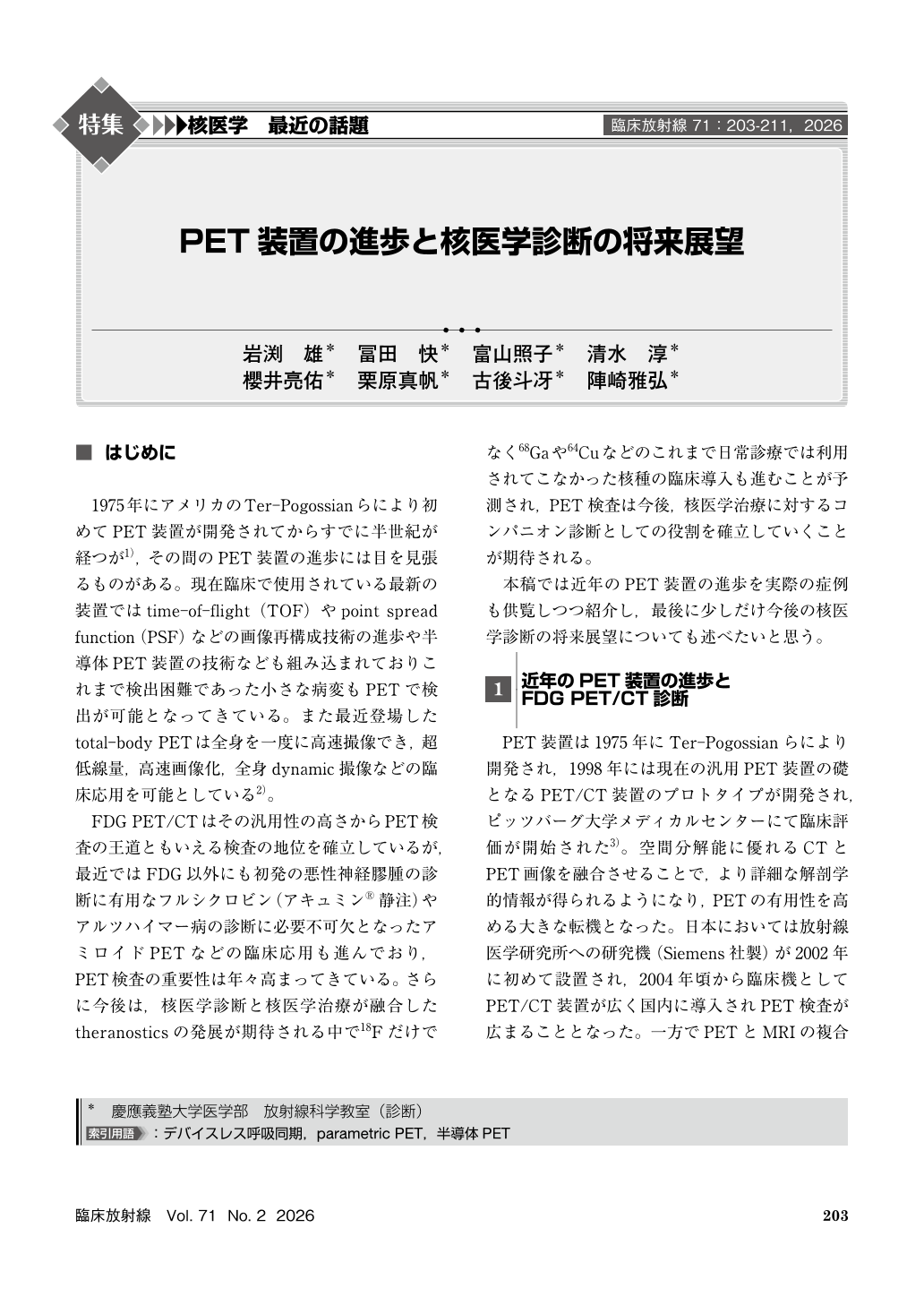
1975年にアメリカのTer-Pogossianらにより初めてPET装置が開発されてからすでに半世紀が経つが1),その間のPET装置の進歩には目を見張るものがある。現在臨床で使用されている最新の装置ではtime-of-flight(TOF)やpoint spread function(PSF)などの画像再構成技術の進歩や半導体PET装置の技術なども組み込まれておりこれまで検出困難であった小さな病変もPETで検出が可能となってきている。また最近登場したtotal-body PETは全身を一度に高速撮像でき,超低線量,高速画像化,全身dynamic撮像などの臨床応用を可能としている2)。
Recent advancements in PET imaging technology are remarkable. Image reconstruction methods, such as time-of-flight(TOF)and point spread function(PSF), enable the detection of smaller lesions. The latest respiratory gating systems, which use device-free technology, contribute to improved examination throughput. The introduction of parametric PET has made it possible to obtain more detailed data on glucose metabolism dynamics. Additionally, digital PET enable short-scan imaging and high spatial resolution. These numerous technological innovations are now being applied in clinical practice. Going forward, such PET technologies are expected to be useful for the application of new diagnostic radionuclides such as 89Zr and 64Cu, and their potential applications in immuno-PET are also garnering attention.
Copyright © 2026, KANEHARA SHUPPAN Co.LTD. All rights reserved.