Japanese
English
- 有料閲覧
PPV購入案内
1,650円 (1,500円+税10%) こちらは、757ページから764ページの文献です。購入には医書.jp本会員登録が必要です。
会員登録完了後に改めて上記「購入サイトへ」を選択してください。
または「購入サイトへ」選択後に「購入ログイン」、「新規会員登録」の順に進んでください。
会員登録について詳しくはをご確認ください。
- Abstract 文献概要
- 1ページ目 Look Inside
- 参考文献 Reference
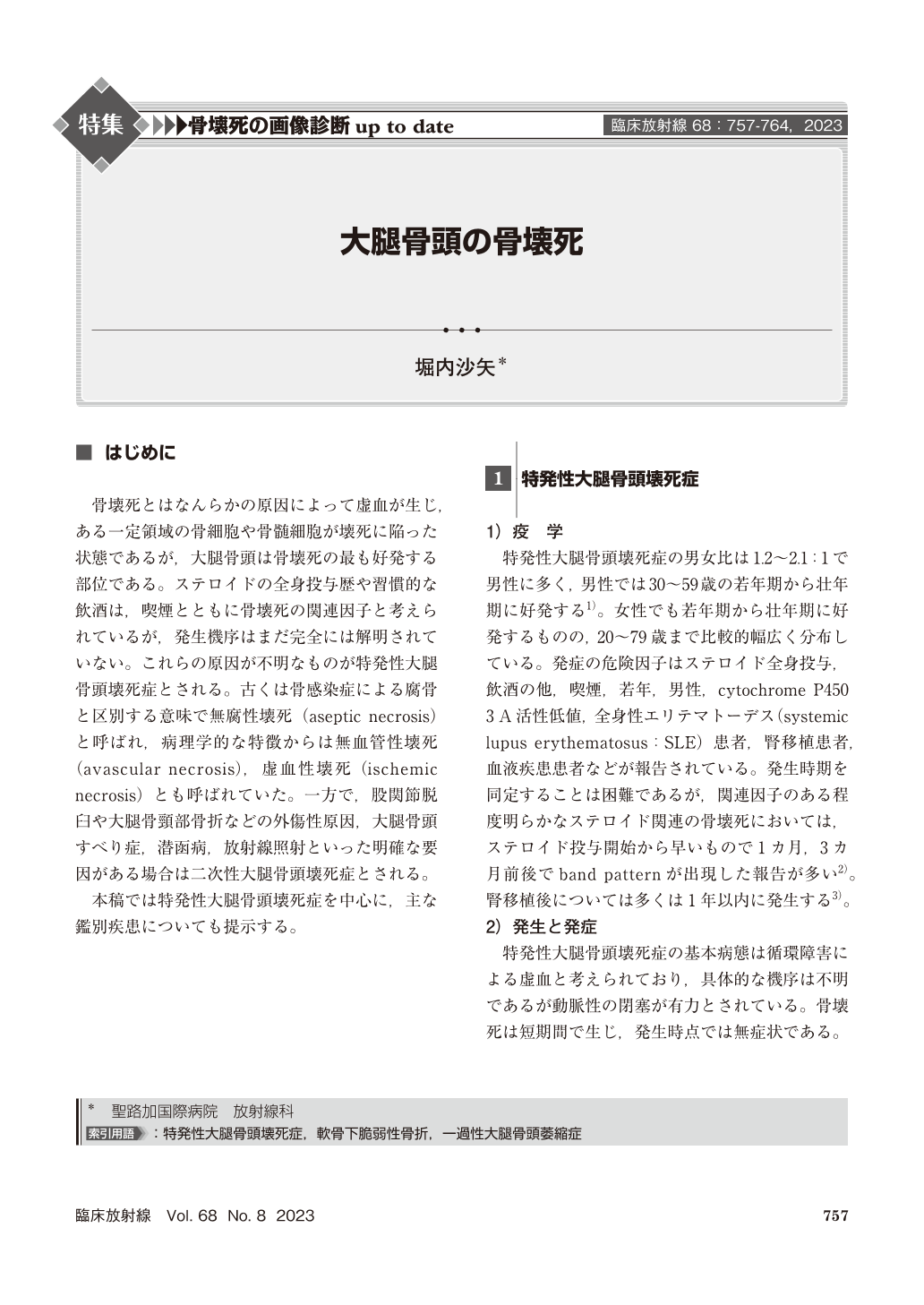
骨壊死とはなんらかの原因によって虚血が生じ,ある一定領域の骨細胞や骨髄細胞が壊死に陥った状態であるが,大腿骨頭は骨壊死の最も好発する部位である。ステロイドの全身投与歴や習慣的な飲酒は,喫煙とともに骨壊死の関連因子と考えられているが,発生機序はまだ完全には解明されていない。これらの原因が不明なものが特発性大腿骨頭壊死症とされる。古くは骨感染症による腐骨と区別する意味で無腐性壊死(aseptic necrosis)と呼ばれ,病理学的な特徴からは無血管性壊死(avascular necrosis),虚血性壊死(ischemic necrosis)とも呼ばれていた。一方で,股関節脱臼や大腿骨頸部骨折などの外傷性原因,大腿骨頭すべり症,潜函病,放射線照射といった明確な要因がある場合は二次性大腿骨頭壊死症とされる。
Osteonecrosis most commonly affects the femoral head. The condition is labeled “idiopathic” when the cause is unknown. Risk factors associated with the disease include chronic steroid use, alcohol abuse, and certain medical conditions, such as lupus. MRI is highly sensitive and is often the preferred method for early detection. A key indicator of osteonecrosis, the “double-line sign,” appears on T2-weighted images as two distinct lines:a bright inner line and a dark outer line. Insufficiency fracture of the femoral head is one of the most important differential diagnoses for femoral head osteonecrosis.
Copyright © 2023, KANEHARA SHUPPAN Co.LTD. All rights reserved.