Japanese
English
- 有料閲覧
PPV購入案内
1,320円 (1,200円+税10%) こちらは、306ページから314ページの文献です。購入には医書.jp本会員登録が必要です。
会員登録完了後に改めて上記「購入サイトへ」を選択してください。
または「購入サイトへ」選択後に「購入ログイン」、「新規会員登録」の順に進んでください。
会員登録について詳しくはをご確認ください。
- Abstract 文献概要
- 1ページ目 Look Inside
- 参考文献 Reference
- サイト内被引用 Cited by
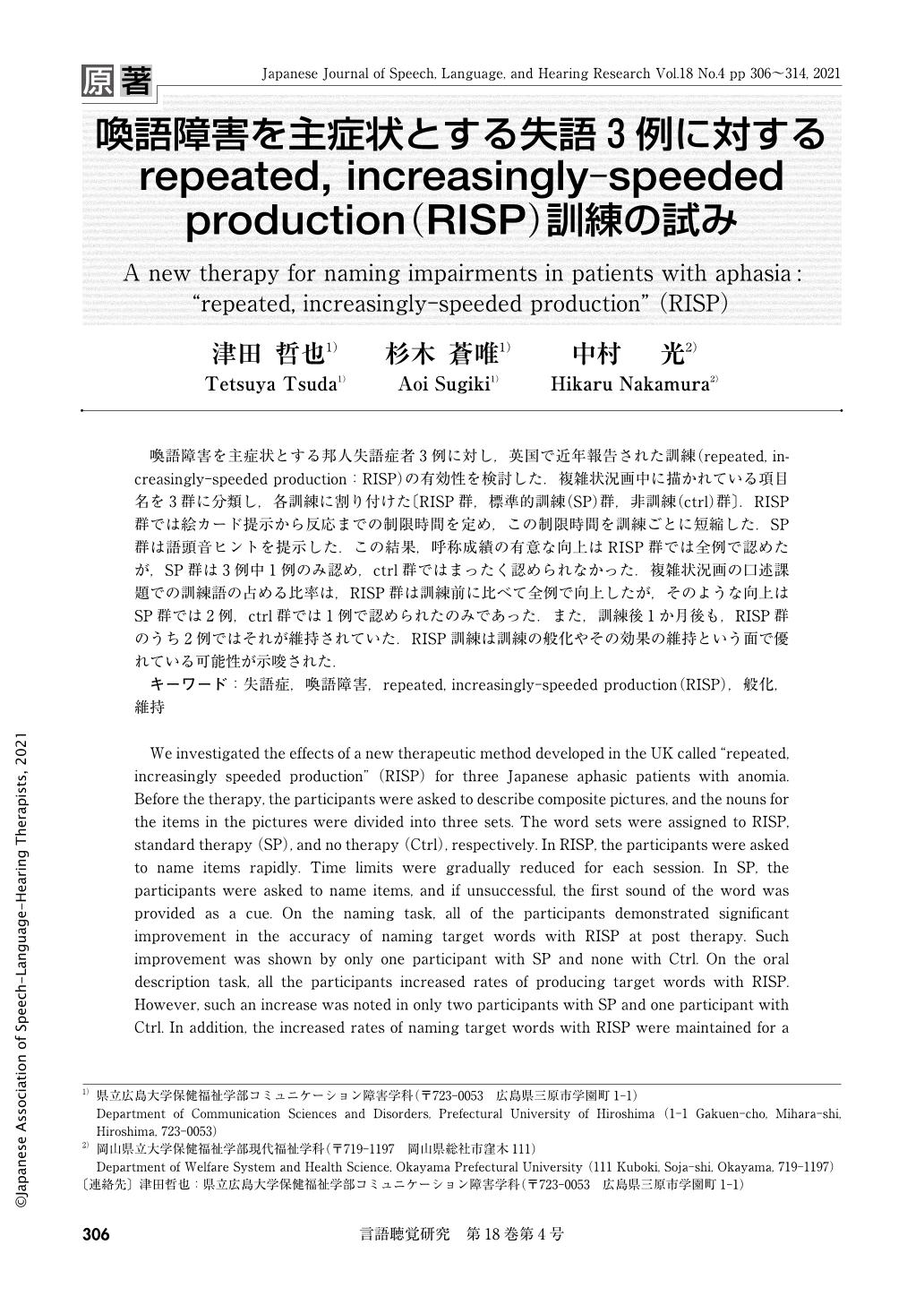
喚語障害を主症状とする邦人失語症者3例に対し,英国で近年報告された訓練(repeated, increasingly-speeded production:RISP)の有効性を検討した.複雑状況画中に描かれている項目名を3群に分類し,各訓練に割り付けた〔RISP群,標準的訓練(SP)群,非訓練(ctrl)群〕.RISP群では絵カード提示から反応までの制限時間を定め,この制限時間を訓練ごとに短縮した.SP群は語頭音ヒントを提示した.この結果,呼称成績の有意な向上はRISP群では全例で認めたが,SP群は3例中1例のみ認め,ctrl群ではまったく認められなかった.複雑状況画の口述課題での訓練語の占める比率は,RISP群は訓練前に比べて全例で向上したが,そのような向上はSP群では2例,ctrl群では1例で認められたのみであった.また,訓練後1か月後も,RISP群のうち2例ではそれが維持されていた.RISP訓練は訓練の般化やその効果の維持という面で優れている可能性が示唆された.
We investigated the effects of a new therapeutic method developed in the UK called “repeated, increasingly speeded production” (RISP) for three Japanese aphasic patients with anomia. Before the therapy, the participants were asked to describe composite pictures, and the nouns for the items in the pictures were divided into three sets. The word sets were assigned to RISP, standard therapy (SP), and no therapy (Ctrl), respectively. In RISP, the participants were asked to name items rapidly. Time limits were gradually reduced for each session. In SP, the participants were asked to name items, and if unsuccessful, the first sound of the word was provided as a cue. On the naming task, all of the participants demonstrated significant improvement in the accuracy of naming target words with RISP at post therapy. Such improvement was shown by only one participant with SP and none with Ctrl. On the oral description task, all the participants increased rates of producing target words with RISP. However, such an increase was noted in only two participants with SP and one participant with Ctrl. In addition, the increased rates of naming target words with RISP were maintained for a month in two of the three participants. Our results show that RISP may be an excellent therapeutic method for word retrieval in patients with aphasia, with the effects being not only generalized across tasks but also maintained over time.
Copyright © 2021, Japanese Association of Speech-Language-Hearing Therapists. All rights reserved.