Japanese
English
- 有料閲覧
PPV購入案内
1,320円 (1,200円+税10%) こちらは、321ページから328ページの文献です。購入には医書.jp本会員登録が必要です。
会員登録完了後に改めて上記「購入サイトへ」を選択してください。
または「購入サイトへ」選択後に「購入ログイン」、「新規会員登録」の順に進んでください。
会員登録について詳しくはをご確認ください。
- Abstract 文献概要
- 1ページ目 Look Inside
- 参考文献 Reference
- サイト内被引用 Cited by
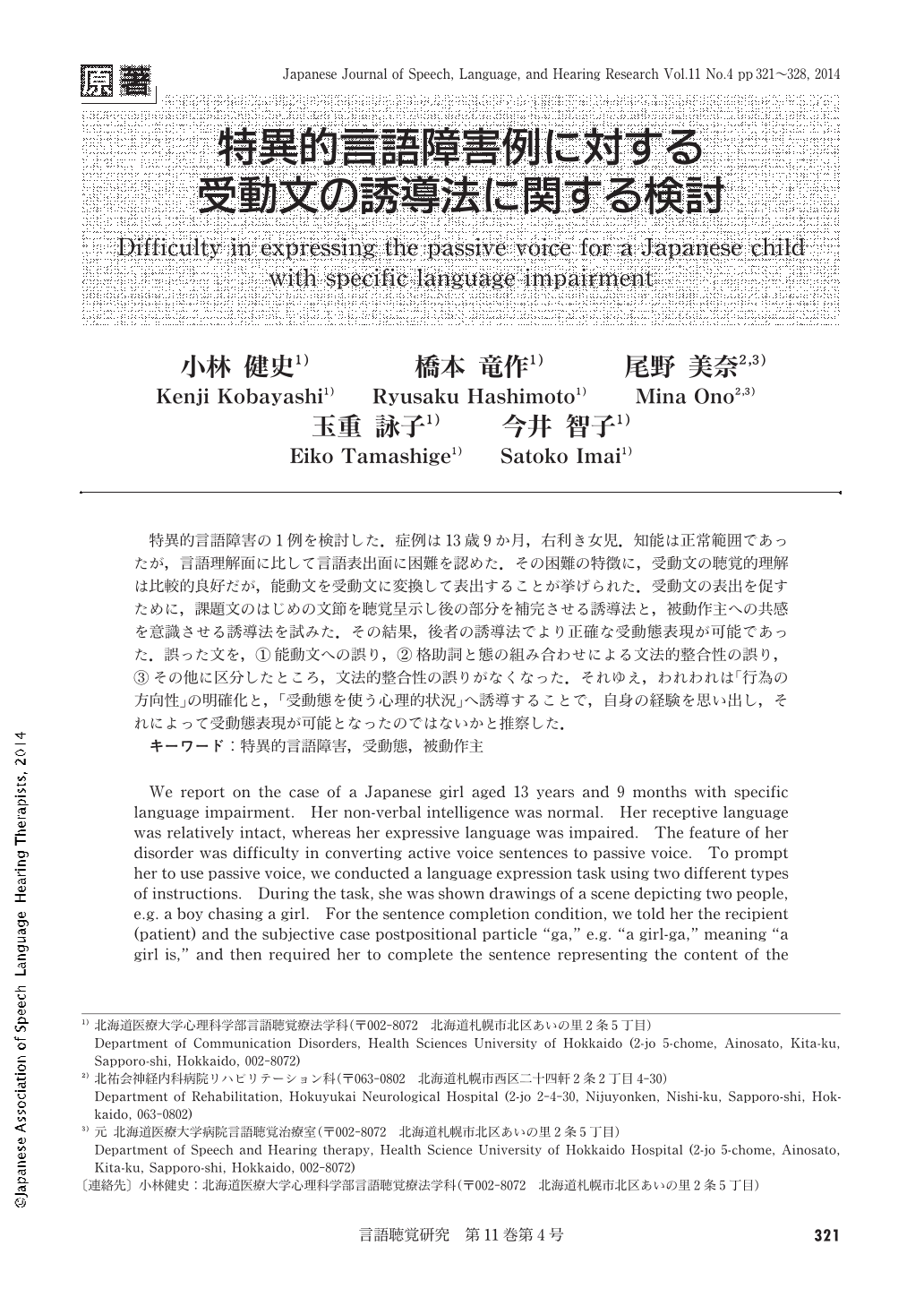
特異的言語障害の1例を検討した.症例は13歳9か月,右利き女児.知能は正常範囲であったが,言語理解面に比して言語表出面に困難を認めた.その困難の特徴に,受動文の聴覚的理解は比較的良好だが,能動文を受動文に変換して表出することが挙げられた.受動文の表出を促すために,課題文のはじめの文節を聴覚呈示し後の部分を補完させる誘導法と,被動作主への共感を意識させる誘導法を試みた.その結果,後者の誘導法でより正確な受動態表現が可能であった.誤った文を,①能動文への誤り,②格助詞と態の組み合わせによる文法的整合性の誤り,③その他に区分したところ,文法的整合性の誤りがなくなった.それゆえ,われわれは「行為の方向性」の明確化と,「受動態を使う心理的状況」へ誘導することで,自身の経験を思い出し,それによって受動態表現が可能となったのではないかと推察した.
We report on the case of a Japanese girl aged 13 years and 9 months with specific language impairment. Her non-verbal intelligence was normal. Her receptive language was relatively intact, whereas her expressive language was impaired. The feature of her disorder was difficulty in converting active voice sentences to passive voice. To prompt her to use passive voice, we conducted a language expression task using two different types of instructions. During the task, she was shown drawings of a scene depicting two people, e.g. a boy chasing a girl. For the sentence completion condition, we told her the recipient (patient) and the subjective case postpositional particle "ga," e.g. "a girl-ga," meaning "a girl is," and then required her to complete the sentence representing the content of the drawing. For the empathy condition, we encouraged her to be aware of the recipient's feeling:"please first imagine the recipient's point of view and then describe the drawing." The percentage of correct responses was significantly higher in the empathy condition (76.5%) than that in the sentence completion condition (52.9%). We speculated that the instructions in the empathy condition helped her to clarify the direction of the action between the two people. Furthermore, the use of this strategy encouraged her to use the passive voice by evoking past personal memories similar to those depicted in the drawings.
Copyright © 2014, Japanese Association of Speech-Language-Hearing Therapists. All rights reserved.