Japanese
English
- 有料閲覧
PPV購入案内
1,320円 (1,200円+税10%) こちらは、171ページから183ページの文献です。購入には医書.jp本会員登録が必要です。
会員登録完了後に改めて上記「購入サイトへ」を選択してください。
または「購入サイトへ」選択後に「購入ログイン」、「新規会員登録」の順に進んでください。
会員登録について詳しくはをご確認ください。
- Abstract 文献概要
- 1ページ目 Look Inside
- 参考文献 Reference
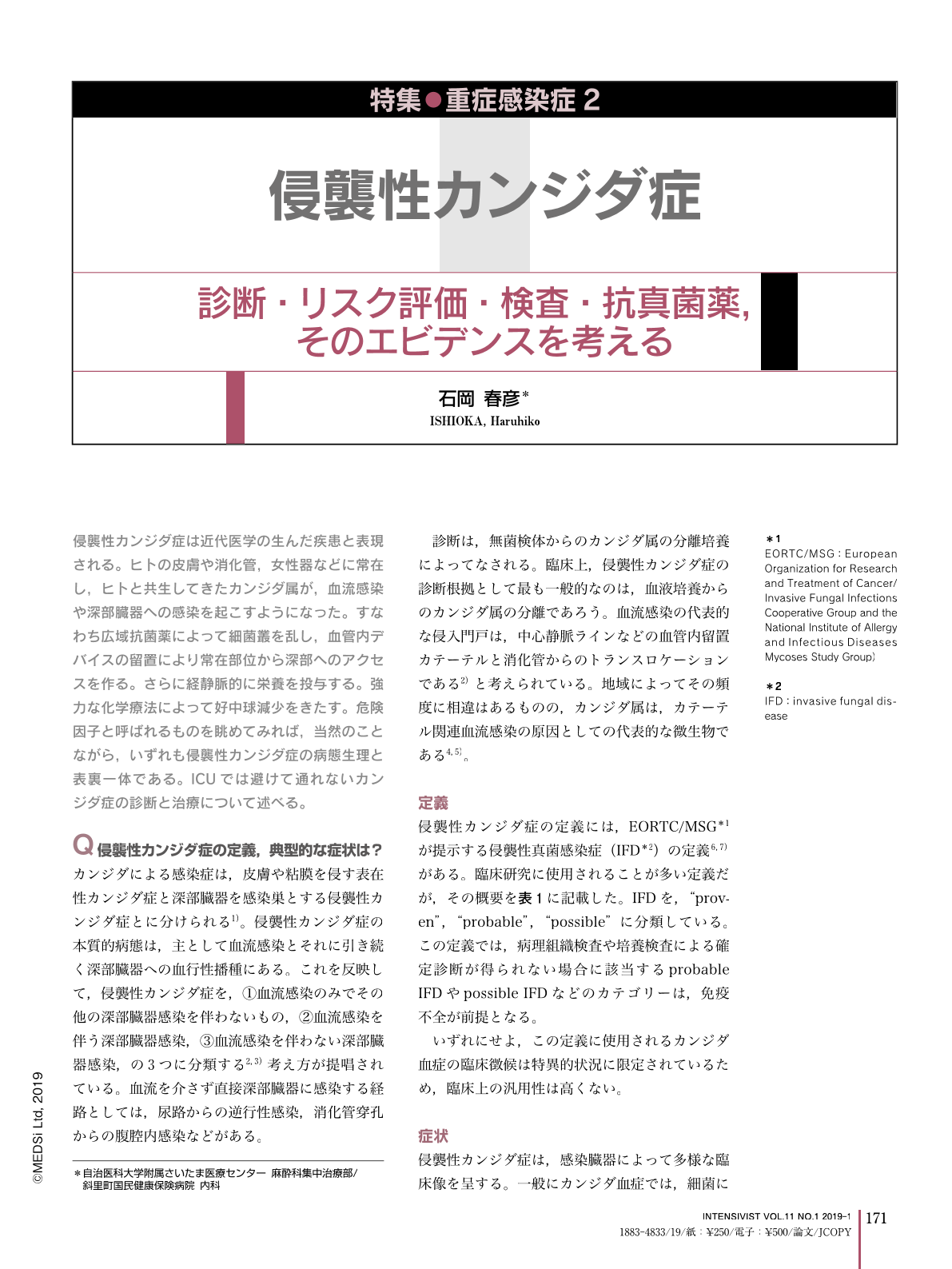
侵襲性カンジダ症は近代医学の生んだ疾患と表現される。ヒトの皮膚や消化管,女性器などに常在し,ヒトと共生してきたカンジダ属が,血流感染や深部臓器への感染を起こすようになった。すなわち広域抗菌薬によって細菌叢を乱し,血管内デバイスの留置により常在部位から深部へのアクセスを作る。さらに経静脈的に栄養を投与する。強力な化学療法によって好中球減少をきたす。危険因子と呼ばれるものを眺めてみれば,当然のことながら,いずれも侵襲性カンジダ症の病態生理と表裏一体である。ICUでは避けて通れないカンジダ症の診断と治療について述べる。
The essential pathophysiology of invasive candidiasis is a blood stream infection and subsequent hematogenous dissemination to deep organs, while direct inoculation of organisms to a sterile site is also responsible for deep-seated infections. Early diagnosis and initiation of treatment are important to improve the outcomes of a patient with invasive candidiasis. Blood cultures are limited by low sensitivity at about 50% and a long interval to positivity, needing 2-5 days of incubation. Scoring systems based on known risk factors and non-culture diagnostics might help identify a high-risk patient who would benefit from empiric antifungal therapy. Fluconazole resistance is still uncommon among Candida albicans isolates, although the proportion of candidemia caused by non-albicans species has been increasing. Based on the epidemiological data and the evidence from clinical trials, an echinocandin is currently recommended as initial therapy for patients with invasive candidiasis both in non-neutropenic and neutropenic patients. Step-down therapy to oral azole in clinically stable patients is a reasonable strategy and has become common practice.
Copyright © 2019, MEDICAL SCIENCES INTERNATIONAL, LTD. All rights reserved.