Japanese
English
- 有料閲覧
PPV購入案内
1,320円 (1,200円+税10%) こちらは、233ページから240ページの文献です。購入には医書.jp本会員登録が必要です。
会員登録完了後に改めて上記「購入サイトへ」を選択してください。
または「購入サイトへ」選択後に「購入ログイン」、「新規会員登録」の順に進んでください。
会員登録について詳しくはをご確認ください。
- Abstract 文献概要
- 1ページ目 Look Inside
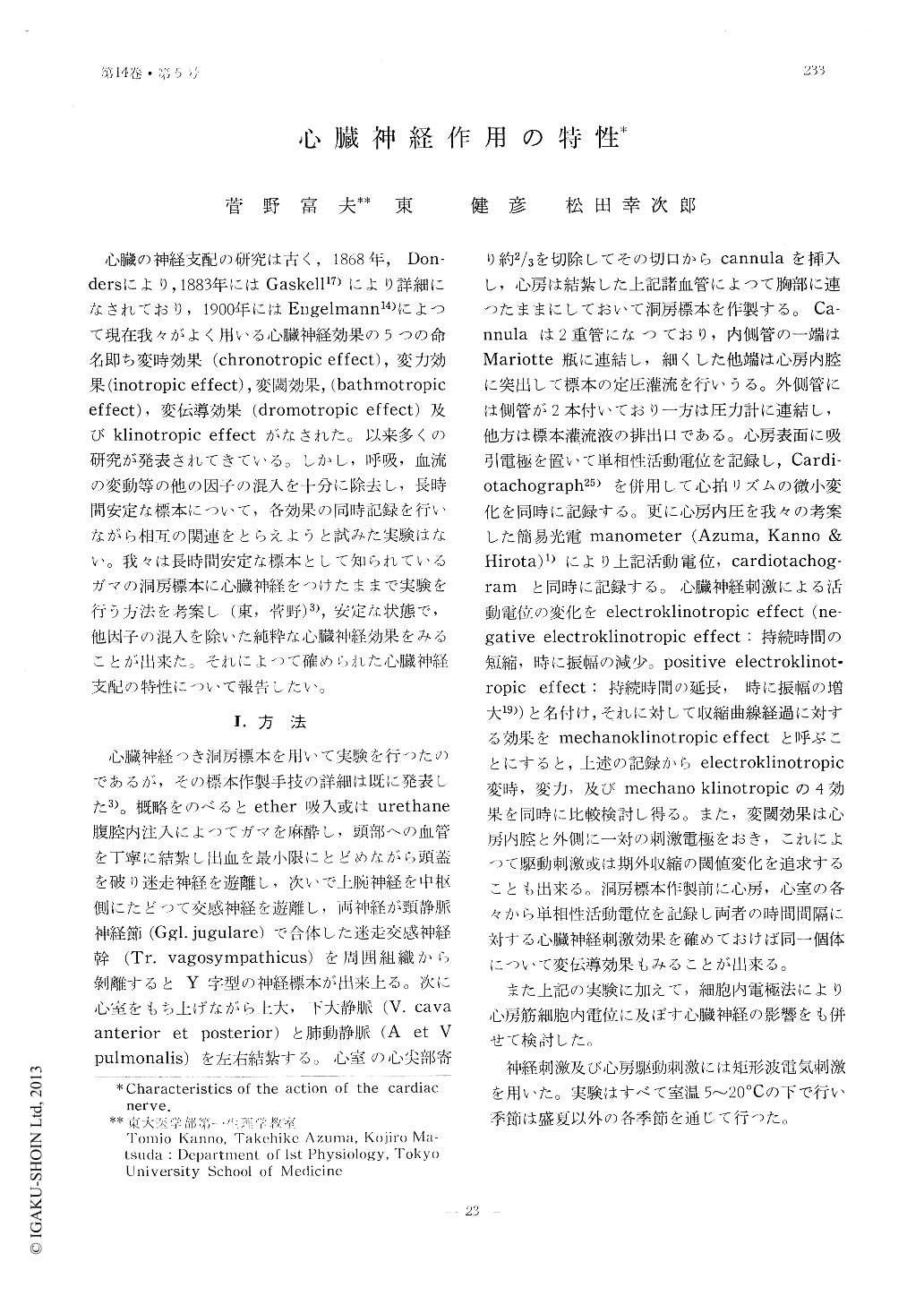
ガマ,心臓神経つき洞房標本を用いて心臓神経作用の基本的特性を調べた。
(1)心臓神経の6つの効果を発現し易さの順に並べると,一般に(i)electroklinotropic(活動電位の形に対する効果),(ii)mechanoklinotropic,(iii)変時或は変力(標本によりいづれかが優位),(iv)変閾,(V)変伝導となる。
(2)迷走神経単一刺激によつて(i)〜(iv)までの効果が発現し,持続時間0.01msecという短いpulse刺激でも十分に有効であつた,しかし単一刺激効果はせいぜい数拍動で消失した。交感神経単一刺激によつて(i)〜(iii)の効果が認められたが,刺激pulseの持続時間は0.1msec或はそれ以上で効果が表われた。単一刺激によつて時には数分に及ぶ著しい促進効果がみられた。
(3)迷走神経単一刺激は,刺激時点によつて効果発現の程度が異り,変時作用については静脈洞の興奮よりも約1.7秒前に心臓神経に単一刺激を与えた時に効果は最大となる。
(4)ガマ心臓神経効果については左右差を一般的に特徴づけることは出来なかつた。
(5)刺激頻度と効果との関係について調べるとどの効果についても,交感神経,迷走神経共に20/sec付近で最大効果を表わした。
(6)心臓神経を長時間頻数刺激し続けたり液素性物質を長く作用させておくと,心房刺激の閾値に対する効果が次第に逆転する。迷走神経刺激,acetylcholine投与で始め閾値上昇後下降,交感神経刺激,adrenaline投与で逆の経過をとつた。
(7)心房に強い直接刺激を与えるとnegative electroklinotropic,negative mechanoklinotropic,陰性変力,陰性変時,陰性変閾効果が現れた。
以上の結果について考察を行つた。
Nervous control of cardiac activity was investigated precisely on the perfused sino-atrial preparation of toad. Results obtained were summerized as follows:
1) Effects of cardiac nerve stimulation could be classified into six:
(1) electroklinotropic (changes in the shape of action potential, especially in its rate of repolarization), (2) mechanoklinotropic, (3) chronotropic, (4) inotropic, (5) bathmotropic and (6) dromotropic. Usually, the electroklinotropic effect was produced by the weakest stimulation. As the strength of the stimulation was increased progressively, remaining five effects were produced in the order described above.
2) All the effects except the dromotropic could be brought about by a single supramaximal vagal shoch of 0.01 msec in duration and they disappeared within a few seconds. A single supramaximal sympathetic shoch could produced the electroklinotropic, mechanoklinotropic, chronotropic and inotropic effects only when its duration was more than 0.1 msec. These effects continued for several minutes after stimulation.
3) The negative chronotropic effect brought about by a single vagal shock varied to the time at which the nerve is stimulated. It became maximum by applying the stimulation 1.7 sec prior to the succeeding sinus excitation.
4) No differences could be observed between the actions of the right and left cardiac nerve of toad.
5) Effects of vagal and sympathetic stimulation were dependent upon the frequency of stimulating current. Both of them became maximum at the frequency of 20/sec.
6) Reversal of bathmotropic effect was observed in the course of long lasting vagal and sympathetic stimulation.
7) Direct strong stimulation of the atral muscle produced vagus-like effects, i.e. negative electro-klinotropic, mechanoklinotropic, inotropic, chronotropic and bathmotropic effect.
Copyright © 1963, THE ICHIRO KANEHARA FOUNDATION. All rights reserved.