Japanese
English
- 有料閲覧
PPV購入案内
1,320円 (1,200円+税10%) こちらは、529ページから535ページの文献です。購入には医書.jp本会員登録が必要です。
会員登録完了後に改めて上記「購入サイトへ」を選択してください。
または「購入サイトへ」選択後に「購入ログイン」、「新規会員登録」の順に進んでください。
会員登録について詳しくはをご確認ください。
- Abstract 文献概要
- 1ページ目 Look Inside
I.はじめに
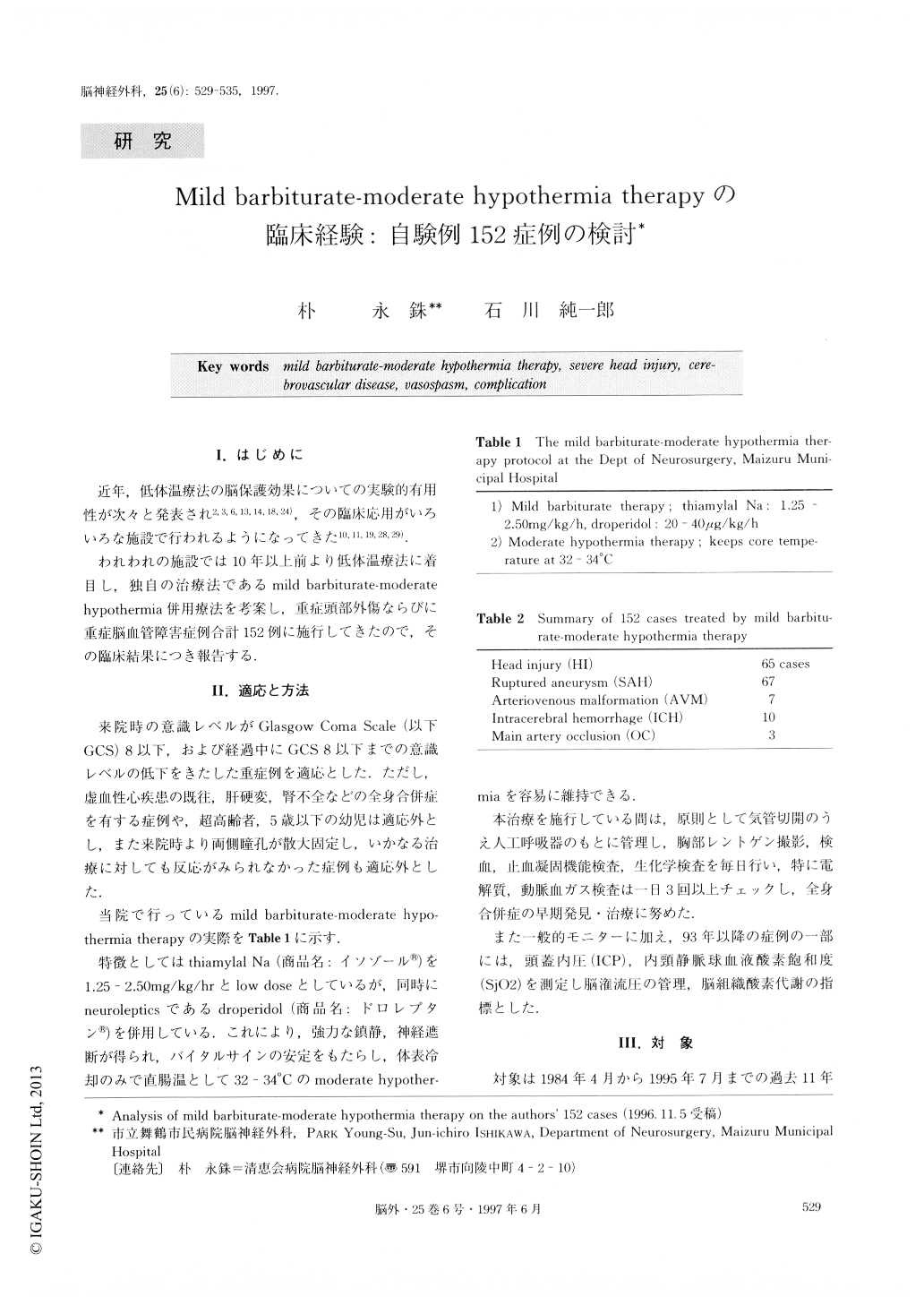
近年,低体温療法の脳保護効果についての実験的有用性が次々と発表され2,3,6,13,14,18,24),その臨床応用がいろいろな施設で行われるようになってきた10,11,19,28,29).
われわれの施設では10年以上前より低体温療法に着目し,独自の治療法であるmild barbiturate-moderate hypothermia併用療法を考案し,重症頭部外傷ならびに重症脳血管障害症例合計152例に施行してきたので,その臨床結果につき報告する.
Mild barbiturate-moderate hypothermia therapy was established for severe head injury and cerebrovascular disease. This study was conducted on 152 patients from April 1984 through July 1995. In this study were in-cluded patients with Glagow Coma Scale score of less than 8 points but those with serious systemic complica-tions and elderly and infantile patients were excluded. Our protocol consisted of administration of thiamylal Na 1.25-2.5mg/kg/h and droperidol 20-40μg/kg/h (mild barbiturate) while maintaining a core tempmera-ture of 32-34℃ (moderate hypothermia). The clinical outcome was good (GR, MD) in 58 cases, poor (SD) in 24 cases and bad (PVS, D) in 70 cases. This therapy was found to be particularly effective for preventing ischemic neurological damage in the vasospasm stage following SAH and severe head injury in young pa-tients.
However, this therapy did not prevent pneumonia, cardiac failure, arrhythmia and hypopotassemia from occurring frequently. We conclude that this therapy is contraindicated in the elderly, i. e, those older than 65 years.
Copyright © 1997, Igaku-Shoin Ltd. All rights reserved.