Japanese
English
- 有料閲覧
PPV購入案内
1,320円 (1,200円+税10%) こちらは、787ページから791ページの文献です。購入には医書.jp本会員登録が必要です。
会員登録完了後に改めて上記「購入サイトへ」を選択してください。
または「購入サイトへ」選択後に「購入ログイン」、「新規会員登録」の順に進んでください。
会員登録について詳しくはをご確認ください。
- Abstract 文献概要
- 1ページ目 Look Inside
I.はじめに
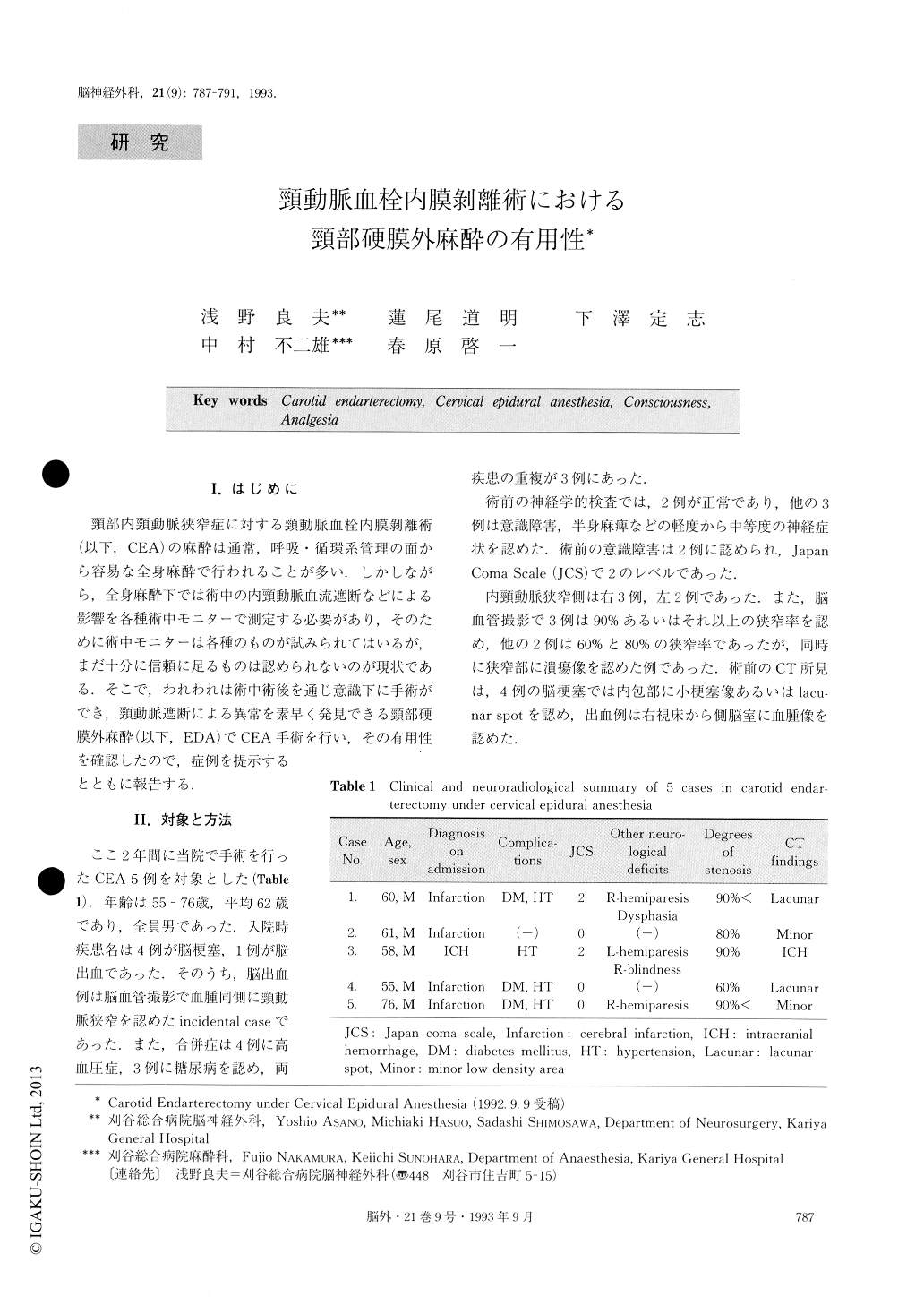
頸部内頸動脈狭窄症に対する頸動脈血栓内膜剥離術(以下,CEA)の麻酔は通常,呼吸・循環系管理の面から容易な全身麻酔で行われることが多い.しかしながら,全身麻酔下では術中の内頸動脈血流遮断などによる影響を各種術中モニターで測定する必要があり,そのために術中モニターは各種のものが試みられてはいるが,まだ十分に信頼に足るものは認められないのが現状である.そこで,われわれは術中術後を通じ意識下に手術ができ,頸動脈遮断による異常を素早く発見できる頸部硬膜外麻酔(以下,EDA)でCEA手術を行い,その有用性を確認したので,症例を提示するとともに報告する.
General anesthesia for carotid endarterectomy (CEA) imposes the need for various monitorings of cerebral function during occlusion of the carotid artery. However, there is no ideal method for detecting all the signs of cerebrovascular insufficiency under general anesthesia.We suggest that the patient's neurological state is the best monitor of cerebral function.
Therefore, our patients underwent cervical epidural anesthesia (EDA) enabling them to remain conscious while experiencing analgesia of the operated areas throughout the course of the operation.
Five patients with cervical internal carotid artery stenosis were operated on under EDA with lidocaine. In all patients, EDA was effective in maintaining an analgesic state in the areas being operated on. It was able to do this either alone, or in combination with a light sedation. Under EDA, although there was no complete suppression of the patient's respiration, blood pressure was elevated beyond 200mmHg in three patients and depressedto 70mmHg in one patient trasiently during the operation. But control of abnormal blood pressure was achieved easily by injections of calcium antagonist or ephedrine. When consciousness of two patients deteriorated during the clamping of the internal carotid artery, it completely recovered to its preoperative level after the insertion of an internal shunt. The patient's level of neurological condition became a good guide for predicting the need for an internal shunt during the periods of occlusion of the internal carotid artery.
In conclusion, we suggest that EDA which is a safe and usefull anesthesia should be employed in many patients who undergo CEA.
Copyright © 1993, Igaku-Shoin Ltd. All rights reserved.