Japanese
English
- 有料閲覧
PPV購入案内
1,320円 (1,200円+税10%) こちらは、398ページから407ページの文献です。購入には医書.jp本会員登録が必要です。
会員登録完了後に改めて上記「購入サイトへ」を選択してください。
または「購入サイトへ」選択後に「購入ログイン」、「新規会員登録」の順に進んでください。
会員登録について詳しくはをご確認ください。
- Abstract 文献概要
- 1ページ目 Look Inside
- 参考文献 Reference
Point
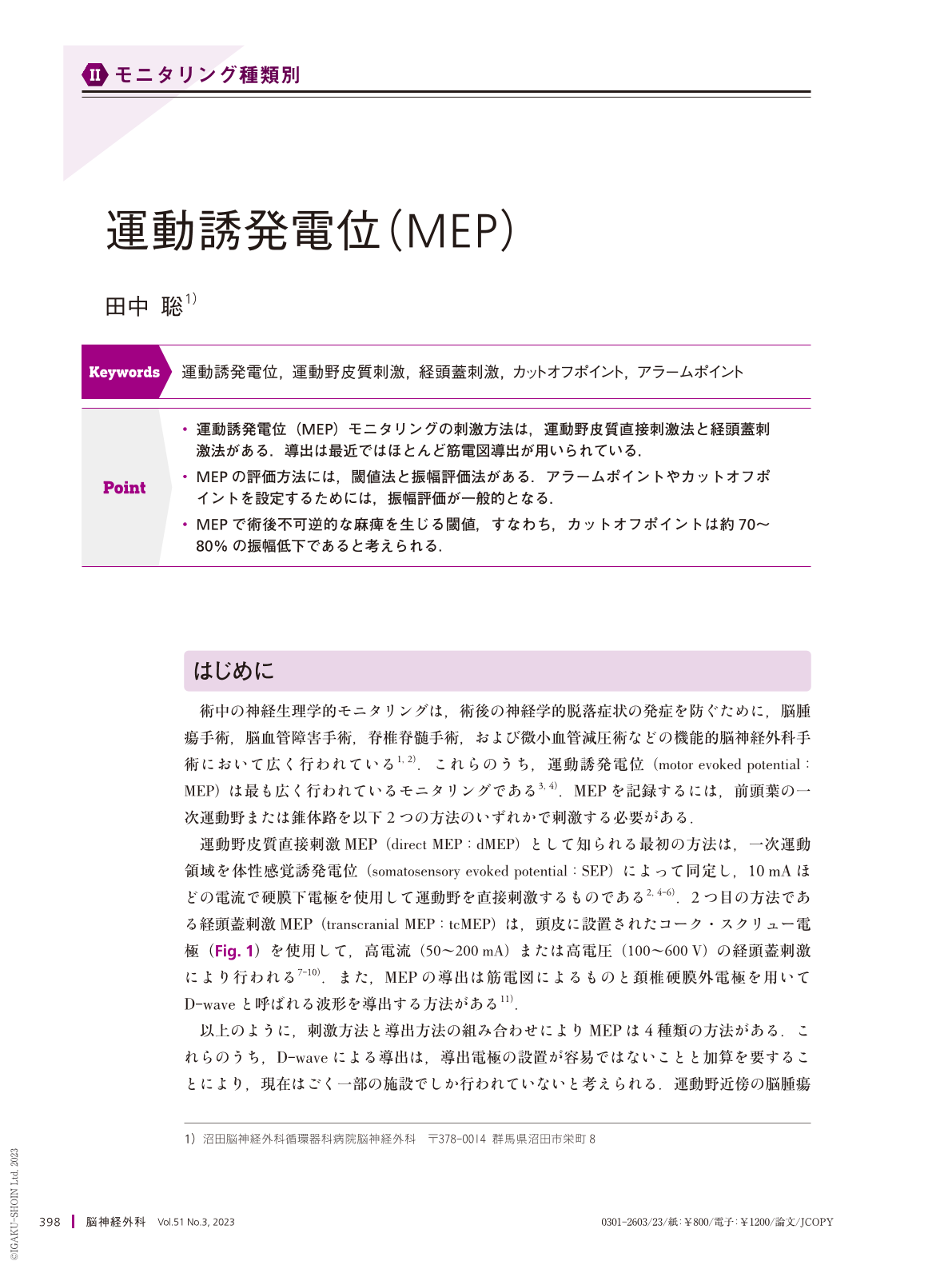
・運動誘発電位(MEP)モニタリングの刺激方法は,運動野皮質直接刺激法と経頭蓋刺激法がある.導出は最近ではほとんど筋電図導出が用いられている.
・MEPの評価方法には,閾値法と振幅評価法がある.アラームポイントやカットオフポイントを設定するためには,振幅評価が一般的となる.
・MEPで術後不可逆的な麻痺を生じる閾値,すなわち,カットオフポイントは約70〜80%の振幅低下であると考えられる.
Motor evoked potential(MEP)is the most widely used intraoperative neurophysiological monitoring measure. It includes cortical direct stimulation MEP(dMEP), which directly stimulates the primary motor cortex of the frontal lobe identified by short-latency somatosensory evoked potentials, and transcranial MEP(tcMEP), which involves high-current or high-voltage transcranial stimulation using cork-screw electrodes installed in the scalp. dMEP is performed in brain tumor surgery close to the motor area. tcMEP is simple, safe, and widely used in spinal and cerebral aneurysm surgeries. The increase in sensitivity and specificity with compound muscle action potential(CMAP)after peripheral nerve stimulation normalization performed in MEP to remove the effect of muscle relaxants is unclear. However, tcMEP for decompression in compressive spinal and spinal nerve diseases may predict the recovery of postoperative neurological symptoms with CMAP normalization. The anesthetic fade phenomenon can be avoided with CMAP normalization. The cutoff rate of loss of amplitude that causes postoperative motor paralysis in intraoperative MEP monitoring is 70%-80%, and setting an alarm at each facility based on this is necessary.
Copyright © 2023, Igaku-Shoin Ltd. All rights reserved.