Japanese
English
- 有料閲覧
PPV購入案内
1,320円 (1,200円+税10%) こちらは、847ページから856ページの文献です。購入には医書.jp本会員登録が必要です。
会員登録完了後に改めて上記「購入サイトへ」を選択してください。
または「購入サイトへ」選択後に「購入ログイン」、「新規会員登録」の順に進んでください。
会員登録について詳しくはをご確認ください。
- Abstract 文献概要
- 1ページ目 Look Inside
- 参考文献 Reference
Point
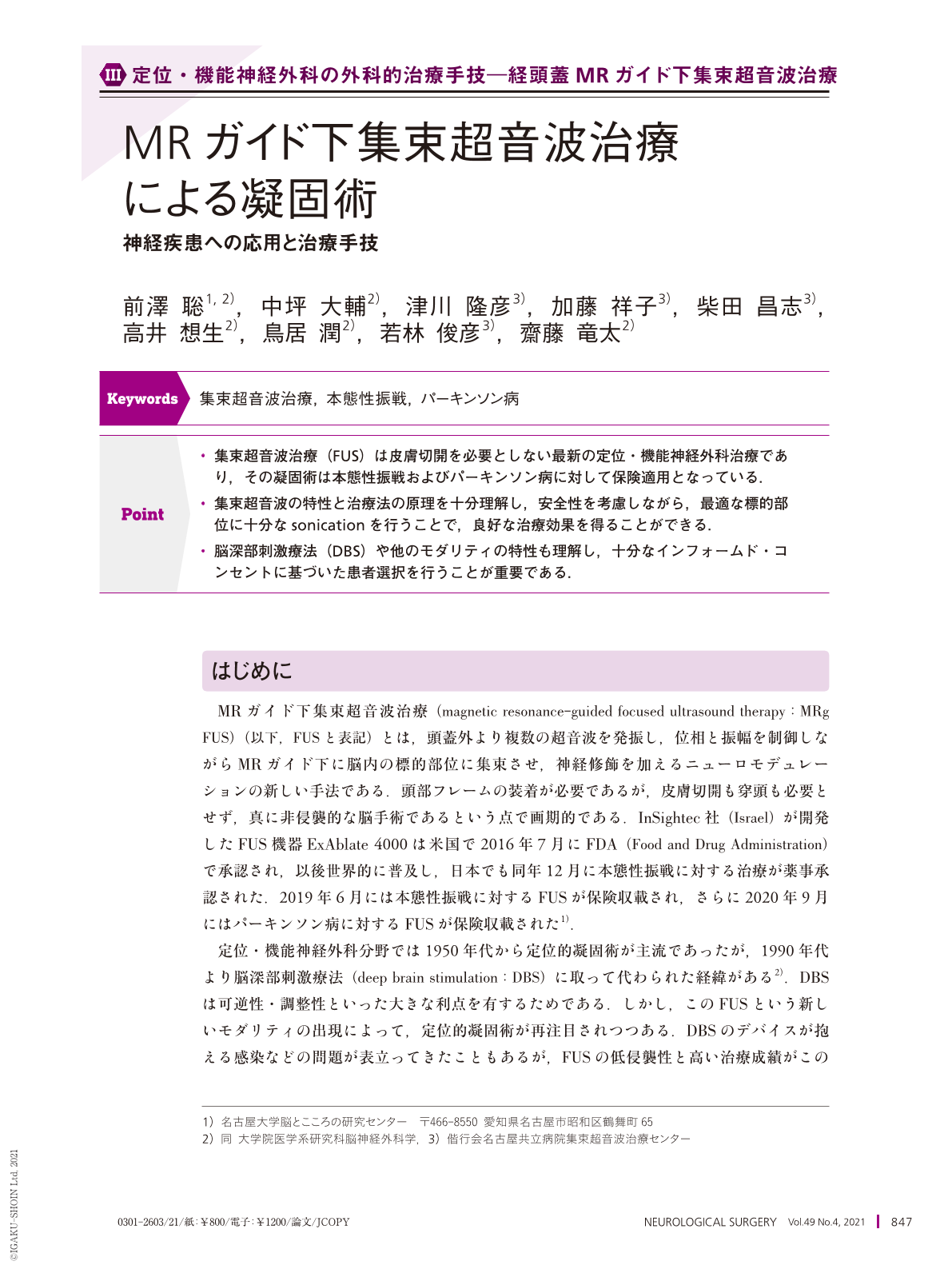
・集束超音波治療(FUS)は皮膚切開を必要としない最新の定位・機能神経外科治療であり,その凝固術は本態性振戦およびパーキンソン病に対して保険適用となっている.
・集束超音波の特性と治療法の原理を十分理解し,安全性を考慮しながら,最適な標的部位に十分なsonicationを行うことで,良好な治療効果を得ることができる.
・脳深部刺激療法(DBS)や他のモダリティの特性も理解し,十分なインフォームド・コンセントに基づいた患者選択を行うことが重要である.
Magnetic resonance(MR)-guided focused ultrasound ablation(FUS)is a minimally invasive technique for targeted tissue thermo-ablation and is promising for neuromodulation in various neurological disorders. The effectiveness and safety of this technique have been recognized worldwide. In Japan, the applications of FUS for the treatment of essential tremors and Parkinson's disease have recently been covered under health insurance. The FUS system is composed of a phased-array transducer with 1024 elements, with a beam of ultrasound emerging from each element. The phase and amplitude of the beam are computed and controlled to focus on the target with the calculation of computed tomography(CT)profiles, resulting in optimal thermo-ablation. To utilize FUS safely and effectively, a deep understanding of the physics of this technology is necessary. Furthermore, the technique should be compared with other options including deep brain stimulation(DBS)and radiofrequency thermo-ablation. Although FUS has received attention because of minimally invasive characteristics and a possibility of procedural target refinement, DBS has some advantages on bilateral implantation, a potential of postoperative adjustment, and control of head/leg tremors. In this article, we first reviewed the physics of FUS and demonstrated the typical treatment protocols. Second, we reviewed the outcomes from the existing literature, and revealed the advantages and disadvantages of this procedure, with the evaluation of the optimal condition for FUS.
Copyright © 2021, Igaku-Shoin Ltd. All rights reserved.