Japanese
English
- 有料閲覧
PPV購入案内
1,320円 (1,200円+税10%) こちらは、147ページから153ページの文献です。購入には医書.jp本会員登録が必要です。
会員登録完了後に改めて上記「購入サイトへ」を選択してください。
または「購入サイトへ」選択後に「購入ログイン」、「新規会員登録」の順に進んでください。
会員登録について詳しくはをご確認ください。
- Abstract 文献概要
- 1ページ目 Look Inside
- 参考文献 Reference
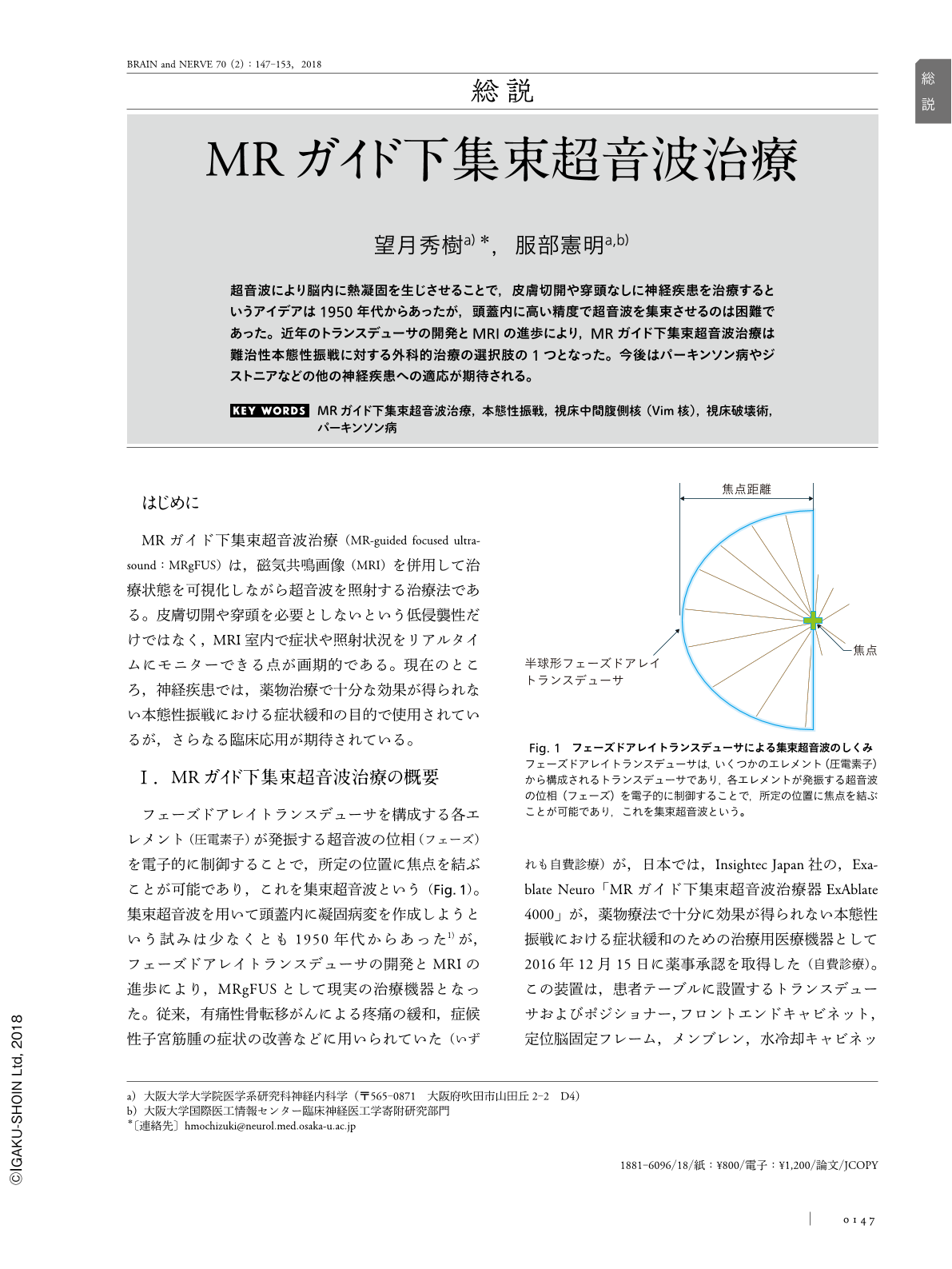
超音波により脳内に熱凝固を生じさせることで,皮膚切開や穿頭なしに神経疾患を治療するというアイデアは1950年代からあったが,頭蓋内に高い精度で超音波を集束させるのは困難であった。近年のトランスデューサの開発とMRIの進歩により,MRガイド下集束超音波治療は難治性本態性振戦に対する外科的治療の選択肢の1つとなった。今後はパーキンソン病やジストニアなどの他の神経疾患への適応が期待される。
Abstract
Since the middle of the 20th century and in order to treat neurological diseases, clinicians have proposed the use of ultrasound, instead of skin incision or trepanation, when performing intracranial thermocoagulation. However, focusing ultrasound intracranially with high precision was technically difficult until recent technological developments. Specifically, advancements in ultrasound phased-array transducers have eliminated the need for a craniotomy, and progress in magnetic resonance (MR) imaging has allowed the real-time measurement of intracranial temperature. Both of the above have enabled the use of MR-guided focused ultrasound as a treatment for refractory essential tremor. Studies focusing on the long-term effects of this treatment are under way. Given that it is less invasive than previous methods, this procedure could be indicated for the treatment of other neurological diseases, including Parkinson's disease, brain tumors, dystonia, and epilepsy.
Copyright © 2018, Igaku-Shoin Ltd. All rights reserved.