Japanese
English
- 有料閲覧
PPV購入案内
1,320円 (1,200円+税10%) こちらは、111ページから118ページの文献です。購入には医書.jp本会員登録が必要です。
会員登録完了後に改めて上記「購入サイトへ」を選択してください。
または「購入サイトへ」選択後に「購入ログイン」、「新規会員登録」の順に進んでください。
会員登録について詳しくはをご確認ください。
- Abstract 文献概要
- 1ページ目 Look Inside
- 参考文献 Reference
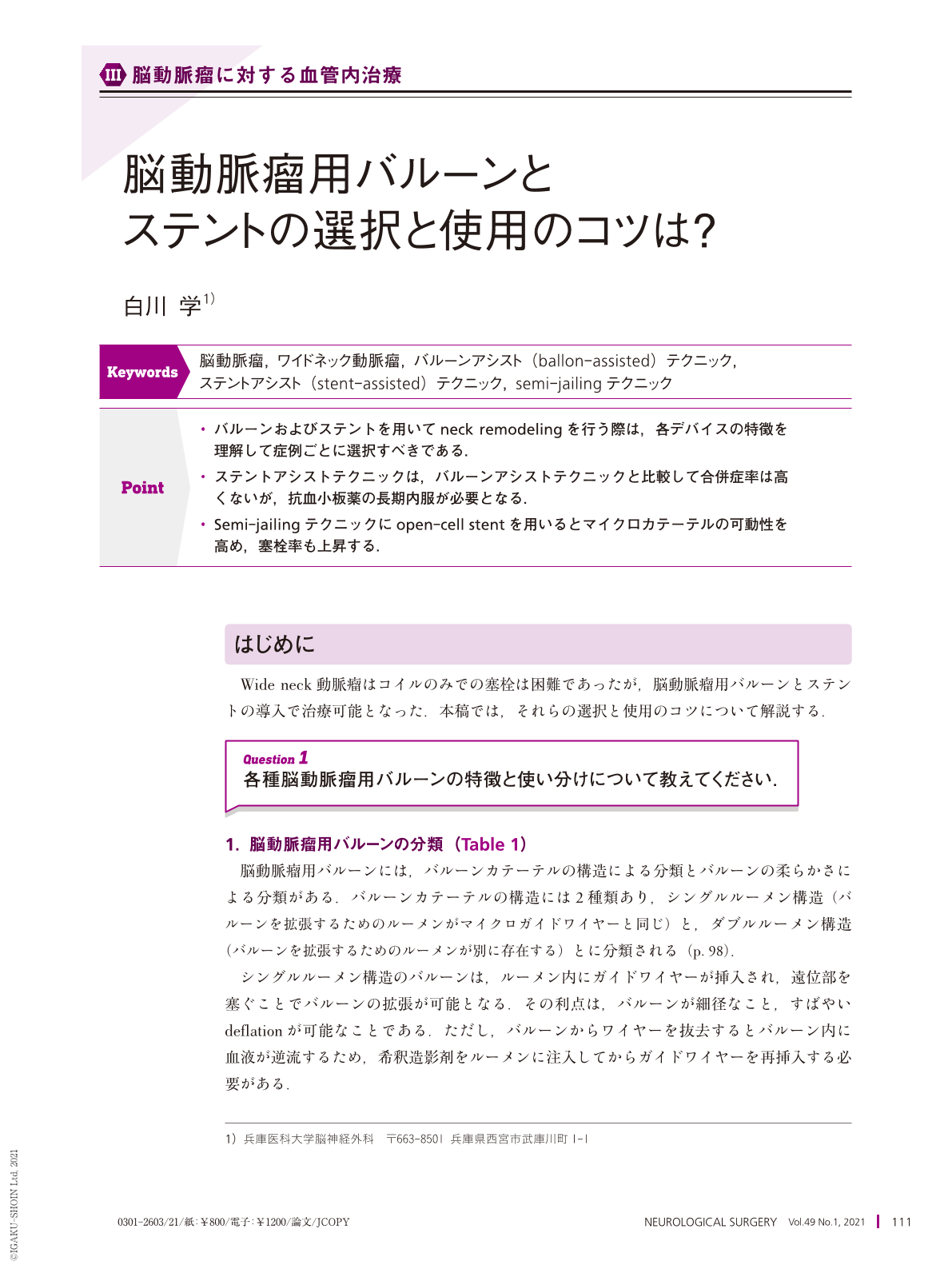
Point
・バルーンおよびステントを用いてneck remodelingを行う際は,各デバイスの特徴を理解して症例ごとに選択すべきである.
・ステントアシストテクニックは,バルーンアシストテクニックと比較して合併症率は高くないが,抗血小板薬の長期内服が必要となる.
・Semi-jailingテクニックにopen-cell stentを用いるとマイクロカテーテルの可動性を高め,塞栓率も上昇する.
We introduce typical use cases and the appropriate use of balloon catheters and neck bridge stents for coil embolization of cerebral aneurysm. There are two types of balloon catheters: single-lumen and double-lumen catheters. They are also classified into compliant and super-compliant balloons by softness. Neck bridge stents are classified into two types: open-cell and closed-cell stents. Balloon- and stent-assisted techniques are both useful for wide-neck aneurysms. The complication rates of these methods are similar but the stent-assisted technique requires long-term administration of antiplatelets after the procedure. Both techniques have the challenge that the microcatheter is fixed during coil embolization. The semi-jailing technique, in which the stent is partially deployed during coil insertion, solves this problem. Open-cell stents seem more suitable for this technique because they fit better to the vessel wall even in the curved part. It is important to understand the characteristics of each device for safe and effective treatments.
Copyright © 2021, Igaku-Shoin Ltd. All rights reserved.