Japanese
English
- 有料閲覧
PPV購入案内
1,320円 (1,200円+税10%) こちらは、525ページから530ページの文献です。購入には医書.jp本会員登録が必要です。
会員登録完了後に改めて上記「購入サイトへ」を選択してください。
または「購入サイトへ」選択後に「購入ログイン」、「新規会員登録」の順に進んでください。
会員登録について詳しくはをご確認ください。
- Abstract 文献概要
- 1ページ目 Look Inside
- 参考文献 Reference
Ⅰ.はじめに
もやもや病では,過換気や啼泣によるhypocapniaが虚血発作や脳梗塞発症の引き金になることがよく知られている.そのため,小児もやもや病の血行再建術の周術期管理において,啼泣を回避することが虚血性合併症を予防する上で非常に大切である.特に術直後は,麻酔覚醒時の術後興奮,疼痛,不安により啼泣しやすい状況にある.さらに脳循環動態が極めて不安定なために,啼泣によるhypocapniaにより広範な脳梗塞に至る危険性がある.啼泣を回避し,normocapniaを維持するため,麻酔科の協力を得て,superficial temporal artery(STA)-middle cerebral artery(MCA)anastomosis+encephalo-myo-synangiosis(EMS)終了後,抜管時より翌朝までデクスメデトミジン(dexmedetomidine:DEX)にて持続的に鎮静を行った.
海外では,DEXのもつ鎮静・鎮痛・臓器保護作用,そして呼吸抑制が少ないという特徴より,小児への投与の有効性が報告されている22,24).日本では2004年から市販されているが,小児例,脳神経外科領域での報告例は少ない.
小児もやもや病の術後啼泣回避のための鎮静薬として,DEXの有用性を検討したので報告する.
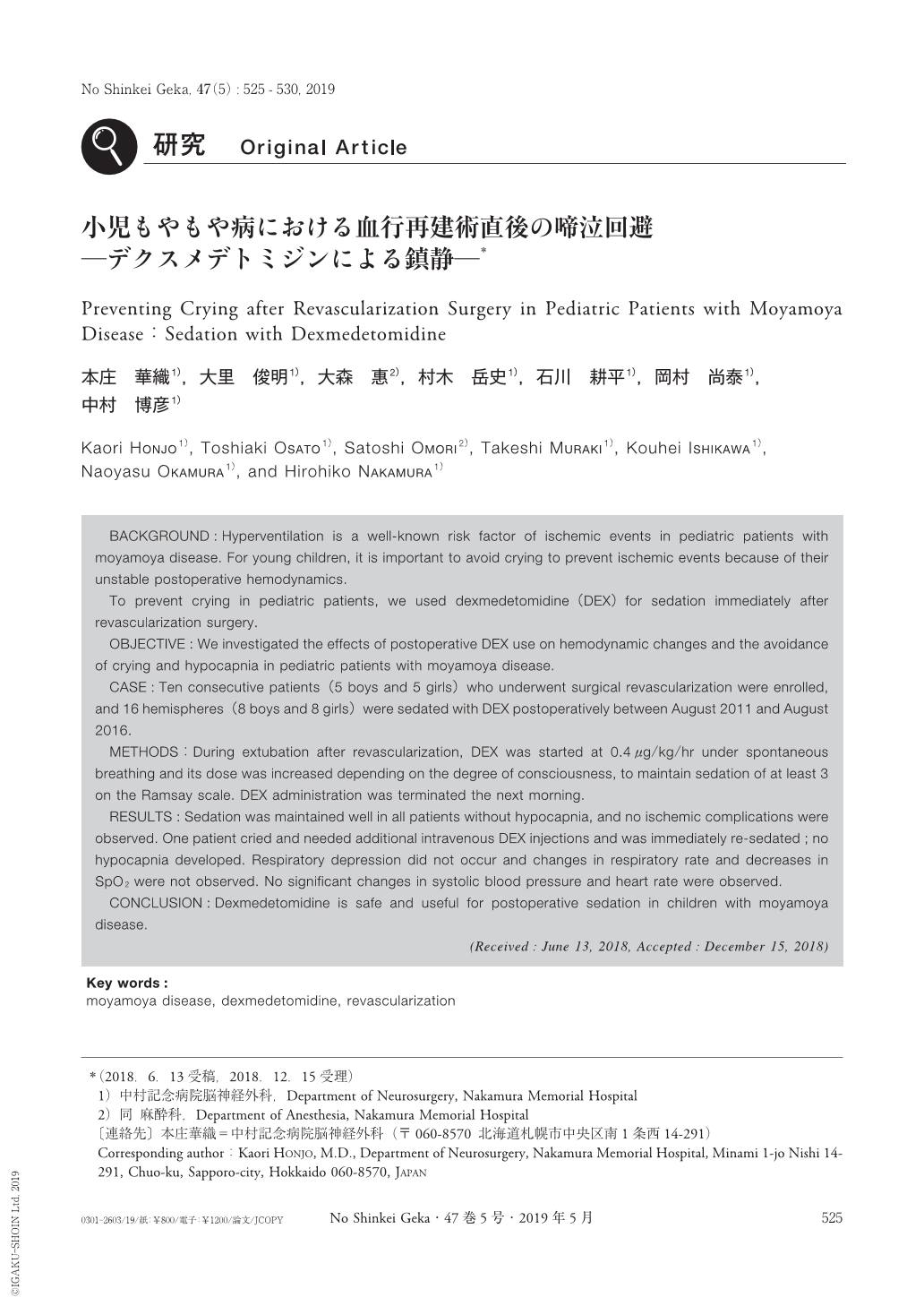
BACKGROUND:Hyperventilation is a well-known risk factor of ischemic events in pediatric patients with moyamoya disease. For young children, it is important to avoid crying to prevent ischemic events because of their unstable postoperative hemodynamics.
To prevent crying in pediatric patients, we used dexmedetomidine(DEX)for sedation immediately after revascularization surgery.
OBJECTIVE:We investigated the effects of postoperative DEX use on hemodynamic changes and the avoidance of crying and hypocapnia in pediatric patients with moyamoya disease.
CASE:Ten consecutive patients(5 boys and 5 girls)who underwent surgical revascularization were enrolled, and 16 hemispheres(8 boys and 8 girls)were sedated with DEX postoperatively between August 2011 and August 2016.
METHODS:During extubation after revascularization, DEX was started at 0.4μg/kg/hr under spontaneous breathing and its dose was increased depending on the degree of consciousness, to maintain sedation of at least 3 on the Ramsay scale. DEX administration was terminated the next morning.
RESULTS:Sedation was maintained well in all patients without hypocapnia, and no ischemic complications were observed. One patient cried and needed additional intravenous DEX injections and was immediately re-sedated;no hypocapnia developed. Respiratory depression did not occur and changes in respiratory rate and decreases in SpO2 were not observed. No significant changes in systolic blood pressure and heart rate were observed.
CONCLUSION:Dexmedetomidine is safe and useful for postoperative sedation in children with moyamoya disease.
Copyright © 2019, Igaku-Shoin Ltd. All rights reserved.