Japanese
English
- 有料閲覧
PPV購入案内
1,320円 (1,200円+税10%) こちらは、783ページから787ページの文献です。購入には医書.jp本会員登録が必要です。
会員登録完了後に改めて上記「購入サイトへ」を選択してください。
または「購入サイトへ」選択後に「購入ログイン」、「新規会員登録」の順に進んでください。
会員登録について詳しくはをご確認ください。
- Abstract 文献概要
- 1ページ目 Look Inside
- 参考文献 Reference
Ⅰ.はじめに
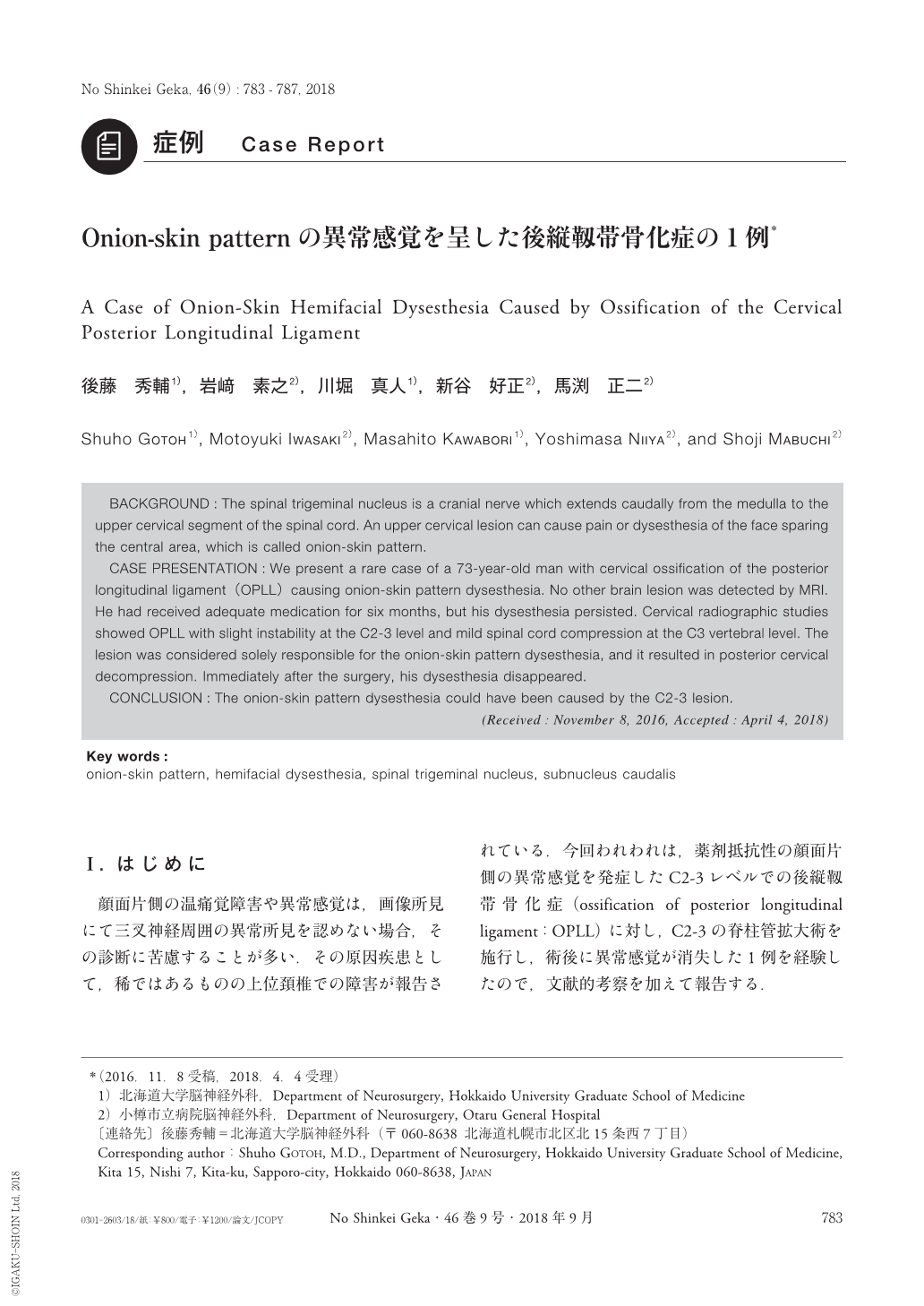
顔面片側の温痛覚障害や異常感覚は,画像所見にて三叉神経周囲の異常所見を認めない場合,その診断に苦慮することが多い.その原因疾患として,稀ではあるものの上位頚椎での障害が報告されている.今回われわれは,薬剤抵抗性の顔面片側の異常感覚を発症したC2-3レベルでの後縦靱帯骨化症(ossification of posterior longitudinal ligament:OPLL)に対し,C2-3の脊柱管拡大術を施行し,術後に異常感覚が消失した1例を経験したので,文献的考察を加えて報告する.
BACKGROUND:The spinal trigeminal nucleus is a cranial nerve which extends caudally from the medulla to the upper cervical segment of the spinal cord. An upper cervical lesion can cause pain or dysesthesia of the face sparing the central area, which is called onion-skin pattern.
CASE PRESENTATION:We present a rare case of a 73-year-old man with cervical ossification of the posterior longitudinal ligament(OPLL)causing onion-skin pattern dysesthesia. No other brain lesion was detected by MRI. He had received adequate medication for six months, but his dysesthesia persisted. Cervical radiographic studies showed OPLL with slight instability at the C2-3 level and mild spinal cord compression at the C3 vertebral level. The lesion was considered solely responsible for the onion-skin pattern dysesthesia, and it resulted in posterior cervical decompression. Immediately after the surgery, his dysesthesia disappeared.
CONCLUSION:The onion-skin pattern dysesthesia could have been caused by the C2-3 lesion.
Copyright © 2018, Igaku-Shoin Ltd. All rights reserved.