Japanese
English
総説
The Late Effects of Central Nervous System Irradiation in the Monkey
William F. Caveness
1
1Laboratory of Experimental Neurology, National Institute of Neurological and Communicative Disorders and Stroke, National Institutes of Health
キーワード:
Radiation necrosis
,
Monkey
,
Pathogenesis
Keyword:
Radiation necrosis
,
Monkey
,
Pathogenesis
pp.895-909
発行日 1980年10月10日
Published Date 1980/10/10
DOI https://doi.org/10.11477/mf.1436201213
- 有料閲覧
PPV購入案内
1,320円 (1,200円+税10%) こちらは、895ページから909ページの文献です。
PPV(ペイ・パー・ビュー)とは、論文(記事)単位で購入・閲覧ができるサービスです。
購入には医書.jp本会員登録が必要です。
会員登録完了後に改めて上記「購入サイトへ」を選択してください。
または「購入サイトへ」選択後に「購入ログイン」、「新規会員登録」の順に進んでください。
会員登録について詳しくはをご確認ください。
購入には医書.jp本会員登録が必要です。
会員登録完了後に改めて上記「購入サイトへ」を選択してください。
または「購入サイトへ」選択後に「購入ログイン」、「新規会員登録」の順に進んでください。
会員登録について詳しくはをご確認ください。
- Abstract 文献概要
- 1ページ目 Look Inside
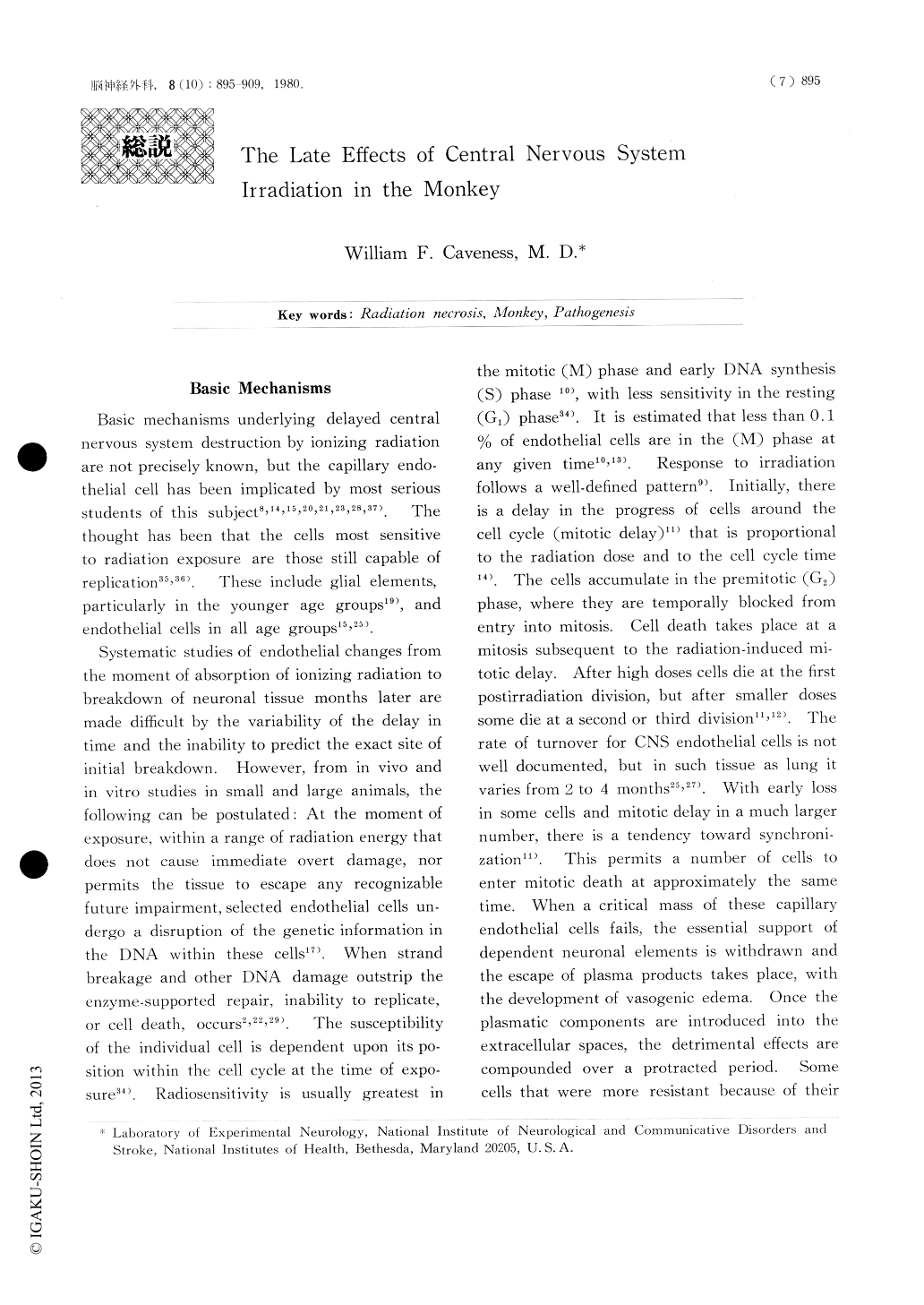
Basic Mechanisms
Basic mechanisms underlying delayed central nervous system destruction by ionizing radiation are not precisely known, but the capillary endothelial cell has been implicated by most serious students of this subject8,14,15,20,21,23,28,37). The thought has been that the cells most sensitive to radiation exposure are those still capable of replication35,36). These include glial elements, particularly in the younger age groups19), and endothelial cells in all age groups15,25).
Copyright © 1980, Igaku-Shoin Ltd. All rights reserved.