Japanese
English
- 有料閲覧
PPV購入案内
1,320円 (1,200円+税10%) こちらは、473ページから486ページの文献です。購入には医書.jp本会員登録が必要です。
会員登録完了後に改めて上記「購入サイトへ」を選択してください。
または「購入サイトへ」選択後に「購入ログイン」、「新規会員登録」の順に進んでください。
会員登録について詳しくはをご確認ください。
- Abstract 文献概要
- 1ページ目 Look Inside
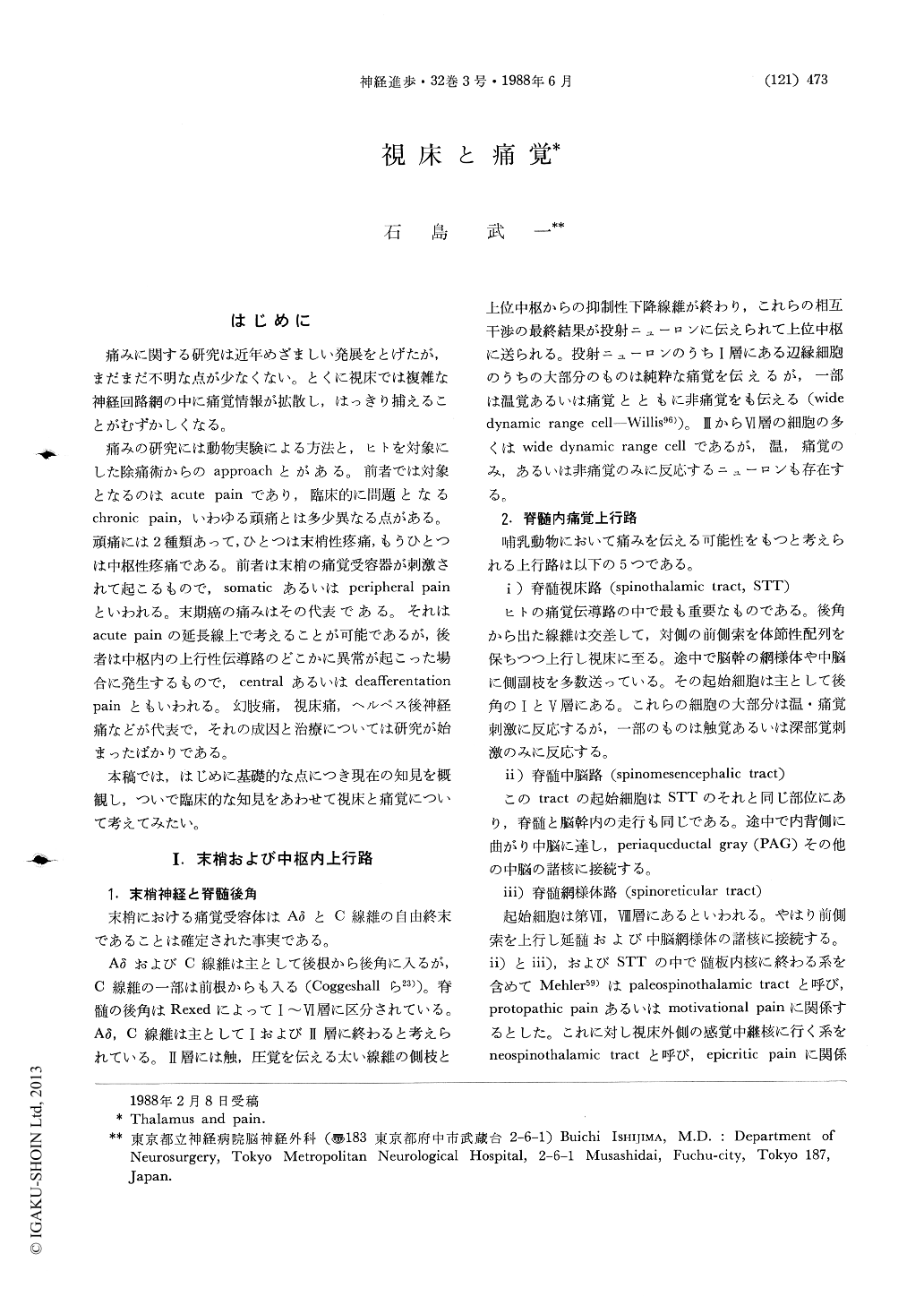
はじめに
痛みに関する研究は近年めざましい発展をとげたが,まだまだ不明な点が少なくない。とくに視床では複雑な神経回路網の中に痛覚情報が拡散し,はっきり捕えることがむずかしくなる。
痛みの研究には動物実験による方法と,ヒトを対象にした除痛術からのapproachとがある。前者では対象となるのはacute painであり,臨床的に問題となるchronic pain,いわゆる頑痛とは多少異なる点がある。頑痛には2種類あって,ひとつは末梢性疼痛,もうひとつは中枢性疼痛である。前者は末梢の痛覚受容器が刺激されて起こるもので,somaticあるいはperipheral painといわれる。末期癌の痛みはその代表である。それはacute painの延長線上で考えることが可能であるが,後者は中枢内の上行性伝導路のどこかに異常が起こった場合に発生するもので,centralあるいはdeafferentationpainともいわれる。幻肢痛,視床痛,ヘルペス後神経痛などが代表で,それの成因と治療については研究が始まったばかりである。
Pain receptors are free endings of peripheral Aδ and C fibers. Impulses generated in the pain receptors are carried to the first and second layers of the spinal dorsal horn. The pain information is modulated in the second layer, where the colla-terals of larger peripheral nerves and fibers of descending inhibitory system converge. The final results are transmitted to the projection neurons in the dorsal horn.
There are five ascending pain tracts in the spinal cord, spinothalamic tract (STT), spinome-sencephalic tract, spinoreticular tract, spinocervical tract and postsynaptic dorsal column pathway.
Copyright © 1988, Igaku-Shoin Ltd. All rights reserved.