Japanese
English
- 有料閲覧
PPV購入案内
1,320円 (1,200円+税10%) こちらは、87ページから96ページの文献です。購入には医書.jp本会員登録が必要です。
会員登録完了後に改めて上記「購入サイトへ」を選択してください。
または「購入サイトへ」選択後に「購入ログイン」、「新規会員登録」の順に進んでください。
会員登録について詳しくはをご確認ください。
- Abstract 文献概要
- 1ページ目 Look Inside
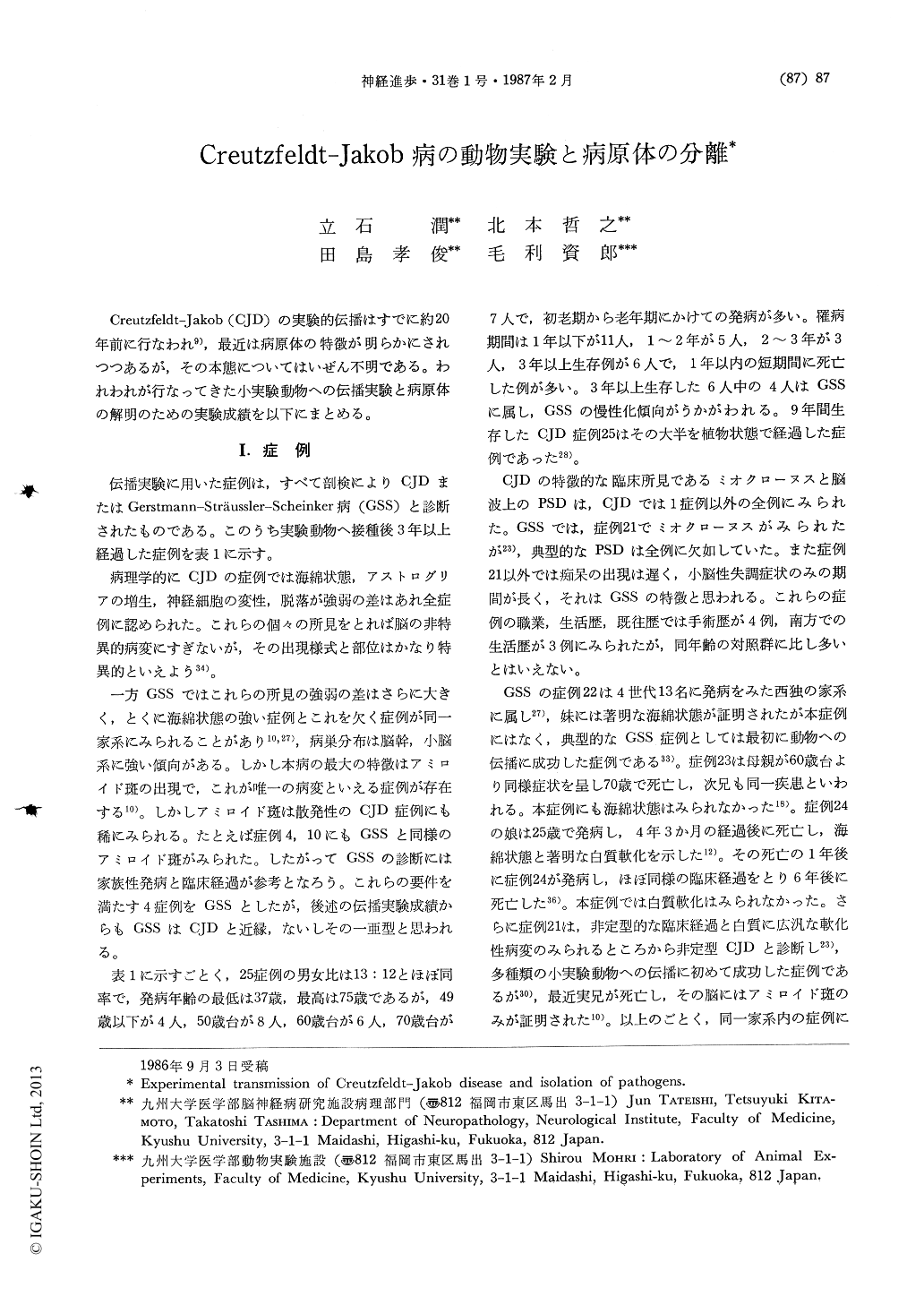
Creutzfeldt-Jakob(CJD)の実験的伝播はすでに約20年前に行なわれ9),最近は病原体の特徴が明らかにされつつあるが,その本態についてはいぜん不明である。われわれが行なってきた小実験動物への伝播実験と病原体の解明のための実験成績を以下にまとめる。
Transmission experiments were done inoculating materials taken from 21 patients with Creutzfeldt-Jakob disease (CJD) and 4 with Gerstmann-Sträussler-Scheinker's disease (GSS) to various laboratory animals. 18 CJD patients and 2 GSS patients were successfully transmitted to rodents. Mice were most susceptible and developed the disease within 4 months after the second passage. Guinea pigs, rats, hamsters, Mongolian gerbils and squirrel monkeys were infected after prolonged incubation periods of this order. Mice strains resulted some differences in incubation periods, while age of mice including fetus, did not.
The highest infectivity was found in the brains of all patients but one whose lymph node was most infectious. Spleen, kidney, cornea, blood and urine of a few patients were also infectious. Cerebrospinal fluid taken from 7 patients could not transmit the disease, though those from 2 diseased mice were infectious. Intracerebral ino-culation was the fastest route of infection, but intraperitoneal, submucosal, subcutaneous and oral routes could transmit the disease.
Copyright © 1987, Igaku-Shoin Ltd. All rights reserved.