Japanese
English
- 有料閲覧
PPV購入案内
1,320円 (1,200円+税10%) こちらは、264ページから270ページの文献です。購入には医書.jp本会員登録が必要です。
会員登録完了後に改めて上記「購入サイトへ」を選択してください。
または「購入サイトへ」選択後に「購入ログイン」、「新規会員登録」の順に進んでください。
会員登録について詳しくはをご確認ください。
- Abstract 文献概要
- 1ページ目 Look Inside
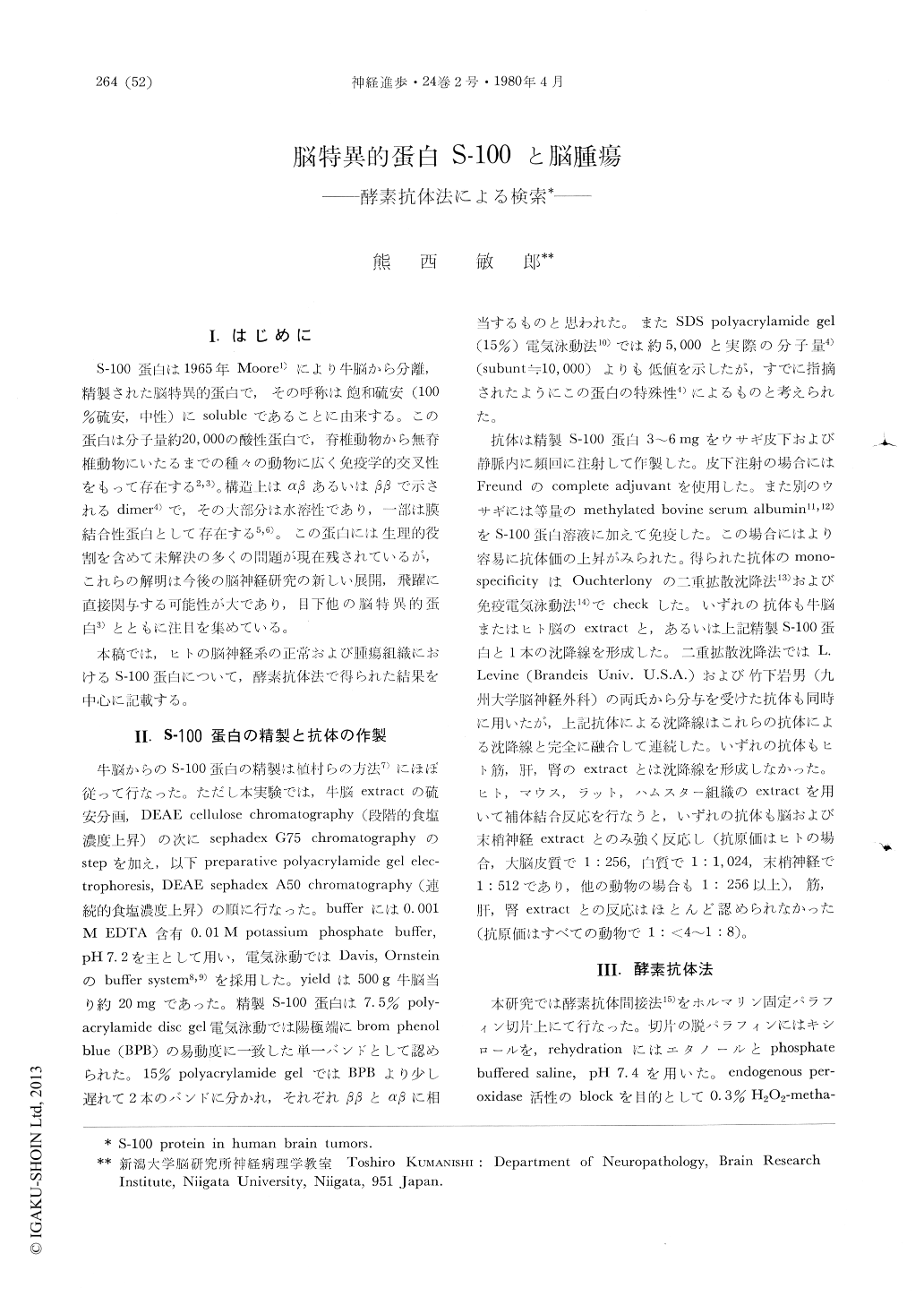
I.はじめに
S−100蛋白は1965年Moore1)により牛脳から分離精製された脳特異的蛋白で,その呼称は飽和硫安(100%硫安,中性)にsolubleであることに由来する。この蛋白は分子量約20,000の酸性蛋白で,脊椎動物から無脊椎動物にいたるまでの種々の動物に広く免疫学的交叉性をもって存在する2,3)。構造上はαβあるいはββで示されるdimer4)で,その大部分は水溶性であり,一部は膜結合性蛋白として存在する5,6)。この蛋白には生理的役割を含めて未解決の多くの問題が現在残されているが,これらの解明は今後の脳神経研究の新しい展開,飛躍に直接関与する可能性が大であり,目下他の脳特異的蛋白3)とともに注目を集めている。
本稿では,ヒトの脳神経系の正常および腫瘍組織におけるS−100蛋白について,酵素抗体法で得られた結果を中心に記載する。
Abstract
Using formalin-fixed, paraffin-embedded sections, immunoperoxidase study was performed on the S-100 protein in the normal and neoplastic tissues of the human nervous system.
Positive staining was observed in normal astrocytes, occasional oligodendroglias and Schwann cells, both in the nucleus and cytoplasm. Processes of astrocytes and Schwann cells were also stained. No distinct staining was observed in nerve cells of the cerebrum, cerebellum, brain stem, spinal cord or trigeminal and spinal ganglia.
Copyright © 1980, Igaku-Shoin Ltd. All rights reserved.