Japanese
English
- 有料閲覧
PPV購入案内
1,320円 (1,200円+税10%) こちらは、221ページから236ページの文献です。購入には医書.jp本会員登録が必要です。
会員登録完了後に改めて上記「購入サイトへ」を選択してください。
または「購入サイトへ」選択後に「購入ログイン」、「新規会員登録」の順に進んでください。
会員登録について詳しくはをご確認ください。
- Abstract 文献概要
- 1ページ目 Look Inside
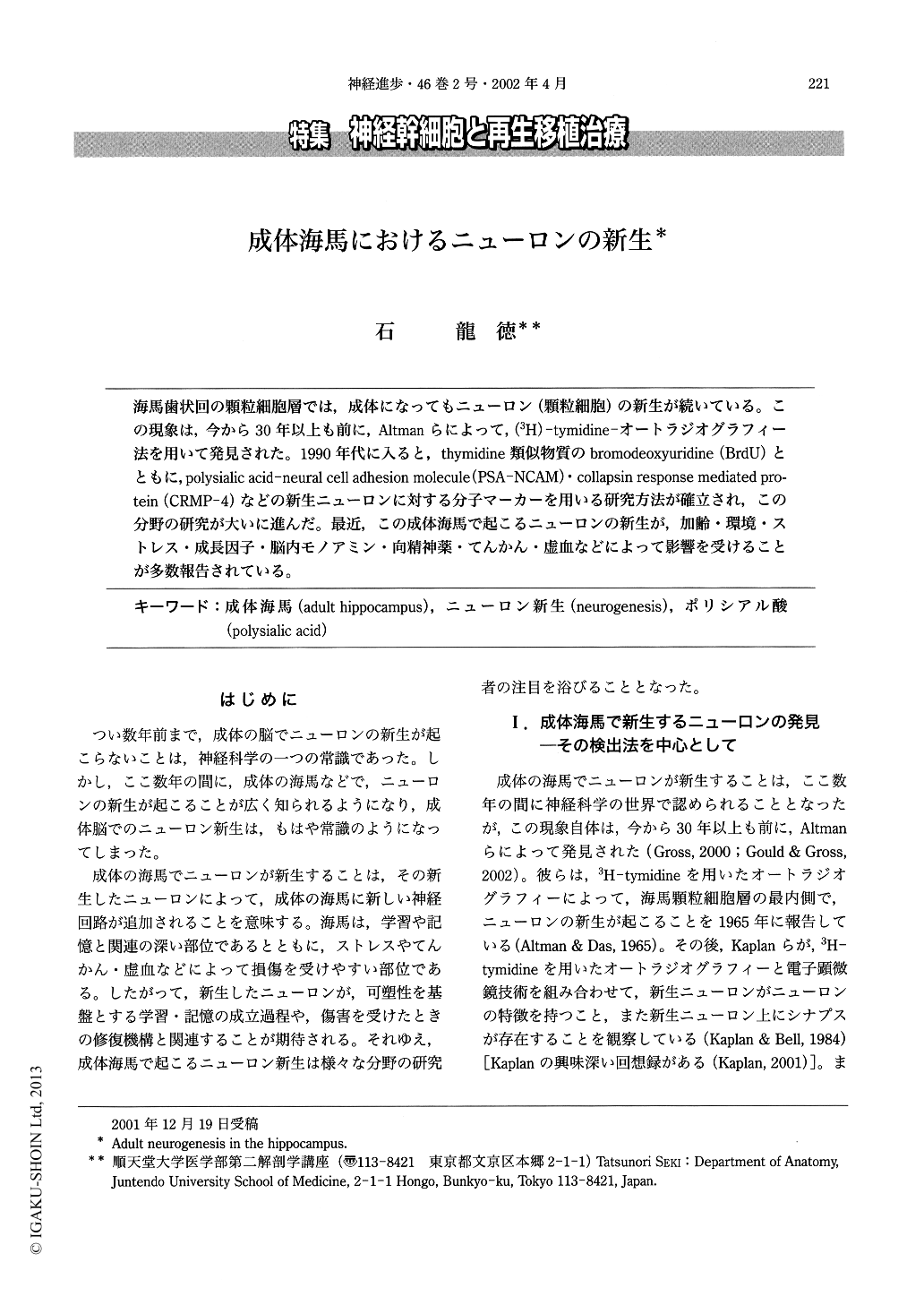
海馬歯状回の顆粒細胞層では,成体になってもニューロン(顆粒細胞)の新生が続いている。この現象は,今から30年以上も前に,Altmanらによって,(3H)-tymidine-オートラジオグラフィー法を用いて発見された。1990年代に入ると,thymidine類似物質のbromodeoxyuridine(BrdU)とともに,polysialic acid-neural cell adhesion molecule(PSA-NCAM)・collapsin response mediated protein(CRMP-4)などの新生ニューロンに対する分子マーカーを用いる研究方法が確立され,この分野の研究が大いに進んだ。最近,この成体海馬で起こるニューロンの新生が,加齢・環境・ストレス・成長因子・脳内モノアミン・向精神薬・てんかん・虚血などによって影響を受けることが多数報告されている。
In the 1960s, Joseph Altman using (3H) -thymidine-autoradiography demonstrated the phenomenon that neurons continue to be generated in the adult hippocampus. In early 1990s, we introduced bromodeoxyuridine (BrdU) labeling and polysialic acid-neural cell adhesion molecule (PSA-NCAM) immunohistochemistry, which allow us to detect the entire structure of newly generated neurons including their dendrites and axons. Using these techniques, we found several features of the developing dendrites and axons of the newly generated granule cells.
Copyright © 2002, Igaku-Shoin Ltd. All rights reserved.