Japanese
English
- 有料閲覧
PPV購入案内
1,320円 (1,200円+税10%) こちらは、605ページから617ページの文献です。購入には医書.jp本会員登録が必要です。
会員登録完了後に改めて上記「購入サイトへ」を選択してください。
または「購入サイトへ」選択後に「購入ログイン」、「新規会員登録」の順に進んでください。
会員登録について詳しくはをご確認ください。
- Abstract 文献概要
- 1ページ目 Look Inside
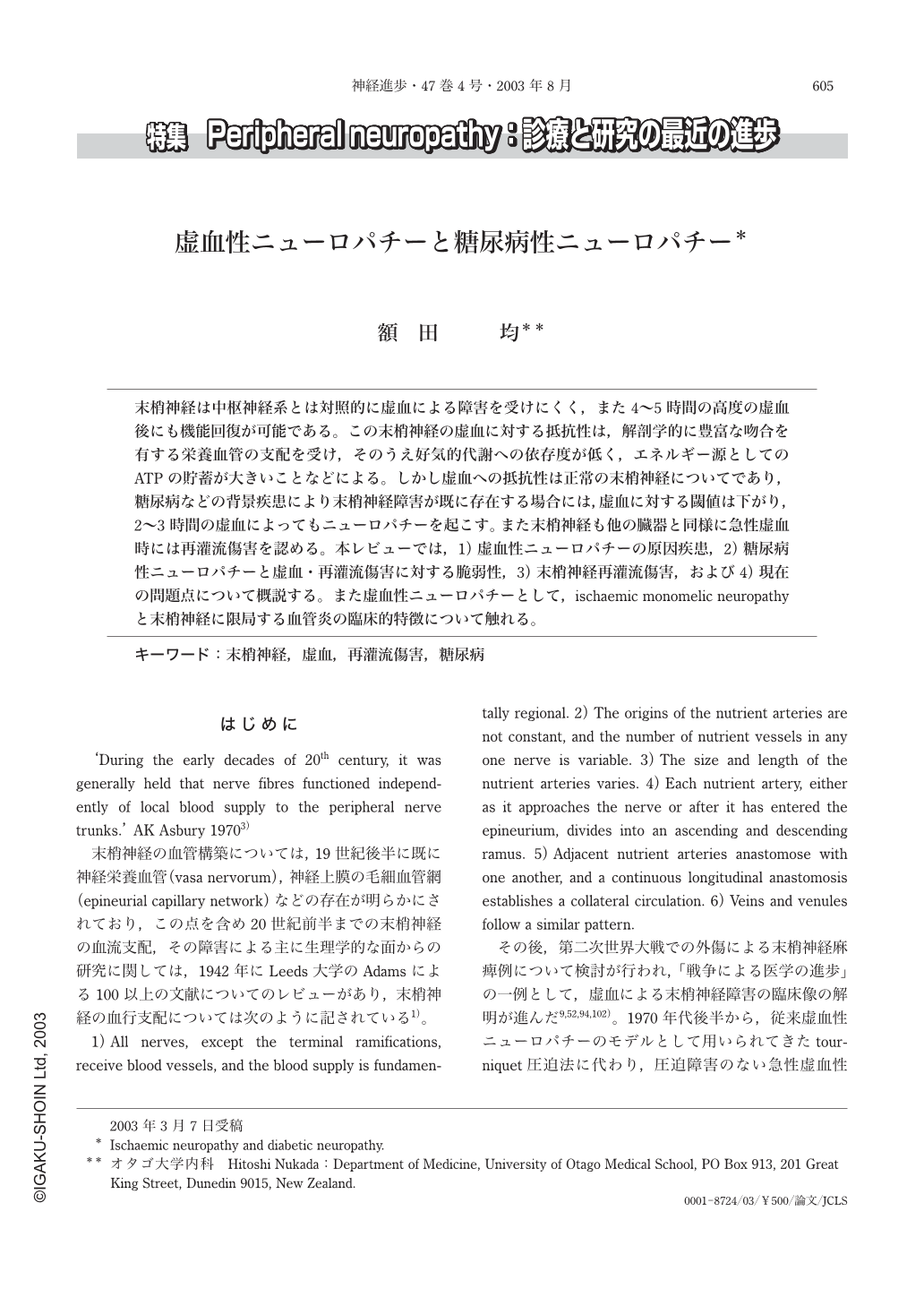
末梢神経は中枢神経系とは対照的に虚血による障害を受けにくく,また4~5時間の高度の虚血後にも機能回復が可能である。この末梢神経の虚血に対する抵抗性は,解剖学的に豊富な吻合を有する栄養血管の支配を受け,そのうえ好気的代謝への依存度が低く,エネルギー源としてのATPの貯蓄が大きいことなどによる。しかし虚血への抵抗性は正常の末梢神経についてであり,糖尿病などの背景疾患により末梢神経障害が既に存在する場合には,虚血に対する閾値は下がり,2~3時間の虚血によってもニューロパチーを起こす。また末梢神経も他の臓器と同様に急性虚血時には再灌流傷害を認める。本レビューでは,1)虚血性ニューロパチーの原因疾患,2)糖尿病性ニューロパチーと虚血・再灌流傷害に対する脆弱性,3)末梢神経再灌流傷害,および4)現在の問題点について概説する。また虚血性ニューロパチーとして,ischaemic monomelic neuropathyと末梢神経に限局する血管炎の臨床的特徴について触れる。
はじめに
‘During the early decades of 20thcentury, it was generally held that nerve fibres functioned independently of local blood supply to the peripheral nerve trunks.’AK Asbury 19703)
末梢神経の血管構築については,19世紀後半に既に神経栄養血管(vasa nervorum),神経上膜の毛細血管網(epineurial capillary network)などの存在が明らかにされており,この点を含め20世紀前半までの末梢神経の血流支配,その障害による主に生理学的な面からの研究に関しては,1942年にLeeds大学のAdamsによる100以上の文献についてのレビューがあり,末梢神経の血行支配については次のように記されている1)。
1)All nerves, except the terminal ramifications, receive blood vessels, and the blood supply is fundamentally regional. 2)The origins of the nutrient arteries are not constant, and the number of nutrient vessels in any one nerve is variable. 3)The size and length of the nutrient arteries varies. 4)Each nutrient artery, either as it approaches the nerve or after it has entered the epineurium, divides into an ascending and descending ramus. 5)Adjacent nutrient arteries anastomose with one another, and a continuous longitudinal anastomosis establishes a collateral circulation. 6)Veins and venules follow a similar pattern.
その後,第二次世界大戦での外傷による末梢神経麻痺例について検討が行われ,「戦争による医学の進歩」の一例として,虚血による末梢神経障害の臨床像の解明が進んだ9, 52, 94, 102)。1970年代後半から,従来虚血性ニューロパチーのモデルとして用いられてきたtourniquet圧迫法に代わり,圧迫障害のない急性虚血性ニューロパチーの動物モデルの確立があいつぎ,虚血による末梢神経障害の病理学的・電気生理学的変化についての理解が飛躍的に進歩した33, 43, 45, 69, 77, 78)。
This review will focus on recent advances in the field of ischaemic and diabetic neuropathies, including underlying disorders of ischaemic neuropathy, morphological susceptibility of diabetic nerve to ischaemia/reperfusion, and reperfusion nerve injury. 1)Ischaemia has been implicated in the pathophysiology of many disorders of peripheral nerves, such as diabetic neuropathies, primary and secondary vasculitides, and occlusive arterial diseases. Ischaemic neuropathy causes mononeuritis multiplex, asymmetrical neuropathy, or symmetrial distal neuropathy. Peripheral nerve vasculitis and ischaemic monomelic neuropathy can be encountered in clinical practice and diagnosis can be challenging. 2)In contrast to the central nervous system, peripheral nerve is relatively resistant to ischaemic damage. After 5-6 hours of severe acute ischaemia, peripheral nerve is able to recover completely. However, if systemic disorders such as diabetes exist, the threshold to ischaemic damage in peripheral nerves is lowered, and severe morphological abnormalities can be induced by 2-3 hours of ischaemia. 3)Pathology in reperfusion nerve injury includes endoneurial oedema, intramyelinic oedema, demyelination at the border zone, axonal degeneration at ischaemic area, and panfasccicular necrosis resulting from no-reflow phenomenon. Demyelination in reperfusion injury can be caused by a direct invasion of macrophages, as seen in multiple sclerosis and Guil-lain-Barrésyndrome. Reactive oxygen metabolites and inflammatory leukocytes play a major role in the development of reperfusion nerve injury. 4)The study of chronic ischaemic neuropathy is limited because of a lack of experimental model. I hope future research will help to delineate the pathophysiology of chronic ischaemic neuropathy.
Copyright © 2003, Igaku-Shoin Ltd. All rights reserved.