Japanese
English
- 有料閲覧
PPV購入案内
1,320円 (1,200円+税10%) こちらは、629ページから636ページの文献です。購入には医書.jp本会員登録が必要です。
会員登録完了後に改めて上記「購入サイトへ」を選択してください。
または「購入サイトへ」選択後に「購入ログイン」、「新規会員登録」の順に進んでください。
会員登録について詳しくはをご確認ください。
- Abstract 文献概要
- 1ページ目 Look Inside
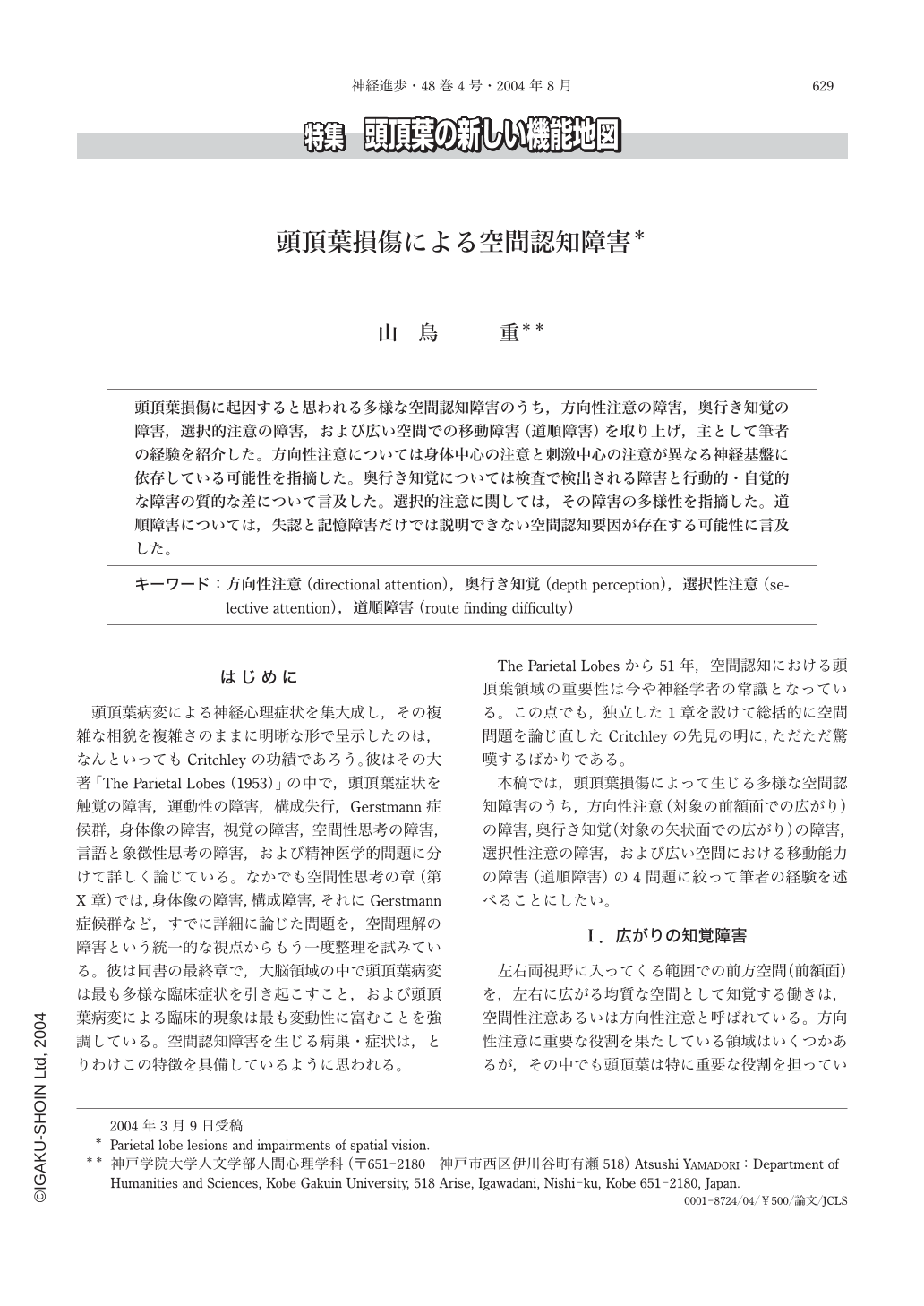
頭頂葉損傷に起因すると思われる多様な空間認知障害のうち,方向性注意の障害,奥行き知覚の障害,選択的注意の障害,および広い空間での移動障害(道順障害)を取り上げ,主として筆者の経験を紹介した。方向性注意については身体中心の注意と刺激中心の注意が異なる神経基盤に依存している可能性を指摘した。奥行き知覚については検査で検出される障害と行動的・自覚的な障害の質的な差について言及した。選択的注意に関しては,その障害の多様性を指摘した。道順障害については,失認と記憶障害だけでは説明できない空間認知要因が存在する可能性に言及した。
Dysfunction of the parietal lobes is known to produce a variety of cognitive disorders related with spatial vision. Directional attention which deals with perception of the space in the frontal plane is jointly supported by two different systems, one being dependent on the body-centered frame of reference and the other dependent on stimulus-centered frame of reference. Depth perception which deals with the spatial extention in the sagital plane is mainly dependent on the activity of the right parietal lobe. Three different types of selective attention disturbances were discussed, i. e. difficulty of seeing plural objects as they are, difficulty of locating a predetermined target on purpose, and fluctuation of target finding capacity depending on the nature of distracters. Pure topographical disorientation has been usually discussed in terms of agnosia or amnesia, but the importance of the impairment of“sense of orientation in space”per se was suggested.
Copyright © 2004, Igaku-Shoin Ltd. All rights reserved.