Japanese
English
- 有料閲覧
PPV購入案内
1,320円 (1,200円+税10%) こちらは、733ページから741ページの文献です。購入には医書.jp本会員登録が必要です。
会員登録完了後に改めて上記「購入サイトへ」を選択してください。
または「購入サイトへ」選択後に「購入ログイン」、「新規会員登録」の順に進んでください。
会員登録について詳しくはをご確認ください。
- Abstract 文献概要
- 1ページ目 Look Inside
- 参考文献 Reference
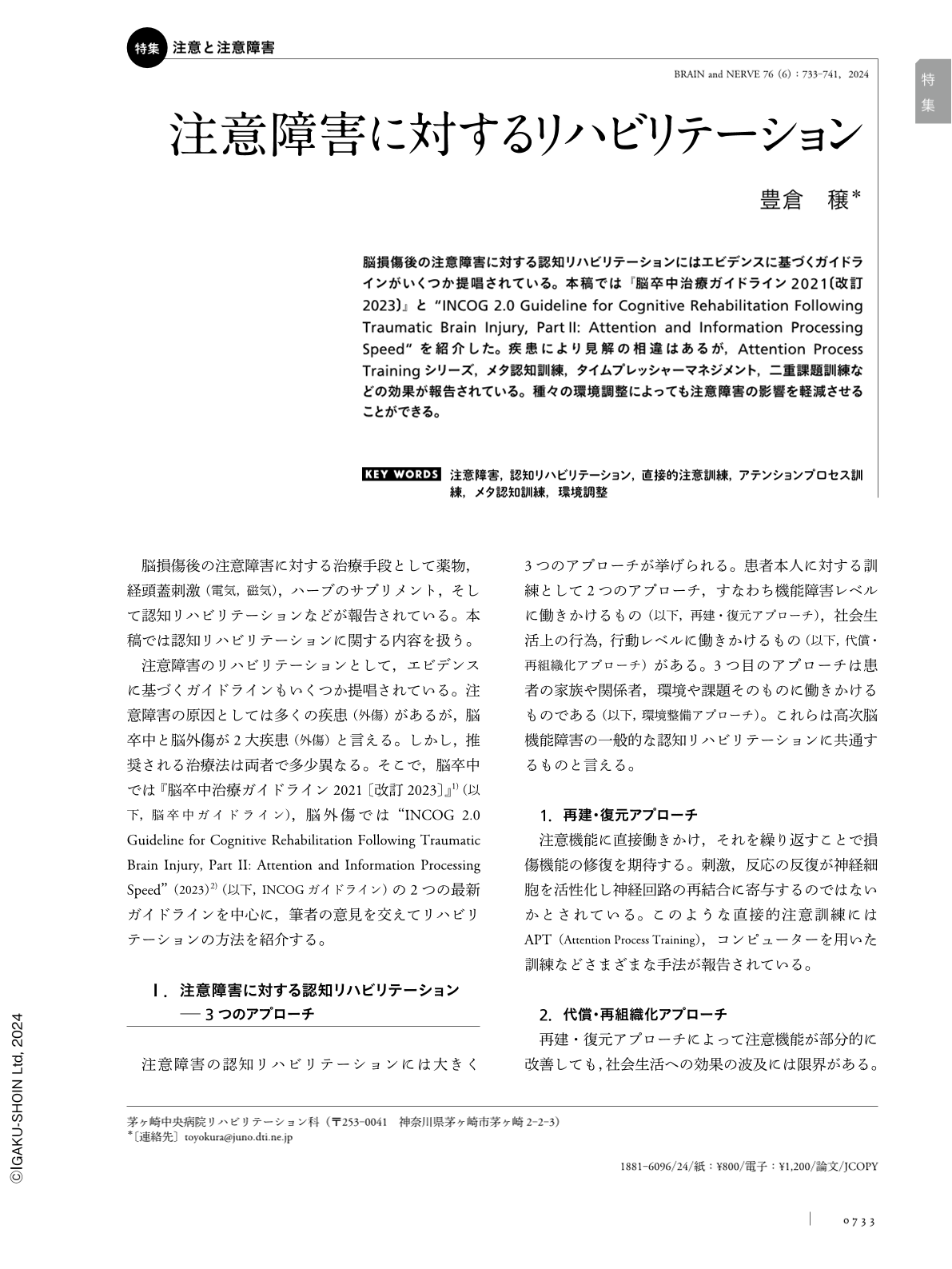
脳損傷後の注意障害に対する認知リハビリテーションにはエビデンスに基づくガイドラインがいくつか提唱されている。本稿では『脳卒中治療ガイドライン2021〔改訂2023〕』と “INCOG 2.0 Guideline for Cognitive Rehabilitation Following Traumatic Brain Injury, PartII: Attention and Information Processing Speed” を紹介した。疾患により見解の相違はあるが,Attention Process Trainingシリーズ,メタ認知訓練,タイムプレッシャーマネジメント,二重課題訓練などの効果が報告されている。種々の環境調整によっても注意障害の影響を軽減させることができる。
Abstract
Several evidence-based guidelines of rehabilitative intervention for attentional disturbance following acquired brain injury have been published. The author introduced two cutting-edge guidelines: Japan Stroke Society Guideline 2021 for the Treatment of Stroke [Revised version 2023]; and INCOG 2.0 Guideline for Cognitive Rehabilitation Following Traumatic Brain Injury, PartII: Attention and Information Processing Speed (2023). The effect of the cognitive rehabilitation should be evaluated by change of performance in real-world tasks and activities as well as measures of various neuropsychological tests including paced auditory serial addition task (PASAT) and trail making test. Direct attention training such as Attention Process Training (APT) series or computer-based training may be useful especially for stroke patients. Dual-task training may specifically improve multi-tasking performance. Time pressure management can improve speed of performance on everyday tasks for patients with slowed information processing. Metacognitive training using everyday activities may be recommended for mild to moderate impairments. Modifications of environment and/or tasks may also be helpful to decrease errors in daily activities.
Copyright © 2024, Igaku-Shoin Ltd. All rights reserved.