Japanese
English
- 有料閲覧
PPV購入案内
1,320円 (1,200円+税10%) こちらは、711ページから722ページの文献です。購入には医書.jp本会員登録が必要です。
会員登録完了後に改めて上記「購入サイトへ」を選択してください。
または「購入サイトへ」選択後に「購入ログイン」、「新規会員登録」の順に進んでください。
会員登録について詳しくはをご確認ください。
- Abstract 文献概要
- 1ページ目 Look Inside
- 参考文献 Reference
- サイト内被引用 Cited by
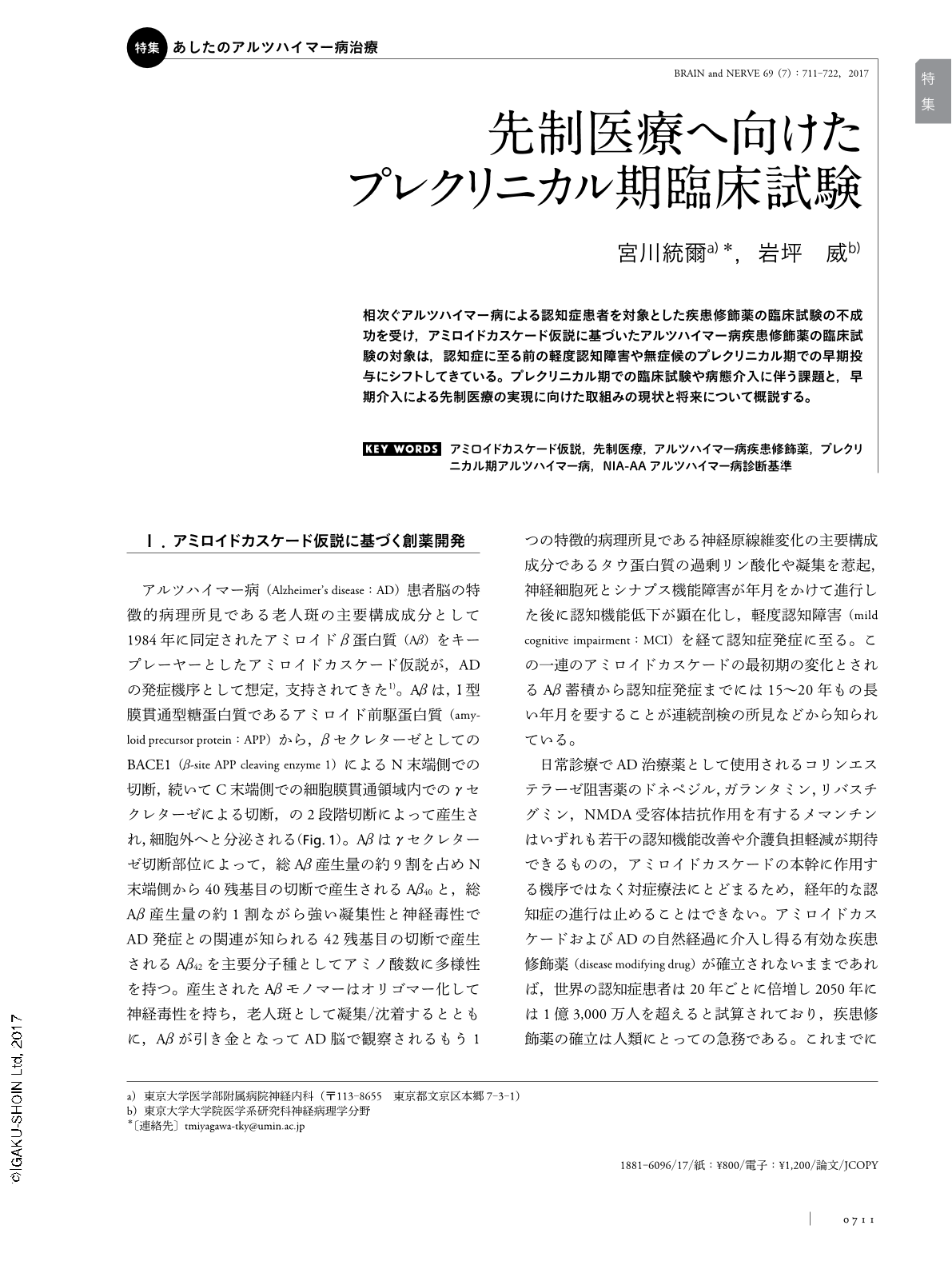
相次ぐアルツハイマー病による認知症患者を対象とした疾患修飾薬の臨床試験の不成功を受け,アミロイドカスケード仮説に基づいたアルツハイマー病疾患修飾薬の臨床試験の対象は,認知症に至る前の軽度認知障害や無症候のプレクリニカル期での早期投与にシフトしてきている。プレクリニカル期での臨床試験や病態介入に伴う課題と,早期介入による先制医療の実現に向けた取組みの現状と将来について概説する。
Abstract
A variety of disease-modifying therapies for Alzheimer's disease (AD) have been developed and advanced to late-phase clinical trials in AD dementia patients, but thus far, no single drug has proven its efficacy in a large phase III trial. In 2011, the National Institute on Aging-Alzheimer's Association (NIA-AA) criteria redefined the concept of AD to encompass the earlier amyloid-related pathophysiological changes of the preclinical stage and mild cognitive impairment (MCI). Clinical trials for AD are now moving toward these earlier stages of the disease, targeting MCI due to AD and preclinical AD. Intervention in the earlier stages of the amyloid cascade is believed to have a better chance at changing the natural course of AD and preventing or at least delaying the conversion to dementia. Although conducting a large and prolonged costly clinical trial in the preclinical stage is challenging, the first step in overcoming this challenge has been taken with enthusiasm and commitment.
Copyright © 2017, Igaku-Shoin Ltd. All rights reserved.