Japanese
English
- 有料閲覧
PPV購入案内
1,320円 (1,200円+税10%) こちらは、1459ページから1470ページの文献です。購入には医書.jp本会員登録が必要です。
会員登録完了後に改めて上記「購入サイトへ」を選択してください。
または「購入サイトへ」選択後に「購入ログイン」、「新規会員登録」の順に進んでください。
会員登録について詳しくはをご確認ください。
- Abstract 文献概要
- 1ページ目 Look Inside
- 参考文献 Reference
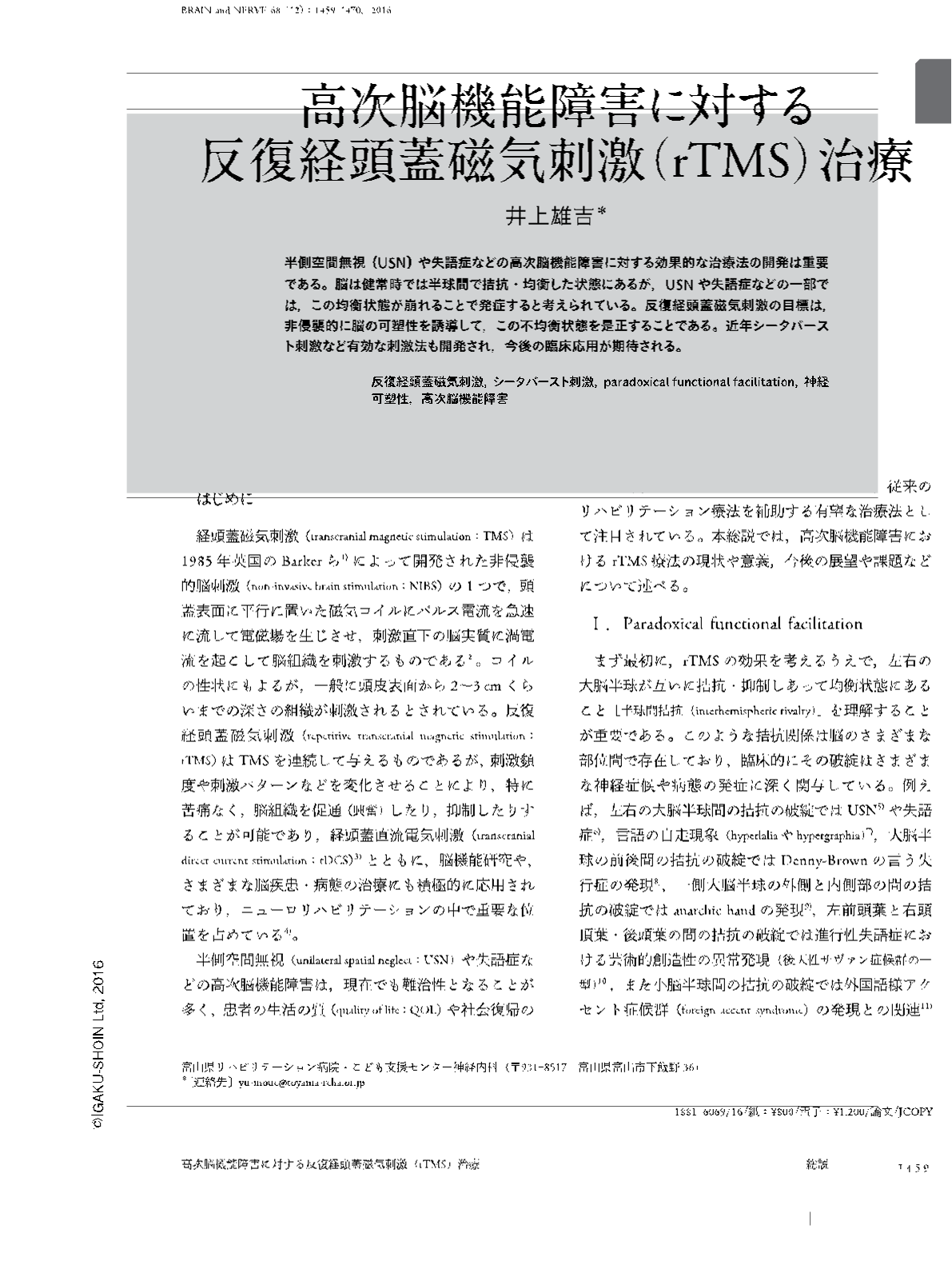
半側空間無視(USN)や失語症などの高次脳機能障害に対する効果的な治療法の開発は重要である。脳は健常時では半球間で拮抗・均衡した状態にあるが,USNや失語症などの一部では,この均衡状態が崩れることで発症すると考えられている。反復経頭蓋磁気刺激の目標は,非侵襲的に脳の可塑性を誘導して,この不均衡状態を是正することである。近年シータバースト刺激など有効な刺激法も開発され,今後の臨床応用が期待される。
Abstract
The management of higher brain dysfunctions such as stroke-induced unilateral spatial neglect (USN) or aphasia is crucial because these dysfunctions have devastating neurological repercussions on the patients' daily life and quality of life. Impairment of the physiological interhemispheric rivalry is often the result of brain insults such as strokes or traumatic injuries, and it may lead to USN or aphasia. Repetitive transcranial magnetic stimulation (rTMS), a non-invasive brain stimulation method, is a promising tool for restoring the pathological imbalance in interhemispheric rivalry by either suppressing the hyperactivity of the unaffected hemisphere or facilitating hypoactivity in the affected hemisphere. The concept of paradoxical functional facilitation (Kapur, 1996) has important clinical implications when coupled with rTMS applications. In addition to conventional rTMS (c-rTMS), other clinically relevant protocols of patterned rTMS (p-rTMS) have been developed: the theta burst stimulation (TBS), the paired associative stimulation (PAS), and the quadripulse stimulation (QPS). TBS is commonly used in the rehabilitation of patients with post-stroke USN and those with non-fluent aphasia because of its prolonged beneficial effects and the short duration of stimulation. TBS may be considered an effective and safe protocol of rTMS. We foresee broader clinical applications of p-rTMS (TBS) and c-rTMS in the treatment of various neurological deficits.
Copyright © 2016, Igaku-Shoin Ltd. All rights reserved.