Japanese
English
- 有料閲覧
PPV購入案内
1,320円 (1,200円+税10%) こちらは、247ページから256ページの文献です。購入には医書.jp本会員登録が必要です。
会員登録完了後に改めて上記「購入サイトへ」を選択してください。
または「購入サイトへ」選択後に「購入ログイン」、「新規会員登録」の順に進んでください。
会員登録について詳しくはをご確認ください。
- Abstract 文献概要
- 1ページ目 Look Inside
- 参考文献 Reference
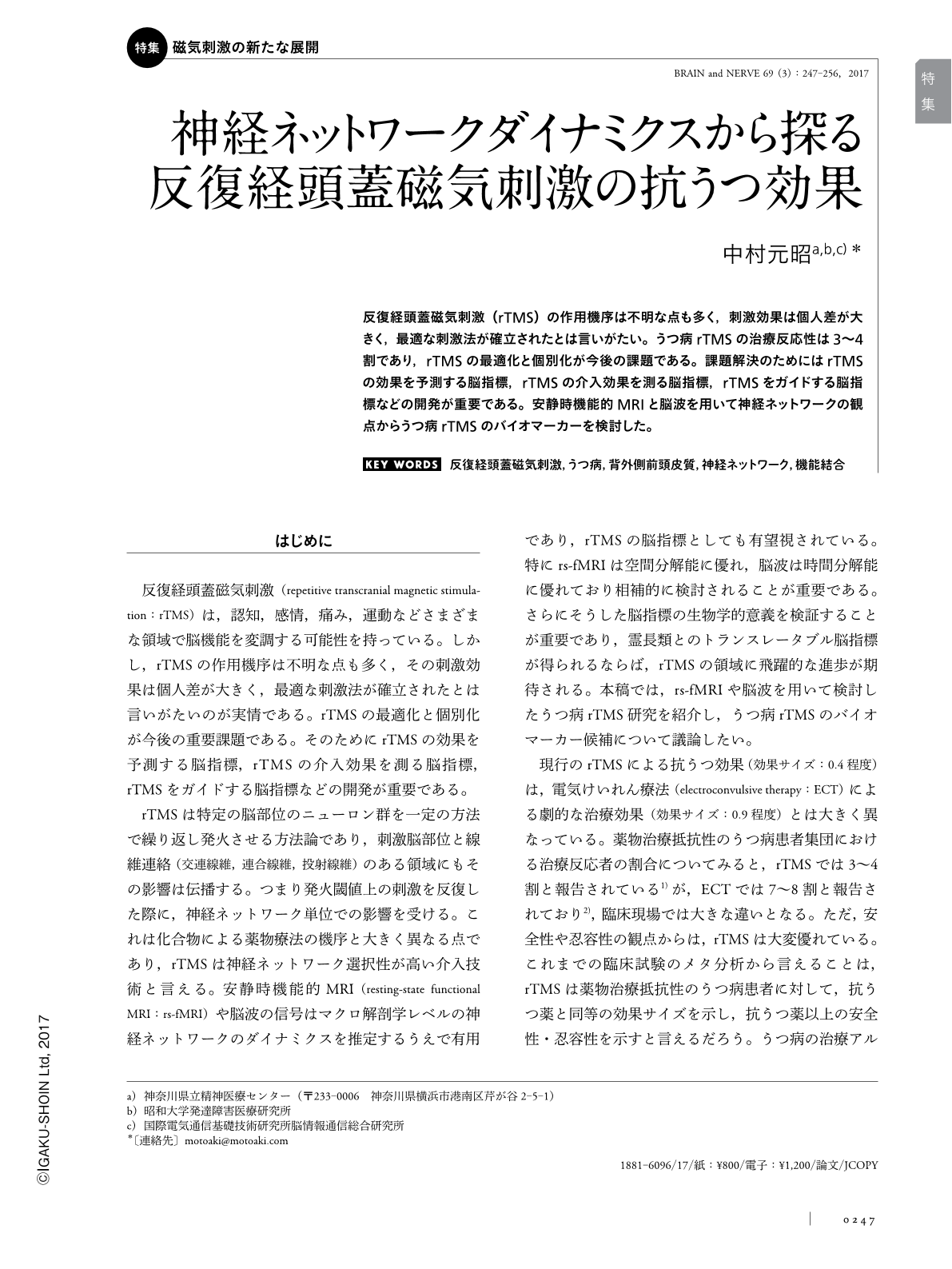
反復経頭蓋磁気刺激(rTMS)の作用機序は不明な点も多く,刺激効果は個人差が大きく,最適な刺激法が確立されたとは言いがたい。うつ病rTMSの治療反応性は3〜4割であり,rTMSの最適化と個別化が今後の課題である。課題解決のためにはrTMSの効果を予測する脳指標,rTMSの介入効果を測る脳指標,rTMSをガイドする脳指標などの開発が重要である。安静時機能的MRIと脳波を用いて神経ネットワークの観点からうつ病rTMSのバイオマーカーを検討した。
Abstract
The neurobiological mechanisms that regulate the therapeutic effects of repetitive transcranial magnetic stimulation (rTMS) remain unknown to date. An optimized rTMS protocol has not been established, partly due to the wide variability in its aftereffects among individuals who have undergone the treatment. Responder rates to rTMS for treating major depression have been reported to be modest (30 to 40 percent). Thus, optimization and personalization of an rTMS protocol is required for better treatment outcomes. To this end, it is necessary to identify brain biomarkers for predicting responsiveness to rTMS treatment and the aftereffects and for personalizing rTMS. In this review, we introduced potential biomarkers of rTMS response for treating major depression by employing two modalities of resting-state functional magnetic resonance imaging (fMRI) and electroencephalogram (EEG) from a perspective of neural network dynamics.
Copyright © 2017, Igaku-Shoin Ltd. All rights reserved.