Japanese
English
- 有料閲覧
PPV購入案内
1,320円 (1,200円+税10%) こちらは、861ページから864ページの文献です。購入には医書.jp本会員登録が必要です。
会員登録完了後に改めて上記「購入サイトへ」を選択してください。
または「購入サイトへ」選択後に「購入ログイン」、「新規会員登録」の順に進んでください。
会員登録について詳しくはをご確認ください。
- Abstract 文献概要
- 1ページ目 Look Inside
- 参考文献 Reference
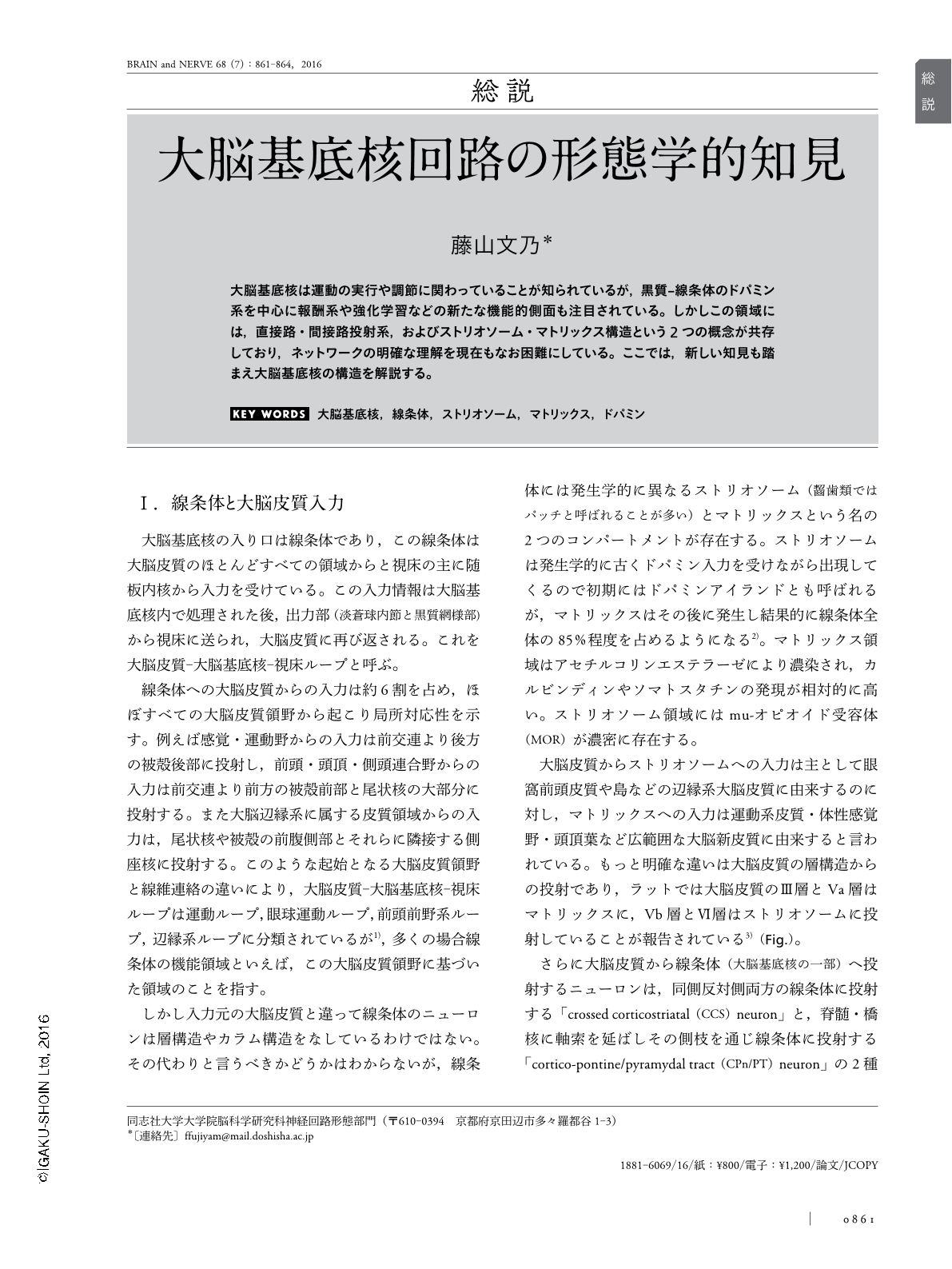
大脳基底核は運動の実行や調節に関わっていることが知られているが,黒質-線条体のドパミン系を中心に報酬系や強化学習などの新たな機能的側面も注目されている。しかしこの領域には,直接路・間接路投射系,およびストリオソーム・マトリックス構造という2つの概念が共存しており,ネットワークの明確な理解を現在もなお困難にしている。ここでは,新しい知見も踏まえ大脳基底核の構造を解説する。
Abstract
Electrophysiological studies in monkeys have shown that dopaminergic neurons respond to the reward prediction error. In addition, striatal neurons alter their responsiveness to cortical or thalamic inputs in response to dopamine signals, via dopamine-regulated synaptic plasticity. These findings have led to the hypothesis that the striatum exhibits synaptic plasticity under the influence of reward prediction error and conducts reinforcement learning throughout the basal ganglia circuits. The reinforcement learning model is useful; however, the mechanism by which such a process emerges in the basal ganglia needs to be anatomically explained. The actor-critic model has been previously proposed and extended by the existence of role sharing within the striatum, with particular focus on the striosome and matrix compartments. However, this hypothesis has been difficult to confirm morphologically, partly because of the complex structure of the striosome and matrix compartments. Here, we review recent morphological studies that elucidate the input/output organization of the striatal compartments.
Copyright © 2016, Igaku-Shoin Ltd. All rights reserved.