Japanese
English
- 有料閲覧
PPV購入案内
1,320円 (1,200円+税10%) こちらは、363ページから366ページの文献です。購入には医書.jp本会員登録が必要です。
会員登録完了後に改めて上記「購入サイトへ」を選択してください。
または「購入サイトへ」選択後に「購入ログイン」、「新規会員登録」の順に進んでください。
会員登録について詳しくはをご確認ください。
- Abstract 文献概要
- 1ページ目 Look Inside
- 参考文献 Reference
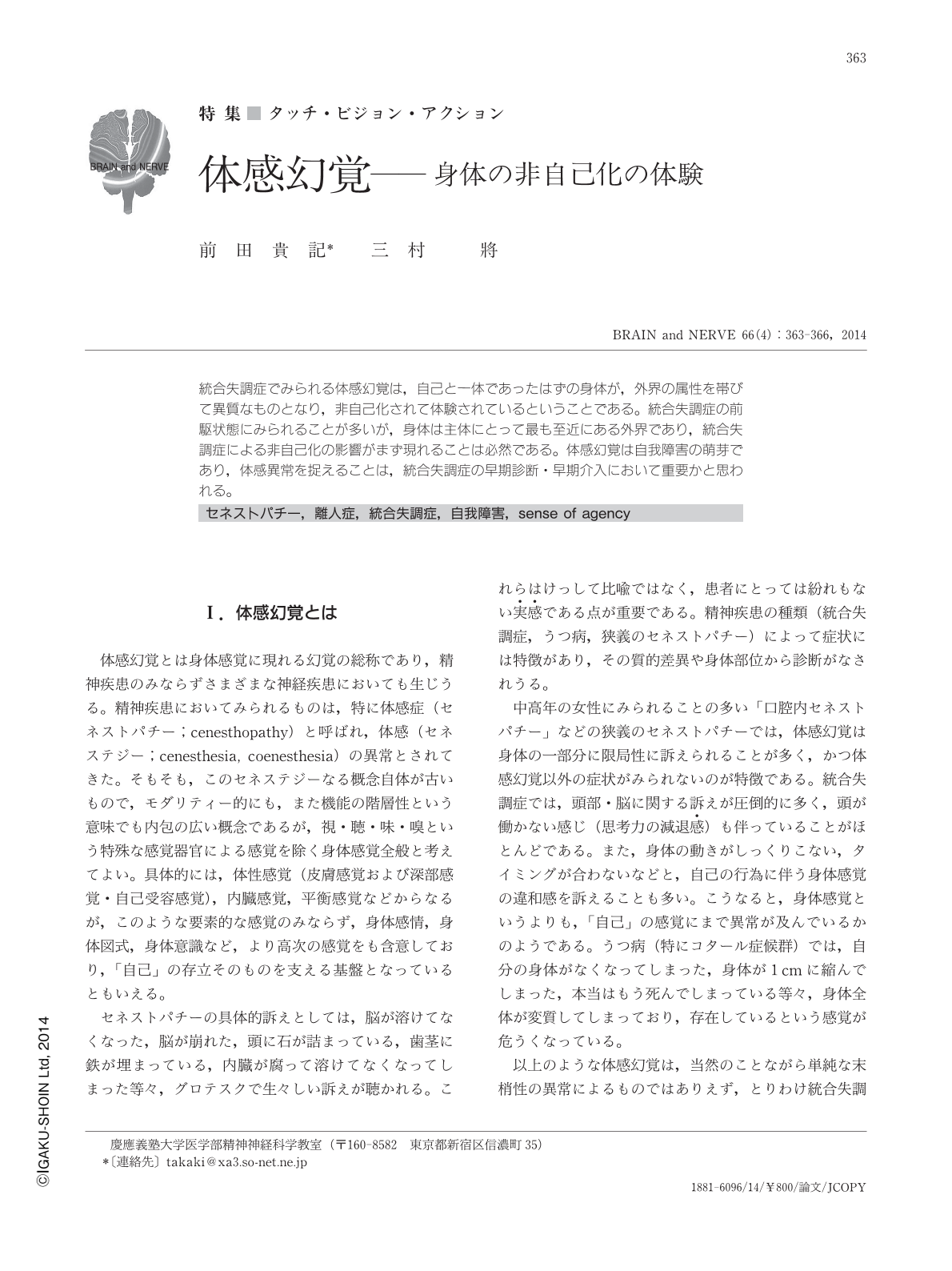
統合失調症でみられる体感幻覚は,自己と一体であったはずの身体が,外界の属性を帯びて異質なものとなり,非自己化されて体験されているということである。統合失調症の前駆状態にみられることが多いが,身体は主体にとって最も至近にある外界であり,統合失調症による非自己化の影響がまず現れることは必然である。体感幻覚は自我障害の萌芽であり,体感異常を捉えることは,統合失調症の早期診断・早期介入において重要かと思われる。
Abstract
Patients with schizophrenia often experience aberrant bodily self including depersonalization and cenesthopathy, especially in its prodromal and early stage. These symptoms are regarded as the beginning of self-disturbances (i.e. the core psychopathology of the illness). Thus, an understanding of schizophrenic bodily experiences could provide insight into the pathophysiology of schizophrenia. Recently, in the field of cognitive neuroscience, research on self-awareness during intentional actions has focused on examining sense of body ownership (SoO) and sense of agency (SoA). The most critical factor for the emergence of those higher-order senses of self is subject's intention for actions. Intentional signals could integrate multiple bodily sensory feedbacks during actions, and lead to develop a coherent sense of self. Empirical studies using behavioral and neuroimaging experiments have demonstrated that schizophrenic patients exhibit specific patterns of abnormal SoO and SoA. Thus, from a clinical standpoint, the detection of specific nature of schizophrenic bodily experiences could provide evidence for early diagnosis and intervention for schizophrenia.
Copyright © 2014, Igaku-Shoin Ltd. All rights reserved.