Japanese
English
- 有料閲覧
PPV購入案内
1,320円 (1,200円+税10%) こちらは、413ページから422ページの文献です。購入には医書.jp本会員登録が必要です。
会員登録完了後に改めて上記「購入サイトへ」を選択してください。
または「購入サイトへ」選択後に「購入ログイン」、「新規会員登録」の順に進んでください。
会員登録について詳しくはをご確認ください。
- Abstract 文献概要
- 1ページ目 Look Inside
- 参考文献 Reference
はじめに
近年,中脳黒質の経頭蓋超音波検査(transcranial sonography:TCS)がパーキンソン病(Parkinson's disease:PD)の診断において注目を集めている。PD患者において特徴的な黒質の高輝度変化が認められることが1995年に初めて『Neurology』誌に発表された1)。当時は,CTやMRIなどのより精密な画像検査で検出できない異常が超音波検査で検出されることに対し,多分に懐疑的な意見が多かった2)。しかし,高性能の超音波診断装置の普及に伴い,多くの施設で追認がなされ,今日TCSはPDの診断において信頼し得る検査と考えられつつある。TCSは,PD発症早期,さらには発症前の診断に役立つ可能性も期待されることから,今後ますます重要性を増すと考えられる。ここではTCSの検査手技,画像所見や,その病態,臨床的意義について最近の報告をもとに述べる。
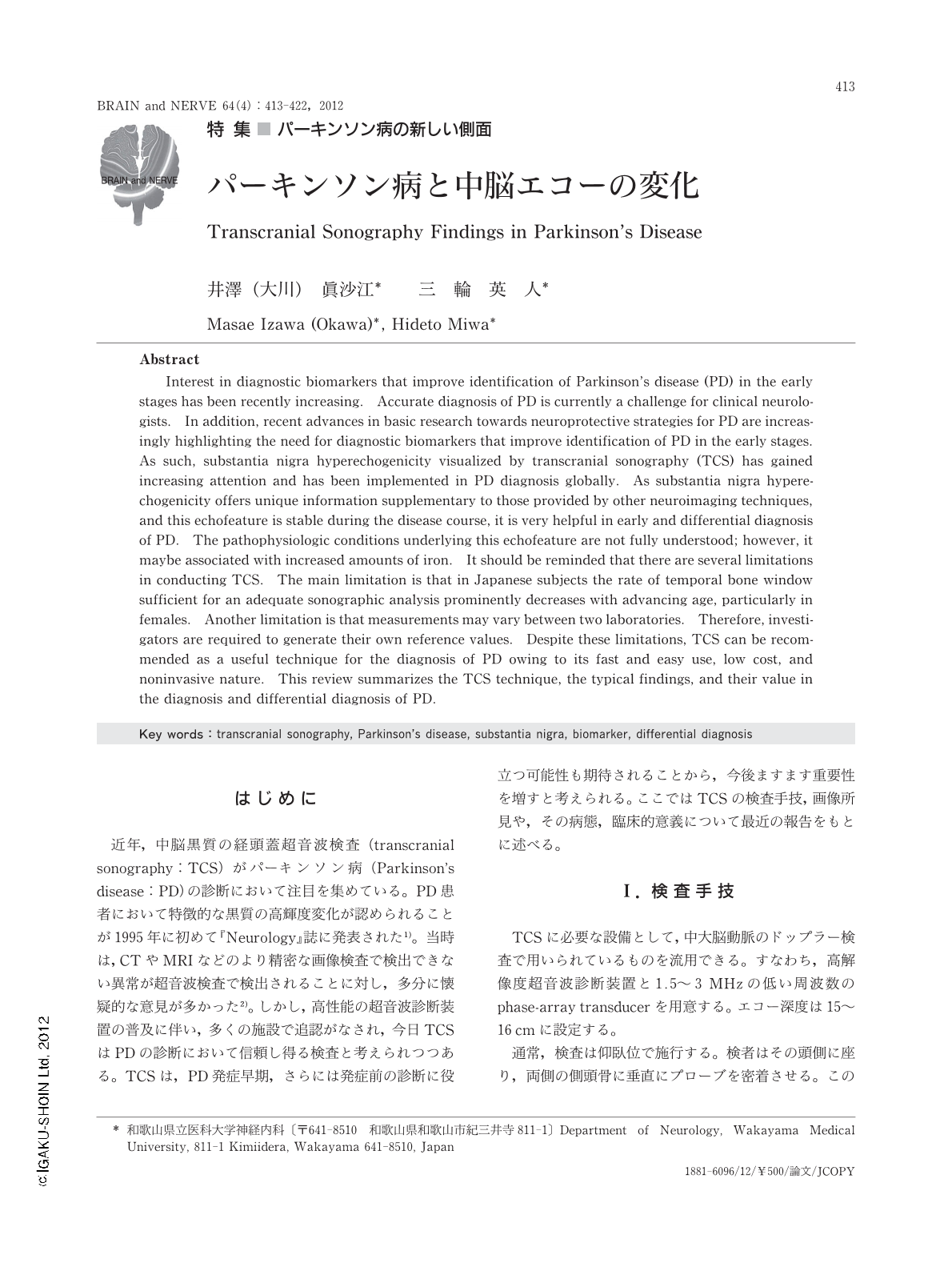
Abstract
Interest in diagnostic biomarkers that improve identification of Parkinson's disease (PD) in the early stages has been recently increasing. Accurate diagnosis of PD is currently a challenge for clinical neurologists. In addition,recent advances in basic research towards neuroprotective strategies for PD are increasingly highlighting the need for diagnostic biomarkers that improve identification of PD in the early stages. As such,substantia nigra hyperechogenicity visualized by transcranial sonography (TCS) has gained increasing attention and has been implemented in PD diagnosis globally. As substantia nigra hyperechogenicity offers unique information supplementary to those provided by other neuroimaging techniques,and this echofeature is stable during the disease course,it is very helpful in early and differential diagnosis of PD. The pathophysiologic conditions underlying this echofeature are not fully understood; however,it maybe associated with increased amounts of iron. It should be reminded that there are several limitations in conducting TCS. The main limitation is that in Japanese subjects the rate of temporal bone window sufficient for an adequate sonographic analysis prominently decreases with advancing age,particularly in females. Another limitation is that measurements may vary between two laboratories. Therefore,investigators are required to generate their own reference values. Despite these limitations,TCS can be recommended as a useful technique for the diagnosis of PD owing to its fast and easy use,low cost,and noninvasive nature. This review summarizes the TCS technique,the typical findings,and their value in the diagnosis and differential diagnosis of PD.
Copyright © 2012, Igaku-Shoin Ltd. All rights reserved.